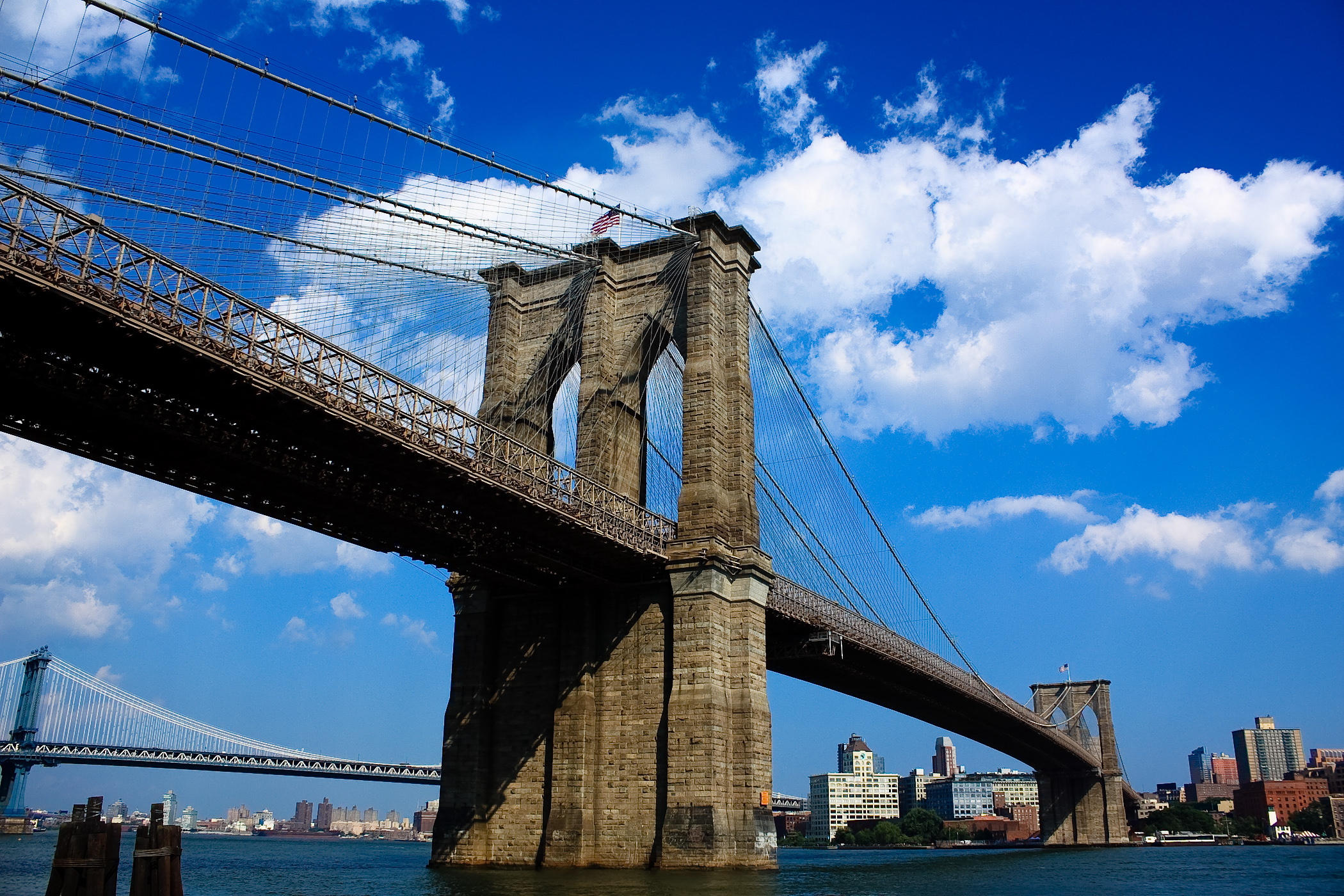
Brooklyn Bridge: The Gothic Gateway That Conquered the River
John Roebling died before construction began. The German-born engineer who designed the Brooklyn Bridge was killed in 1869 when a ferry crushed his foot against a piling during site surveys; tetanus followed within weeks. His son, Washington Roebling, took over, only to be crippled by caisson disease (the bends) from working in the underwater chambers where the towers' foundations were dug. From an apartment overlooking the river, paralyzed and unable to speak, Washington Roebling directed construction through his wife, Emily, who became the project's de facto chief engineer. The bridge opened in 1883, the longest suspension span in the world, its Gothic towers and steel cables creating a silhouette that would define New York forever.
The Vision
John Roebling had built suspension bridges before - the Cincinnati-Covington Bridge, the Niagara Falls Railway Bridge - but the East River crossing would be his masterpiece. The span would be 1,595 feet, half again longer than any existing bridge. The towers would rise 276 feet, taller than any building in either city. The deck would carry trains, vehicles, and pedestrians, suspended from cables of steel wire - a material Roebling had pioneered. The design combined Gothic architecture with industrial engineering, stone towers anchoring steel cables, history and modernity visible in a single structure. Roebling did not live to see it; his vision survived him.
The Caissons
The bridge foundations required excavating to bedrock beneath the East River. Workers descended into caissons - pressurized wooden boxes sunk to the riverbed - and dug in air compressed to resist the water. The conditions were hellish: heat, darkness, the risk of fire (several occurred), and the mysterious malady that struck workers who ascended too quickly. Caisson disease, now known as decompression sickness or the bends, killed at least 27 workers and disabled many more, including Washington Roebling. The science was not understood; workers suffered agonizing deaths from nitrogen bubbles forming in their blood. The Brooklyn foundation reached bedrock at 44.5 feet; the New York side stopped at 78 feet, never reaching rock, resting on hard-packed gravel.
The Opening
The Brooklyn Bridge opened on May 24, 1883, with ceremony and spectacle. President Chester Arthur walked across; fireworks lit the sky; cannon fired from warships in the river. 150,000 people crossed on opening day. Within a week, panic struck - a rumor of collapse sent crowds stampeding, crushing twelve people to death. The bridge stood, as it has stood for 140 years. P.T. Barnum paraded elephants across in 1884, demonstrating its strength. The elevated trains that once ran on it have been removed; the deck now carries vehicular traffic with a wooden pedestrian walkway above. The Gothic towers remain the bridge's identifying feature - stone arches framing the Manhattan skyline.
The Symbol
The Brooklyn Bridge became what it was designed to become: the symbol of New York, of engineering triumph, of what human ambition could achieve. It has appeared in countless photographs, films, and artworks - the silhouette instantly recognizable. The walk across remains a pilgrimage, tourists and commuters sharing the wooden planks, the towers framing views in both directions. The bridge connected Brooklyn (then an independent city) to Manhattan, eventually leading to consolidation in 1898. What was once the longest span in the world is now modest by modern standards, but no bridge has ever been more photographed, more painted, more symbolic.
Visiting Brooklyn Bridge
The Brooklyn Bridge connects Manhattan and Brooklyn across the East River. Pedestrians can access the walkway from either end: in Manhattan near City Hall, in Brooklyn at the Fulton Ferry landing in DUMBO. The walk is approximately one mile each way; allow 30-45 minutes per crossing. The Manhattan-to-Brooklyn direction faces the Brooklyn skyline; the reverse offers Manhattan views. Sunset and night crossings offer dramatic light. DUMBO (Down Under the Manhattan Bridge Overpass) provides excellent photography angles of the bridge framing Manhattan. The Brooklyn Bridge Park extends beneath the Brooklyn side. The experience is free and continuously available; summer crowds can be dense. The walk offers perspective on the city that few other experiences provide - the river below, the towers above, the cables radiating like a harp's strings.
From the Air
Located at 40.71°N, 73.99°W spanning the East River between Manhattan and Brooklyn in New York City. From altitude, the Brooklyn Bridge appears as the southernmost of the East River crossings, its distinctive Gothic towers identifiable even among the cluster of bridges. The walkway is visible above the roadway deck. Brooklyn Bridge Park extends along the waterfront on the Brooklyn side. Lower Manhattan's skyscrapers cluster to the west; the Brooklyn skyline rises to the east. The original bridge design intended the towers to dominate; today they are modest amid surrounding development but remain iconic in profile. What appears from altitude as one of many river crossings is the original - the bridge that took fifteen years and cost lives and careers, built by a dying father, a crippled son, and a woman who taught herself engineering to complete what her family had begun.