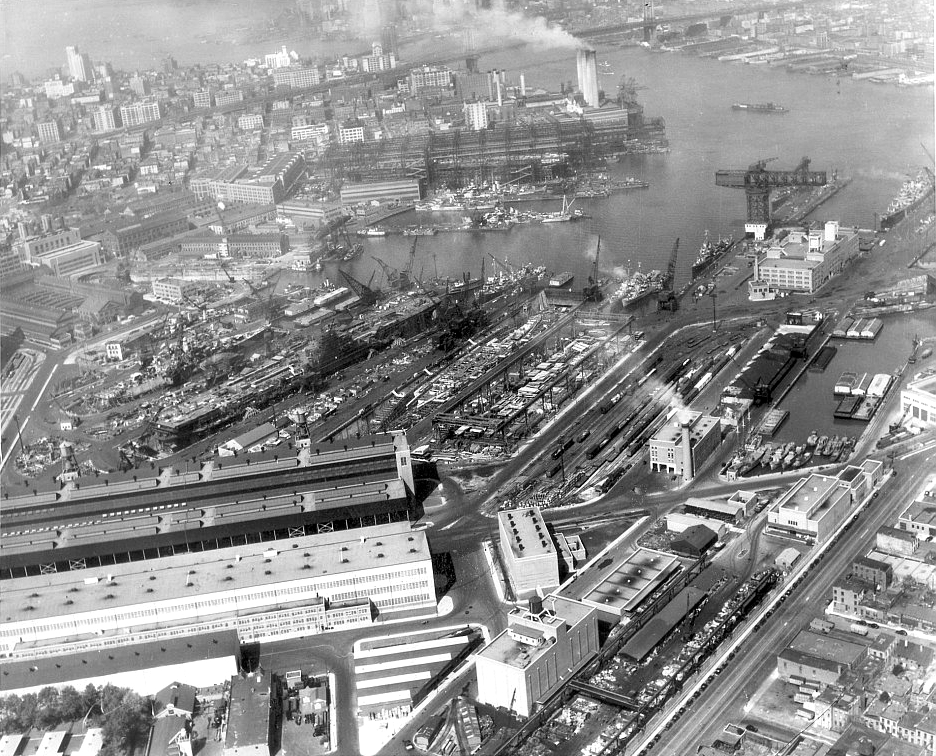
Brooklyn Navy Yard: The Can-Do Shipyard
Twelve thousand American prisoners of war died on British prison ships moored in Wallabout Bay during the Revolution, their bodies buried in shallow trenches along the shore. Two decades later, the United States government bought that same stretch of Brooklyn waterfront and began building warships on it. The Brooklyn Navy Yard would spend the next 165 years constructing vessels that shaped the course of American naval power, from wooden frigates to ironclads to battleships, before falling silent as a military installation and then roaring back to life as a civilian industrial complex. The prison ships are long gone, but their monument stands in nearby Fort Greene, and the yard itself has never stopped working.
From Mudflats to Ironclads
Before it was a shipyard, this bend in the East River was a tidal marsh farmed by the Canarsie people and later by Joris Jansen Rapelje, a Walloon settler from Belgium who gave Wallabout Bay its name. The federal government bought the land in 1801 and established the yard in 1806, though early development was slow under Thomas Jefferson's reluctance toward military buildup. By the 1820s, the yard had a commandant's house, marine barracks, and shiphouses on its northwestern corner. The real transformation came during the Civil War, when the yard manufactured 14 large vessels and retrofitted 416 commercial ships for the Union Navy's blockade against the Confederacy. One vessel was rumored to have been converted in less than 24 hours. Most famously, the yard built the USS Monitor, the Navy's first ironclad warship, which fought the CSS Virginia at the Battle of Hampton Roads in 1862 and changed naval warfare forever.
The Can-Do Shipyard
World War II turned the Brooklyn Navy Yard into a city within a city. At its peak, 75,000 workers labored around the clock across a site that had expanded to over 300 acres, earning the facility its legendary nickname. The yard built battleships like the USS North Carolina and the USS Iowa, repaired and overhauled dozens more, and launched vessels at a pace that seemed impossible. Women and African Americans entered the workforce in unprecedented numbers, welding hulls and rigging cranes alongside the immigrant laborers who had long filled the yard's ranks. The eleven-story supply storehouse, Building 3, was the yard's first reinforced-concrete structure, built by Turner Construction after government officials raided their factory expecting to find German guns and instead discovered engine foundations being manufactured. Building 77, a sixteen-story windowless warehouse, housed the yard headquarters and storage for the sprawling wartime operation.
Silence on the Waterfront
Peace killed the Brooklyn Navy Yard. After World War II, the workforce shrank steadily, and in 1966, the Navy deactivated the yard as a military installation. The city of New York purchased it, and the Commerce Labor Industry Corporation of Kings, known as CLICK, was established to manage its transition to civilian use. The first commercial lease was signed in May 1968. Seatrain Shipbuilding became the largest tenant, employing 2,700 workers by 1973 to build the biggest ships ever constructed at the yard: very large crude carriers for the oil trade. But the 1973 oil crisis devastated Seatrain, and corruption scandals plagued CLICK. By October 1980, the yard employed just 2,900 people. The 30,000 to 40,000 jobs that city officials had promised never materialized, and local residents grew frustrated with the lack of transparency and opportunity.
Reinvention on the East River
The Brooklyn Navy Yard found its second life not as a shipyard but as a hive of small businesses. By the early 1990s, its proximity to Manhattan and relatively low rents attracted manufacturers, filmmakers, and entrepreneurs. Steiner Studios opened the largest film and television production facility outside Hollywood on the yard's grounds, and by 2011, the Navy Yard employed over 6,000 people across 330 businesses. A new cogeneration plant built in 1995 was the first in the nation constructed under federal Clean Air Act specifications. The commandant's house, Quarters A, built in 1807, still stands as the oldest structure on the site. Building 92, the former Marine commandant's residence, became a museum dedicated to the shipyard's history, offering exhibits, tours, and workforce development programs. Six dry docks still operate under GMD Shipyard Corp., and the yard hosts a homeport for the NYC Ferry system. The Brooklyn Navy Yard covers roughly 300 acres and remains one of New York City's largest industrial complexes, listed on the National Register of Historic Places.
Ghosts and Graving Docks
Dry Dock 1, completed in 1851, required workers to drive more than 6,500 wooden piles into the bay's quicksand using the first steam pile driver in American history. The cofferdam was stabilized with gravel foundations, and springs were sealed with a mixture of planks, dry cement, brick, and Roman mortar. The pumping engine built for it was the largest in the United States at the time. Nearby, the timber shed known as Building 16, constructed between 1833 and 1853, is one of the yard's oldest surviving structures. WPA workers in the 1930s unearthed a skeleton thought to belong to one of the Revolutionary War prison ship martyrs, a reminder that this industrial landscape sits atop layers of American history stretching back to the nation's founding. The Brooklyn Naval Hospital, established in 1825, served the yard for over a century before being decommissioned in 1948, its buildings now slated for restoration as a media campus.
From the Air
Brooklyn Navy Yard (40.7019N, 73.9689W) occupies a prominent bend in the East River at Wallabout Bay, directly visible from the air as a large industrial complex on Brooklyn's northwest waterfront. The Williamsburg Bridge is immediately to the northeast and the Manhattan Bridge to the southwest. The yard's dry docks, piers, and large warehouse buildings (including the 16-story Building 77) are distinctive landmarks. Nearby airports: KJFK (John F. Kennedy, 22km SE), KLGA (LaGuardia, 13km NE), KEWR (Newark Liberty, 15km W). Best viewed at 2,000-4,000 feet AGL approaching along the East River. The semicircular shape of Wallabout Bay is clearly identifiable from above.