The Brown Derby
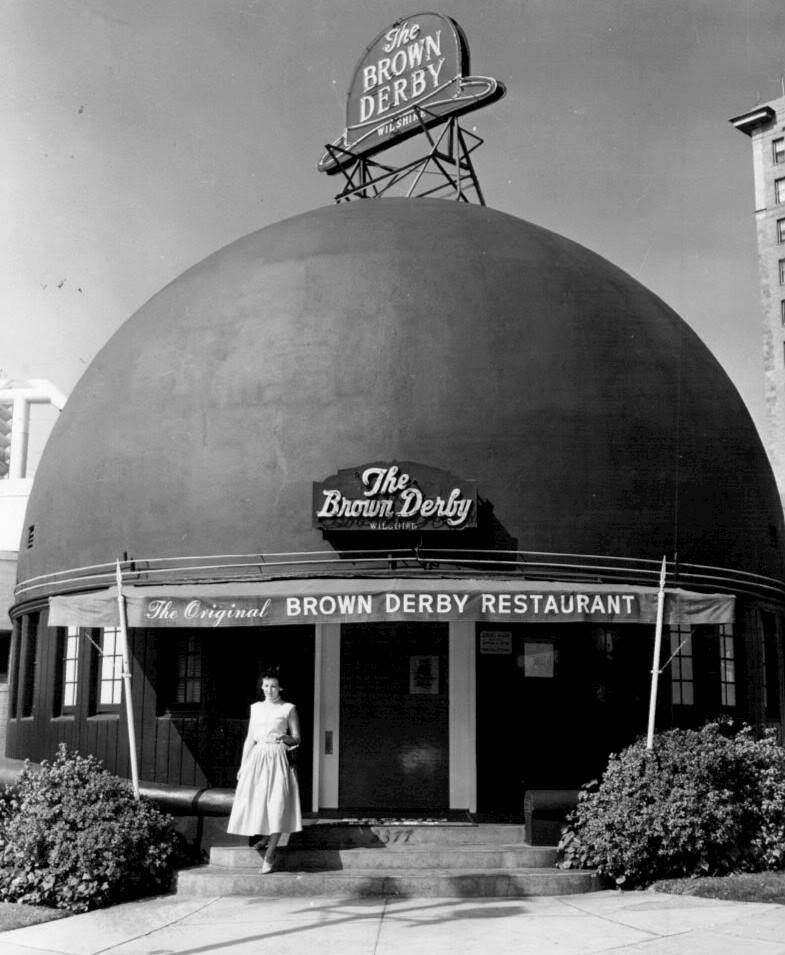
The original Brown Derby, opened in February 1926 on Wilshire Boulevard, was shaped like a hat — an actual giant derby hat, sitting on a street corner in Los Angeles as if daring the city to take itself seriously. It worked. Within three years, a second location had opened in Hollywood, and the Brown Derby had become the place where the film industry ate lunch, negotiated deals, and watched each other be famous. The hat-shaped building was the gimmick that got people through the door. What kept them coming was everything else.
The Wilshire Hat and the Hollywood Room
The first Brown Derby opened February 1926 at 3427 Wilshire Boulevard as a literal derby-hat structure — architect Carl Jungquist's contribution to the Los Angeles tradition of novelty architecture. On Valentine's Day 1929, a second location opened at 1628 North Vine Street in Hollywood, and this one quickly overshadowed the original. The Hollywood location was designed in a more conventional style, but its position in the heart of the studio district made it the industry's default dining room. Stars and executives ate there daily; the booths were assigned by status; being seated near the front meant something.
What Was Invented There
The Brown Derby's Hollywood location claims two culinary inventions that outlasted the restaurant by decades. The Cobb salad — the combination of chicken, bacon, hard-boiled egg, tomato, blue cheese, and avocado over chopped romaine — was reportedly created by owner Robert Cobb around 1937 when he was assembling a late-night meal from whatever he found in the walk-in refrigerator. The Shirley Temple mocktail, the ginger ale and grenadine combination that the restaurant made for child actress Shirley Temple, was also reportedly developed there. Neither claim can be definitively verified, but neither has been convincingly disputed.
Lucy at the Brown Derby
The clearest evidence of the Brown Derby's cultural centrality may be an episode of I Love Lucy. In 'L.A. at Last!' filmed at the Hollywood location in 1955, Lucille Ball's character attempts to get William Holden's autograph and ends up covered in pie — a scene that required the actual restaurant as its setting because no other location would have carried the same weight. The episode required that viewers immediately recognize the Brown Derby as the restaurant in Hollywood, and they did. The show was watched by tens of millions of people. The restaurant had become part of the shared American understanding of what celebrity and Los Angeles looked like.
The Decline and the Disney Afterlife
The Hollywood location closed in 1985, its moment having passed along with the era that produced it. The building was damaged by the 1994 Northridge earthquake and demolished shortly after. The original Wilshire hat-building had been moved and later demolished. What survived was the concept: Disney licensed the Brown Derby name and design for their theme parks, where a replica operates at Walt Disney World's Hollywood Studios, serving, among other things, a Cobb salad prepared according to the original recipe. The restaurant's afterlife as a theme-park reproduction is, in its way, perfect — a Hollywood institution that has become permanent by becoming fictional.
From the Air
The Brown Derby's Hollywood location was at 34.0596°N, 118.3274°W at 1628 North Vine Street, near the intersection of Vine and Hollywood Boulevard. The area is in the heart of Hollywood, where the intersection of Hollywood and Vine was long considered the symbolic center of the entertainment industry. From the air, the Hollywood grid is visible as a dense urban cluster between the hills to the north and the flatlands to the south. Nearest airports: Burbank Bob Hope (KBUR) 8 miles northeast, Van Nuys (KVNY) 9 miles north, Santa Monica (KSMO) 10 miles west.