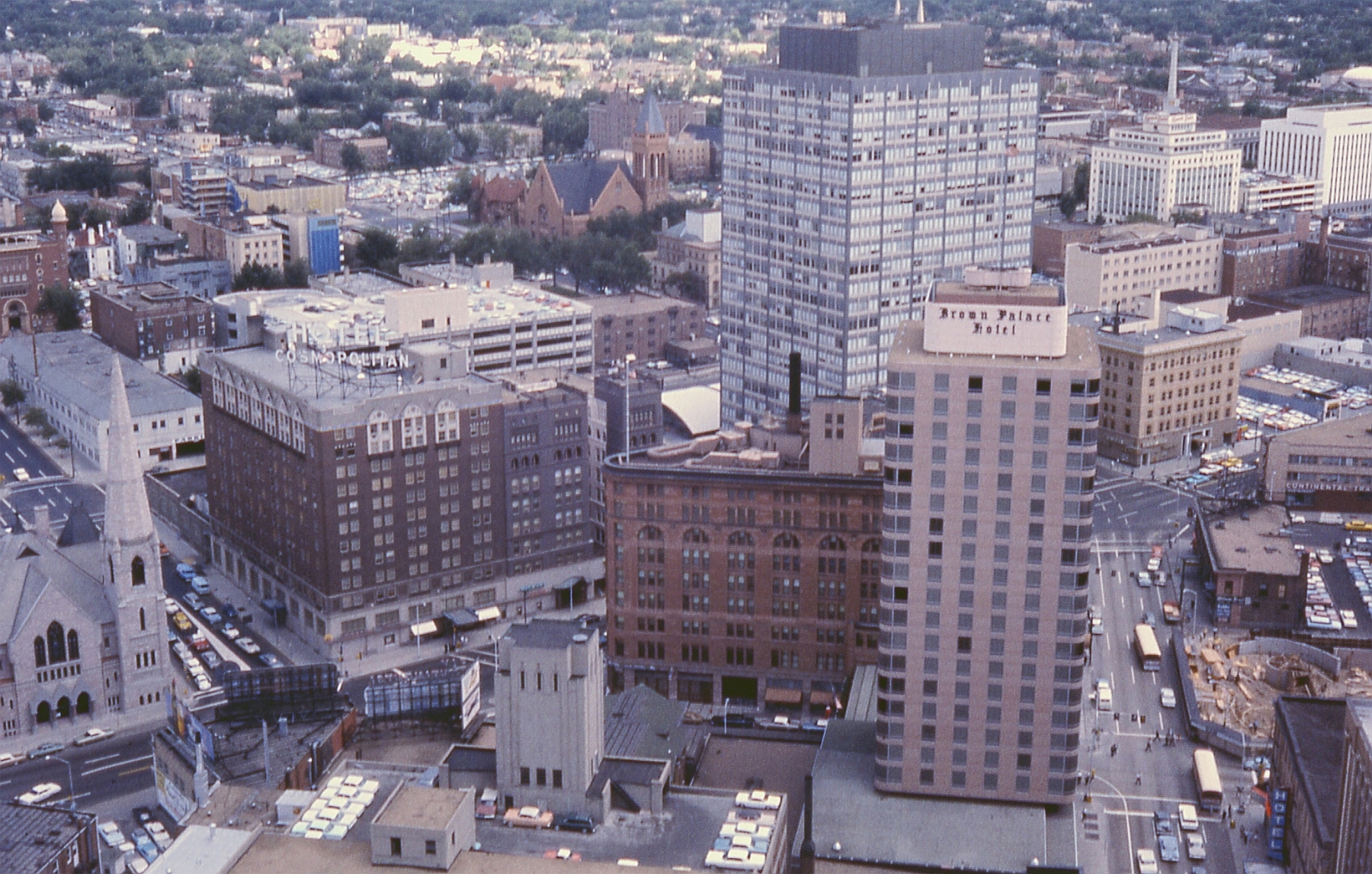
Brown Palace Hotel
A week after surviving the Titanic's sinking in April 1912, Margaret "Molly" Brown walked through the doors of the Brown Palace Hotel and checked into her favorite suite. It was the kind of place where the unsinkable came to rest. Built in 1892 from Colorado red granite and sandstone, this nine-story triangular wedge of Victorian ambition had already seen presidents come and go, and would witness a scandalous double murder in its Marble Bar. The Brown Palace was never just a hotel; it was Denver's living room, its stage, its confession booth.
The Flatiron of the Rockies
Henry C. Brown had homesteaded the Capitol Hill area when Denver was still a mining camp with pretensions. By 1892, he had architect Frank Edbrooke design something unprecedented: a triangular hotel that wrapped around the odd corner where 17th Street, Broadway, and Tremont Place converged. The building rose with an iron and steel frame covered in sandstone from the Whitehouse and Wirgler Stone Company, making it one of America's first fireproof structures according to a May 1892 Scientific American cover story. When complete, it stood as Denver's tallest building. The interior atrium soars eight floors up to a stained glass ceiling, with ornate iron railings wrapping each level like balconies at an opera house. Edbrooke's work here remains, in the words of architectural historians, the finest extant example of his career.
Murder in the Marble Bar
The Brown Palace's most infamous night came in 1911, when Denver high society's dirty laundry spilled blood across the hotel's elegant bar. Frank Henwood and Sylvester Louis "Tony" von Phul were both entangled with Isabel Springer, the wife of wealthy businessman and political candidate John W. Springer. Their rivalry ended with gunshots in the Marble Bar. Henwood killed von Phul and accidentally struck an innocent bystander named George Copeland, who also died. The scandal consumed Denver: a love triangle among the city's elite, shootings in the city's finest hotel, and a series of very public trials that played out in newspapers across the country. The Brown Palace absorbed it all and kept serving afternoon tea.
A Guest Register of History
Every sitting president from Theodore Roosevelt to Dwight D. Eisenhower has stayed at the Brown Palace. William Taft was a guest in 1907. Warren Harding came through during his ill-fated presidency. But the hotel's guest register reads like a catalog of early twentieth-century fame beyond politics. Helen Keller visited in 1925. Charles Lindbergh stayed here in 1927, the year of his famous transatlantic flight, greeted by 200,000 Denverites. Emperor Akihito of Japan has slept in these rooms. Shirley Temple charmed guests. Peter Lorre lurked in the lobbies. And Denver's own crime boss Jefferson "Soapy" Smith knew the establishment well, adding a hint of frontier lawlessness to the registry's gilded pages.
Art Deco Additions
The Brown Palace evolved with Denver. In 1935, two years after Prohibition's repeal, Denver architect Alan Fisher designed the Ship Tavern, transforming the hotel's restaurant into a nautical fantasy that remains one of four dining rooms operating today. In 1937, Colorado muralist Allen Tupper True unveiled two works in the lobby: Stage Coach and Airplane Travel, commissioned by owner Charles Boettcher, capturing the transformation of Western travel from dust trails to contrails. A 22-story annex tower rose across Tremont Place in 1959, connected to the original building by a skybridge and underground tunnel, expanding the hotel's capacity while preserving its Victorian heart.
Where Denver Still Gathers
The Brown Palace endures as Denver's second-longest continuously operating hotel. The atrium still hosts afternoon tea under that stained glass ceiling. The Ship Tavern still pours drinks. Listed on the National Register of Historic Places and now operated by Marriott's Autograph Collection, the hotel joined Historic Hotels of America in 2023. From the air, the triangular footprint is unmistakable among downtown Denver's modern glass towers, a red granite anchor to the past. The building that Scientific American once called revolutionary now feels timeless, still welcoming guests to the living room that Henry Brown built for a city determined to become something more than a mining town.
From the Air
Located at 39.744N, -104.987W in downtown Denver. The distinctive triangular shape is visible from above between 17th Street, Broadway, and Tremont Place, just behind Republic Plaza. Denver International Airport (KDEN) lies 23 miles northeast. Centennial Airport (KAPA) is 15 miles south. Rocky Mountain Metropolitan Airport (KBJC) is 18 miles northwest. Best viewed at 3,000-5,000 feet AGL for downtown context.