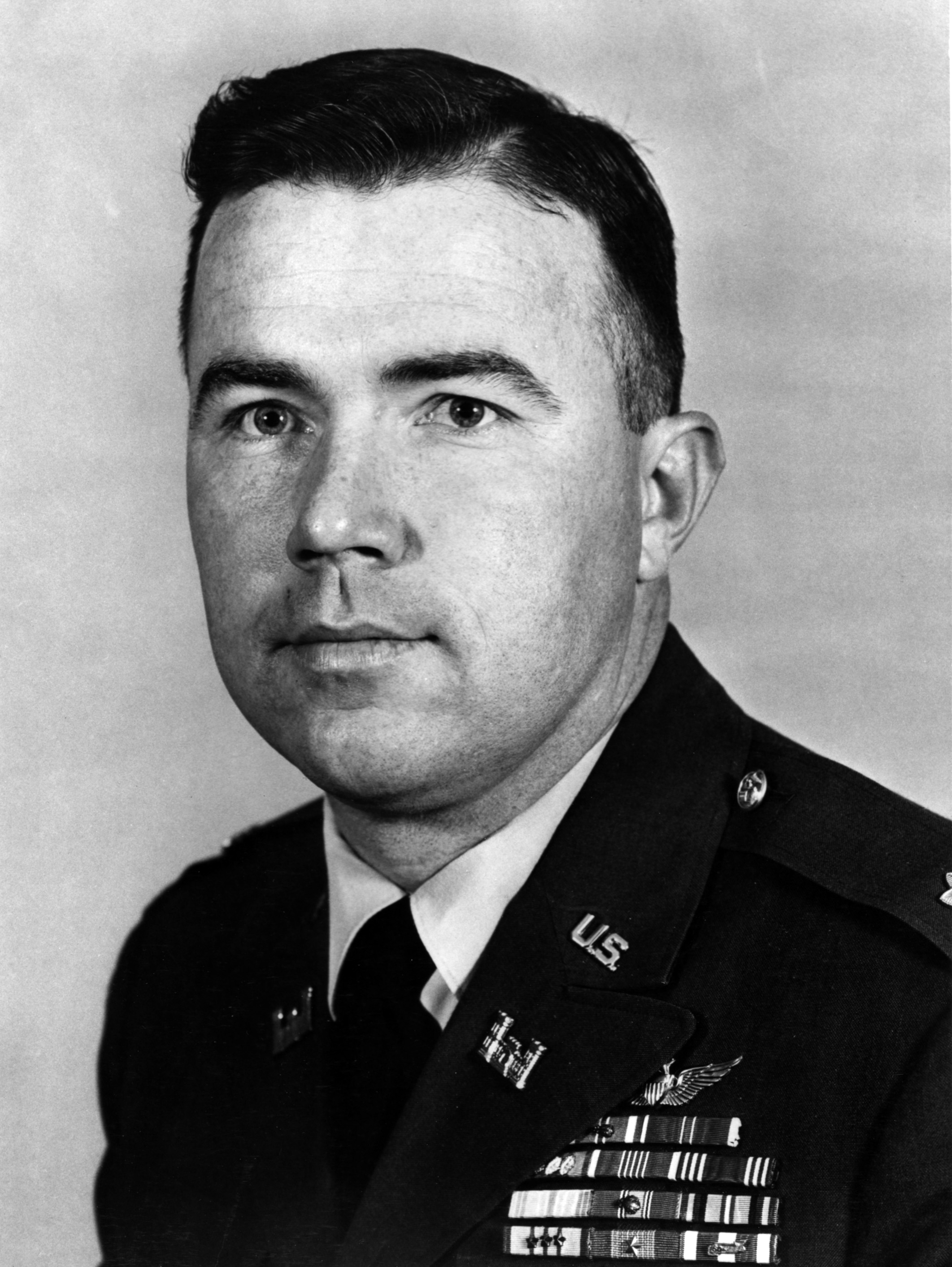
Bruce P. Crandall
On the morning of November 14, 1965, Major Bruce Crandall lifted his unarmed Huey off the ground at Plei Me and headed for a small clearing in the Ia Drang Valley designated Landing Zone X-Ray. He would not shut down his engine for more than sixteen hours. By the time darkness finally stopped him, Crandall had flown into a landing zone so hot that the dedicated medevac unit refused to enter it, evacuating more than 70 wounded soldiers in flight after flight while enemy fire shredded the trees around his helicopter. The Medal of Honor he received for that day did not come until February 26, 2007, forty-two years after the battle. The University of Washington, where Crandall had been a student when the Army drafted him, now honors him at its Medal of Honor Memorial on campus.
A Ballplayer Goes to War
Bruce Perry Crandall was born on February 17, 1933, in Olympia, Washington. He joined the Army National Guard at fifteen and later enrolled at the University of Washington on a baseball scholarship, batting nearly .600 as a high school outfielder. The Korean War intervened. Drafted in 1953, Crandall attended Engineer Officer Candidate School at Fort Belvoir, Virginia, graduating in 1954. He earned his wings and spent his first overseas assignment mapping the Libyan desert from Wheelus Air Force Base in Tripoli. Aviation suited him. By 1965, he commanded Company A of the 229th Assault Helicopter Battalion, 1st Cavalry Division, stationed at An Khe, Vietnam. His radio call sign was Ancient Serpent 6.
Sixteen Hours at X-Ray
The mission that morning was a routine troop insertion. Crandall's flight of sixteen helicopters carried soldiers from Plei Me to Landing Zone X-Ray in the Ia Drang Valley, the first major engagement between American and North Vietnamese regular forces. On the fourth lift, enemy fire found the helicopters. By the fifth, the landing zone was a killing field. The ground commander ordered the other aircraft to abort, but Crandall refused to leave his soldiers behind. With his wingman, Major Ed Freeman, Crandall continued flying into X-Ray. The medevac helicopters, designed and equipped for casualty evacuation, would not land in such intense fire. So Crandall did it in their place, loading wounded men into a helicopter built to carry troops, not stretchers. Across more than a dozen flights, over sixteen hours that stretched from 6 a.m. to 10:30 p.m., he carried more than 70 casualties to safety and ferried ammunition back in.
The Long Wait for Recognition
Crandall's commanding officer recommended him for the Medal of Honor shortly after the battle, but the paperwork stalled in the military bureaucracy. He received the Distinguished Flying Cross instead. Crandall went on to fly over 900 combat missions across two tours in Vietnam before retiring. The Ia Drang story reached the public through the 1992 book We Were Soldiers Once...And Young, written by Harold G. Moore and Joseph L. Galloway, both of whom had been on the ground that day. The 2002 film adaptation, We Were Soldiers, cast Greg Kinnear as Crandall; the real Crandall served as an aviation consultant during filming. Finally, on February 26, 2007, President George W. Bush presented the Medal of Honor to Crandall at the White House, correcting a four-decade oversight.
A Campus Remembers
The University of Washington's Medal of Honor Memorial stands at the south end of Memorial Way, tucked inside a traffic circle between Parrington and Kane Halls. Privately funded and dedicated on Veterans Day 2009, the memorial honors eight UW alumni who received the nation's highest military decoration. Crandall's name appears alongside those of Greg Boyington, the Marine Corps flying ace; William Kenzo Nakamura, a Japanese American soldier who fought in World War II while his family was interned; and five others whose service spans from the trenches of World War I to the jungles of Vietnam. Crandall was inducted into the Air Force's Gathering of Eagles in 1994, one of only seven Army aviators so honored, and the Army Aviation Hall of Fame in 2004. In 2013, the Seattle Seahawks invited him to raise the 12th Man flag before a home game. The ballplayer from Olympia who traded a scholarship for a cockpit became one of Washington state's most decorated soldiers.
From the Air
The University of Washington Medal of Honor Memorial is located at 47.657N, 122.310W on the UW campus in Seattle's University District. From the air, the campus is identifiable by its distinctive Red Square plaza and the surrounding academic buildings south of the Ship Canal. The memorial sits in a traffic circle at the south end of Memorial Way (17th Ave NE), between Parrington and Kane Halls. Nearest airports: Boeing Field/King County International (KBFI) 7nm south, Renton Municipal (KRNT) 9nm southeast, Seattle-Tacoma International (KSEA) 13nm south. Best viewed at 2,000-3,000 feet approaching from the west over Portage Bay.