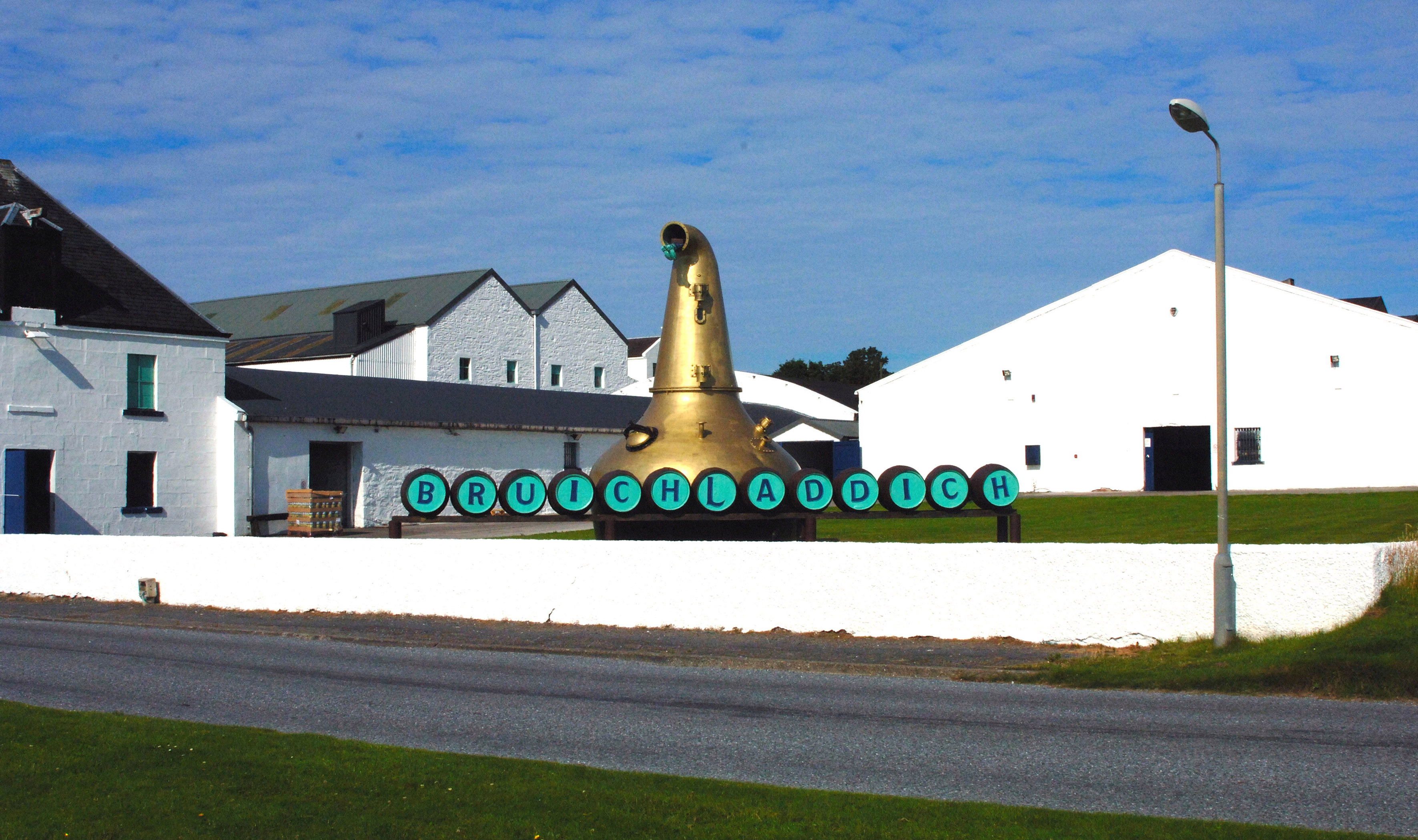
Bruichladdich Distillery
When the American Defense Threat Reduction Agency noticed suspicious activity on the webcams of a Scottish distillery, they investigated. The equipment visible through the cameras -- antique copper stills, Victorian pipework, mysterious vessels -- bore an unsettling resemblance, at least to analysts thousands of miles away, to the chemical weapons apparatus that intelligence agencies were searching for in Iraq. An agent emailed the distillery to inquire when one of the webcams went offline. The distillery responded by releasing a limited run of commemorative bottles labeled "WMD" -- Whisky of Mass Distinction. That kind of defiant humor defines Bruichladdich, a distillery on the Rhinns of Islay that has been doing things its own way since three brothers built it from shore stone in 1881.
Three Brothers and a Hillside
The name means "Brae of the Shore" in Scottish Gaelic -- Bruthach a' Chladaich -- and the distillery sits exactly where you would expect: on the hillside above Loch Indaal, on the westernmost point of Islay. William, John, and Robert Harvey came from a Glasgow whisky dynasty that had owned distilleries since 1770. Using an inheritance, they combined their talents in 1881 -- John designed, Robert engineered, William financed -- to build something fundamentally different from Islay's older farm distilleries. Where those had grown organically from agricultural buildings, Bruichladdich was purpose-built around a spacious courtyard, constructed from stone gathered from the sea shore. The brothers chose uniquely tall and narrow-necked stills to produce an unusually pure spirit, the opposite of the heavy, smoky character associated with Islay. Then they quarreled before the distillery was even finished, and William ran it alone until a fire in 1933.
Death and Resurrection
Bruichladdich's history reads like a patient's chart: periods of operation interrupted by closures, ownership changes, and corporate indifference. After the Harvey era, it passed through Associated Scottish Distilleries, Invergordon Distillers, and Whyte and Mackay, which shut it down in 1994 as "surplus to requirements." The resurrection came in December 2000, when a group of private investors led by Mark Reynier purchased the distillery. Jim McEwan, who had worked at Bowmore Distillery since he was fifteen, was hired as master distiller. Between January and May 2001, the entire distillery was dismantled and reassembled, retaining the original Victorian decor and machinery. The key decision was what not to change: no computers would be used in production. All processes would be controlled by skilled workers measuring progress with dipsticks and flotation devices, passing knowledge orally, much as the Harveys' workers had done a century earlier.
Peat, Smoke, and Provenance
Bruichladdich produces three distinct whisky identities from a single distillery. The Bruichladdich line is unpeated -- clean, maritime, a deliberate contrast to Islay's smoky reputation. Port Charlotte is heavily peated. And Octomore is super-heavily peated, considered the most heavily peated single malt whisky in the world. All are sold as single malts. The distillery sources all its barley exclusively from Scotland, with increasing quantities grown on Islay itself since 2004. Provenance is not just a marketing concept here -- individual farms, farmers, and even the specific fields where the grain is grown are identified on the packaging. It is an approach that treats whisky the way the French treat wine: as a product of a particular place, inseparable from its soil and climate.
Islay's Largest Employer
When Remy Cointreau acquired Bruichladdich in 2012 for fifty-eight million pounds, the distillery had already become something more than a producer of whisky. It was Islay's largest private employer, with around sixty jobs on an island where employment options are limited. The construction of Islay's only commercially scaled bottling hall meant that the entire process -- from barley to bottle -- could happen on the island, rather than shipping casks to the mainland for finishing and packaging. The distillery still uses the original open seven-tonne mashtun, the only one on the island and one of the last of its kind anywhere. Six wooden washbacks made from Douglas fir hold 210,000 litres. The two spirit stills stand six metres tall with necks only 0.9 metres wide. And in 2010, the last authentic Lomond still, rescued from the demolition of Inverleven distillery in Dumbarton, was installed and modified by Jim McEwan to produce The Botanist gin -- Islay's first and only gin, distilled using foraged island botanicals. The Victorian machinery endures, not as a museum exhibit, but as the working heart of a community.
From the Air
Located at 55.77N, 6.36W on the shore of Loch Indaal on the Rhinns of Islay, the westernmost part of the island. The distillery buildings are visible from the air along the waterfront. Islay Airport (EGPI) is approximately 10 km to the south. The island's other distilleries -- Bowmore across the loch, and the southern trio of Laphroaig, Lagavulin, and Ardbeg -- are all within a short flying distance. Islay is served by Loganair flights from Glasgow.