The Sultan's Mirror
On 29 February 1972, a leap day in every sense, Queen Elizabeth II opened a museum on the banks of the Brunei River that the nation had been assembling in borrowed rooms for seven years. The Brunei Museum had begun life in 1965, crammed into the Civic Centre of what was then still called Brunei Town. By the time the Queen cut the ribbon at the new purpose-built structure in Kota Batu, the collection had outgrown its ambition. Islamic manuscripts and blown glass from ninth-century Egypt shared space with archaeological finds unearthed from the surrounding hillsides, natural history specimens from Borneo's rainforests, and -- perhaps most remarkably -- treasures drawn from the personal collection of the Sultan himself. This was not merely a museum. It was a nation explaining itself to itself.
A Tomb's Architecture, Reimagined
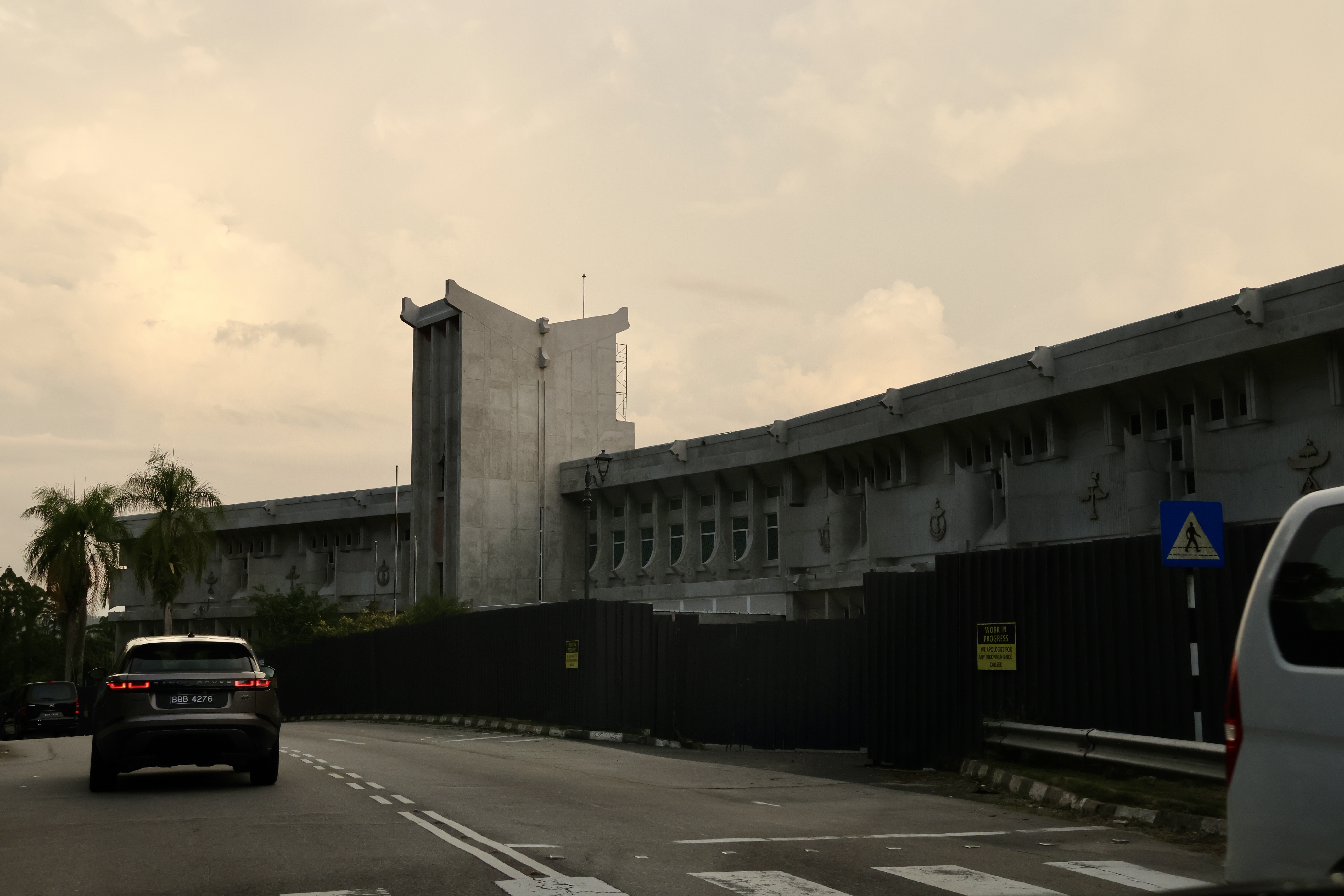
The building that houses the collection is itself a statement. Its facades carry traditional Malay motifs drawn from the tomb of Sultan Bolkiah, the fifth sultan of Brunei, who ruled during the empire's fifteenth-century zenith when Bruneian influence stretched across much of coastal Borneo and into the Philippines. Choosing a royal tomb as architectural inspiration was deliberate -- connecting the modern institution to the era when Brunei commanded trade routes across Southeast Asia. Construction began in 1968 at a cost of M$4.39 million, and the finished building sits on elevated ground at Kota Batu, roughly five kilometers from the capital's center, overlooking the river that has been Brunei's lifeline for centuries.
The Weight of Gold and Glass
The Islamic art galleries hold the museum's most striking possessions, many sourced from the Sultan of Brunei's personal holdings. Ceramics from Iran and Central Asia date to the ninth and tenth centuries. Blown glass from Egypt and the Levant catches the gallery light in colors that artisans shaped over a thousand years ago. Manuscripts of the Quran range from grand illuminated folios to miniature editions no larger than a matchbox, their calligraphy impossibly precise. Gold and silver coins from across the Islamic world trace the reach of faith and commerce. Together, these objects make an argument: that Brunei's Islamic identity is not recent or superficial but rooted in centuries of cultural exchange with the wider Muslim world.
From Samurai Armor to Oil Derricks
The museum's range can surprise. One gallery features "The Spirit of Budo: The History of Japan's Martial Arts," displaying replicas of armor and weapons spanning the eighth through fourteenth centuries -- a reminder that Brunei's historical connections radiated in every direction, not just toward the Arab world or China. Elsewhere, a Brunei Shell Petroleum exhibit traces the discovery of oil at Seria and its transformation of the national economy, connecting the deep past to the petro-wealth that defines modern Brunei. The juxtaposition is jarring and intentional: samurai helmets and oil derricks, Qurans and celadon pottery, all housed under one roof shaped by a sultan's tomb.
A Complex on Sacred Ground
The museum does not stand alone. Kota Batu -- literally "Stone Fortress" -- is one of Brunei's most historically significant sites. The surrounding archaeological park has yielded evidence of settlement stretching back centuries, and the nearby Malay Technology Museum and Brunei Darussalam Maritime Museum complete a cultural complex that covers everything from traditional boat-building to the 13,261 artifacts recovered from a Ming-era shipwreck. Walking between these institutions, along paths that follow the contours of ancient habitation, the visitor moves through layers of time compressed into a few hectares of riverbank.
Waiting to Reopen
The Brunei Museum closed in 2014 for major renovations. Plans called for redesigned interiors, interactive exhibits, modern technology, and a new open-concept gallery layout. The reopening was initially scheduled for 2020, but as of 2025, the doors remain shut. The building itself has been preserved -- a 2014 government directive ensured the historic structure would be maintained during the upgrade. For now, the museum exists as potential: a collection of extraordinary depth waiting behind scaffolding and planning documents. When it finally reopens, visitors will encounter a nation's memory refreshed but not rewritten, the same story of trade and faith and empire told with new tools for a new generation.
From the Air
Coordinates: 4.885N, 114.969E. The museum is situated on elevated ground at Kota Batu along the Brunei River, approximately 5 km from central Bandar Seri Begawan. Brunei International Airport (WBSB) lies about 10 km to the northeast. From the air, the Kota Batu museum complex is identifiable as a cluster of institutional buildings on the river's south bank. The golden dome of the Sultan Omar Ali Saifuddien Mosque in the city center provides a prominent visual reference to the northwest. Best appreciated at 1,500-3,000 feet altitude.