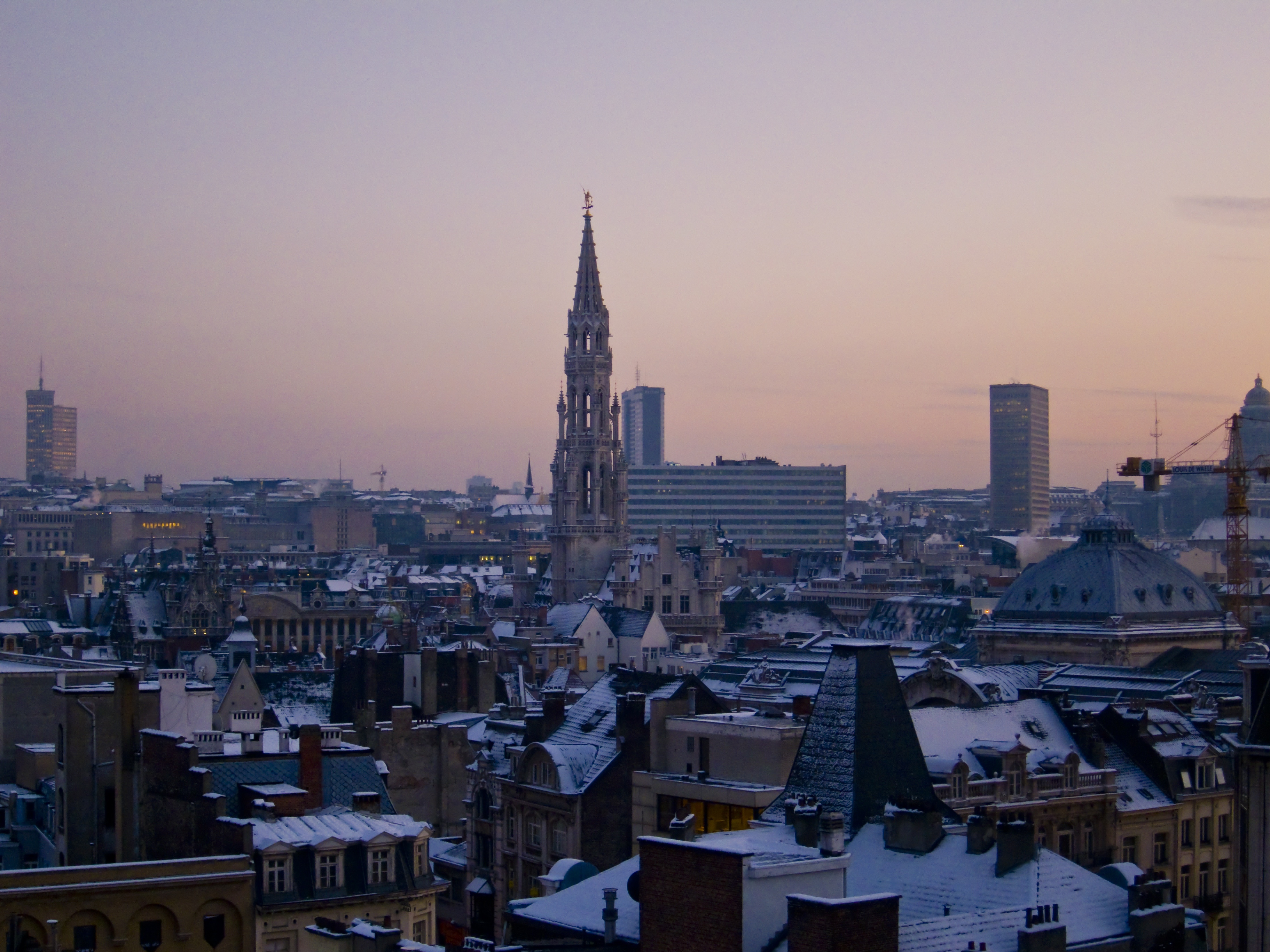
Brussels
Brussels is a capital three times over: capital of Belgium, capital of Flanders (though the region is Dutch-speaking and Brussels is mostly French), and de facto capital of the European Union. The layers of government reflect a city that has spent centuries at the crossroads of European power - Spanish Netherlands, Austrian Netherlands, briefly French, then the new Belgian kingdom created in 1830 specifically to prevent any major power from controlling the strategic territory. The compromise that created Belgium persists in its capital: a bilingual region in a country divided between French and Dutch speakers, a neutral zone hosting institutions that belong to no single nation. Brussels holds 1.2 million people in the city region, another million in the metropolitan area that sprawls into Flemish territory, a population that is now over 30% foreign-born thanks to the EU institutions that have made the city international almost by default.
The Grand Place
The Grand Place survived because the guilds rebuilt it. In 1695, French artillery bombarded Brussels for three days, destroying most of the medieval city. The guild houses that surround the central square were reconstructed within four years, each guild competing to outdo the others in baroque exuberance - the brewers, the bakers, the haberdashers, the archers, each facade more ornate than the last. The Town Hall, which survived the bombardment, anchors the square with its Gothic spire; the Maison du Roi opposite now houses the city museum.
Victor Hugo called the Grand Place the most beautiful square in the world, a judgment tourists photograph themselves confirming. The flower market fills the cobblestones each morning; the chocolate shops and lace stores line the surrounding streets; the tourist economy that the beauty generates is inseparable from the beauty itself. The square represents what Brussels does well: taking destruction and rebuilding it better, finding common ground between competing interests, making compromise look like achievement.
The EU Quarter
The European Quarter surrounds the Schuman roundabout, named for one of the EU's founders, where the glass and steel buildings of European institutions occupy what was once a residential neighborhood. The Berlaymont, headquarters of the European Commission, spreads its star-shaped wings across the landscape. The European Parliament building - the largest in Europe - hosts the monthly sessions when members travel from their home countries to vote. The thousands of civil servants, lobbyists, translators, and journalists who make the EU function live and work in the surrounding streets.
The quarter is not beautiful. The buildings are bureaucratic modernism, the streets designed for traffic rather than walking, the atmosphere functional rather than inspiring. Brussels won the EU institutions by default - the city was neutral, central, and available - not because it offered anything the project needed except geography. The European project has transformed Brussels into an international city without making it a European capital; the institutions exist here without quite belonging, their staff often departing when contracts end, their presence economic rather than emotional.
Art Nouveau City
Brussels was the birthplace of Art Nouveau architecture - Victor Horta's townhouses, designed in the 1890s, established the style that would spread across Europe. The Horta Museum, his former home and studio, displays the sinuous lines and natural forms that defined the movement: iron that curves like vines, stained glass that seems to grow from the walls, an integration of design from facade to furniture. The Hotel Tassel, considered the first true Art Nouveau building, began a transformation of Brussels' streetscape.
Much was lost. The Maison du Peuple, Horta's masterpiece for the socialist movement, was demolished in 1965 despite international protests - the decision that awakened Brussels to the value of what it was destroying. The remaining Art Nouveau buildings, scattered through neighborhoods like Saint-Gilles and Ixelles, now receive protection and attract architectural tourists. The style that Brussels invented, briefly forgot, and now celebrates represents the city's complicated relationship with its own heritage - European significance followed by neglect followed by belated appreciation.
The Language Divide
Belgium is divided between Dutch-speaking Flanders in the north, French-speaking Wallonia in the south, and Brussels - officially bilingual but practically French-speaking - caught between them. The linguistic frontier runs through the country like a scar, each side nursing grievances, the federal government repeatedly paralyzed by disputes that threaten to split the nation entirely. Brussels, though in Flemish territory, speaks French because the 19th-century bourgeoisie preferred it; the Flemish never forgave the betrayal.
The compromise is elaborate and fragile. Street signs are bilingual. Government services are offered in both languages. The regional parliament of Flanders sits in Brussels even though most Brusselers do not speak Dutch. The systems work because the alternative is dissolution, and both sides have too much to lose. Brussels embodies Belgian compromise: a city that belongs fully to neither community, that functions because it has learned to split every difference, that makes complexity look like stability.
The Fry Capital
Belgian frites - what Americans call French fries - originated here, double-fried in beef tallow, served with mayonnaise from paper cones at frituren stands. The dish is Belgian cultural patrimony, its preparation technique protected, its presence at every festival and fair non-negotiable. The Belgian claim predates the French one; American soldiers in World War I, encountering the fries in French-speaking Belgium, misattributed their origin.
The food culture extends beyond frites. Belgian chocolate is produced by hundreds of chocolatiers, from industrial brands to artisan pralines. Belgian waffles - the Brussels variety light and rectangular, the Liege variety denser and sweeter - are sold from stands and cafes throughout the city. Belgian beer, brewed by Trappist monasteries and craft breweries, fills bars that offer hundreds of varieties. Brussels eats well for a northern European city, the food compensating for the weather, the pleasures of the table one thing the divided nation agrees upon.
From the Air
Brussels (50.85N, 4.35E) lies in central Belgium on relatively flat terrain. Brussels Airport (EBBR/BRU) is located 11km northeast of the city center with three runways: 07L/25R (3,638m), 07R/25L (3,211m), and 01/19 (3,211m). Brussels South Charleroi Airport (EBCI/CRL) 46km south handles low-cost carriers. The Grand Place is in the center of the historic pentagonal core. The EU Quarter is east of the center around Schuman. The Atomium from the 1958 World's Fair is visible 9km northwest. The terrain is gently rolling. Weather is oceanic - mild temperatures year-round with frequent overcast and rain. Fog is common, especially in autumn and winter. Visibility can be limited for extended periods.