Brussels and the European Union
There is no treaty article that declares Brussels the capital of the European Union. There is no signing ceremony, no founding day, no inscription on a marble pediment that says so. What happened instead, over six decades, is that the European Commission moved in, then the Council of Ministers, then bits of the European Parliament, then NGOs and lobbyists and embassies and the press corps, and at some indeterminate point in the 1990s the question of whether Brussels was the capital stopped being a question. Today the Brussels-Capital Region hosts 120 international institutions, 181 embassies, more than 2,500 diplomats, and ten thousand registered lobbyists. There are more accredited journalists here than in Washington, D.C.
The story of how this came to be is a story of compromise and delay and Belgian opportunism - and of a particular logic about geography. Brussels was chosen, in the end, because it sat almost exactly halfway between Paris, Berlin and London, the three capitals whose twentieth-century quarrels had killed seventy million people. Putting the institutions of peace in a smaller country between them was the point.
Six Countries, No Capital
When Belgium, France, Italy, Luxembourg, the Netherlands and West Germany signed the Treaty of Paris in 1951, they created the European Coal and Steel Community - and four institutions that needed a home: the High Authority, the Council of Ministers, the Court of Justice and the Common Assembly. Brussels was the obvious neutral compromise. But the Belgian Government, beset by internal political instability, made the bizarre decision to push hard for Liege in Wallonia instead. The other five members refused. Belgium could not then back Brussels in time. So Luxembourg got the executives by default, and the Common Assembly went to Strasbourg, which happened to own the only large enough hemicycle in any candidate city - the one used by the Council of Europe. There were briefly plans to move everything to Saarbrucken as a 'European District.' Those plans evaporated.
When the 1957 Treaty of Rome created two more communities - the EEC and Euratom - the question of a permanent seat was deliberately deferred so it would not derail ratification. Brussels submitted its application a month before the talks. The Belgian Government, having learned its lesson, pushed harder this time but still incompletely. The six governments agreed in February 1958 to set up offices in Brussels provisionally and consult an expert committee on the final seat. They have been consulting that committee, in effect, ever since.
Buying Property and Hoping
The Commission's services moved into the Avenue de la Joyeuse Entree in 1958, with overflow staff scattered across leased offices on rue Belliard, rue d'Arlon, rue Joseph II, rue de la Loi, avenue de Kortenberg and avenue de Tervueren. The Belgian government built the Council of Ministers a new home on Mont des Arts. The European administration grew faster than anyone planned, and the institutions kept renting more space in the east of the city - the area now called the European Quarter or the Leopold Quarter.
A Committee of Experts eventually confirmed what everyone could see: Brussels had all the necessary features for a European capital - a large multilingual metropolis, good rail links to other member capitals, plenty of housing, an open economy, and a useful position halfway between France, Germany and the United Kingdom and on the border between the Latin and Germanic worlds. Crucially, as the capital of a small country, Brussels could not use the presence of the institutions to bully larger member states. The report was approved. The Council still could not vote on it. Luxembourg fought to keep its institutions. France fought for Strasbourg. Italy tried to back any Italian city, mostly to thwart the others. The Parliament passed a resolution complaining about being split across three cities. Nothing changed.
The Merger Treaty Cement
The 1965 Merger Treaty was supposed to settle it. The separate Commissions and Councils were being combined into single institutions; this was the moment to pick a single seat. What emerged instead was the compromise Brussels still lives with. The Commission and most of the Council would be in Brussels. Luxembourg would keep the Court of Justice, some Commission departments, and the Secretariat of the European Parliament. Strasbourg would keep the Parliament's plenary sessions. The Council would meet in Luxembourg three months a year - April, June and October - to keep the Grand Duchy happy.
With this status secured, Brussels invested seriously. The Commission moved into the Berlaymont building in 1967, a cross-shaped tower that became the most recognizable image of EU bureaucracy in Europe. The Charlemagne building next door took the Council. The Schuman metro station opened nearby. But none of this was planned coherently - the European Quarter grew through speculative office construction, with little master planning, contributing to the phenomenon known as Brusselisation: the destruction of historic neighborhoods by ad-hoc commercial development. The Parliament finally gained its own plenary chamber in Brussels on Rue Wiertz in 1985, but Strasbourg refused to give up its monthly sessions, and the Parliament still shuttles between two cities every month at considerable cost.
Asbestos, Edinburgh, and the Final Word
In 1989 asbestos was discovered in the Berlaymont, and the Commission had to evacuate the building. The Commission threatened to leave Brussels entirely if it was not given a suitable replacement. The threat was credible enough that the Belgian Government built the Breydel building in just 23 months as an emergency Commission headquarters - and the Commission moved in just before the Edinburgh European Council of December 1992. At Edinburgh, the EU finally adopted a formal agreement on the location of its institutions, which was later annexed to the 1997 Treaty of Amsterdam. Brussels interprets that agreement as declaring it the capital. Officially, the EU still has no capital. Practically, the matter is settled.
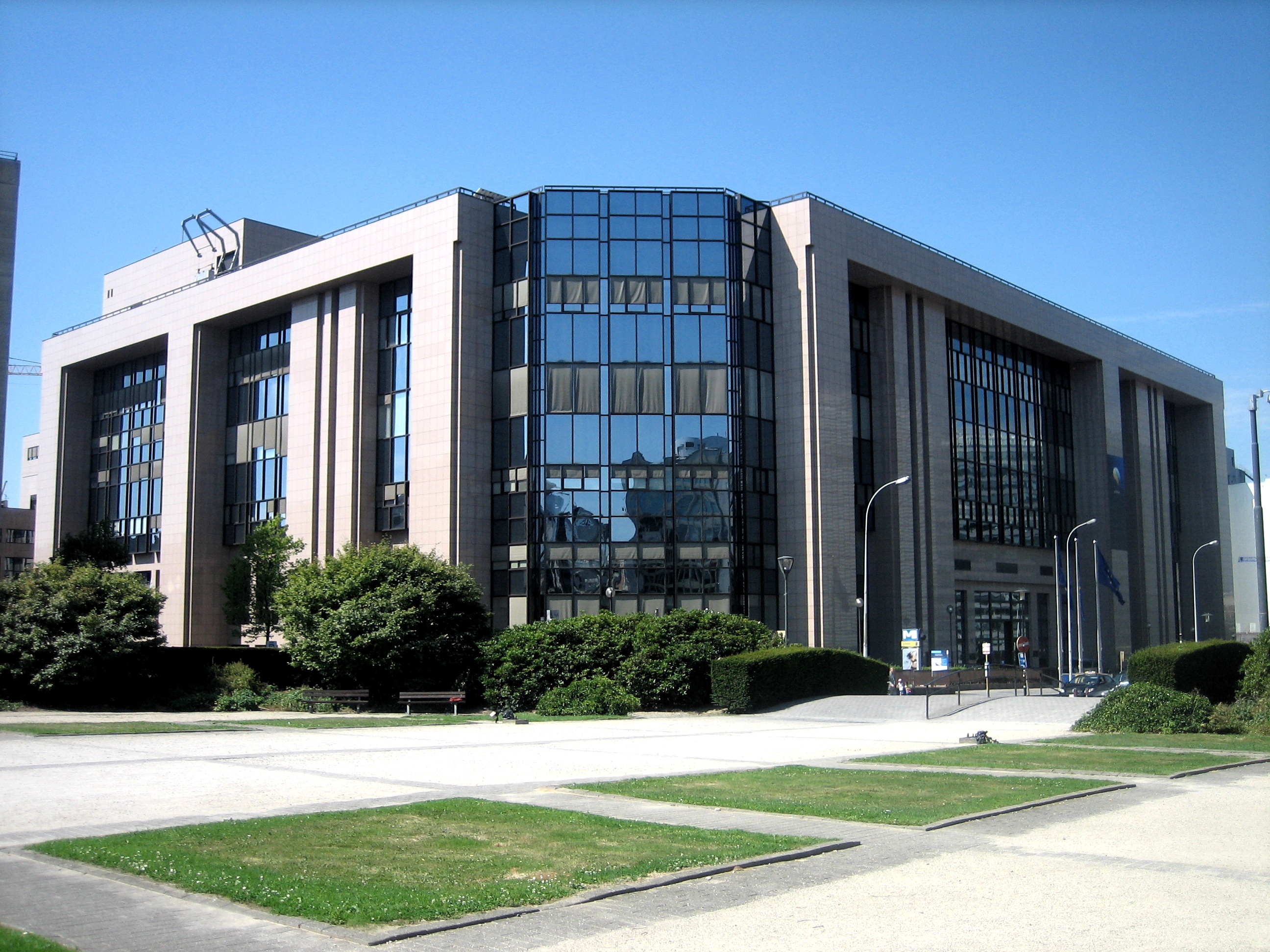
The Berlaymont was eventually renovated and the Commission returned. The Justus Lipsius building took heavy Council use, and in 2017 the Council moved its main meetings into the new Europa building - a glass cube containing a lantern-shaped chamber made of recycled windows from across Europe, intended, the architects said, to appear 'united from afar but showing their diversity up close.' The Parliament built its Espace Leopold complex on the site of the old Leopold Quarter train station, an enormous glass dome the locals nicknamed 'the Caprice des Dieux' after a wedge of French cheese.
What the City Becomes
The numbers are worth pausing on. The European Commission employs about 25,000 people in Brussels. The Parliament employs about 6,000. The institutions and their satellites draw in roughly 50,000 direct workers and another 20,000 indirect. About forty-six percent of the population of the Brussels-Capital Region was born outside Belgium - one of the highest proportions in Europe. Two thousand foreign companies have set up shop because the EU is here, employing eighty thousand multilingual locals. There are thirty international schools serving fifteen thousand pupils. Half of the city's 3.5 million square meters of office space is occupied by the EU and adjacent organizations. Business tourism alone generates 2.2 million hotel room nights a year.
The European Quarter today is a tense piece of urbanism - mostly office, dense with diplomats and lobbyists during the day, sometimes hollow in the evenings. The Rue de la Loi is being reimagined by the French architect Christian de Portzamparc as a series of taller buildings with more open public spaces, including a redesigned Place Schuman and a covered Beaulieu-to-Parliament 'promenade of Europeans.' The city is also pushing the EU to develop a second pole at the Heysel Plateau, near the Atomium. The political experiment between regions and communities that runs Belgium itself - bilingual, federal, perpetually negotiated - has been described, only half in jest, as a 'laboratory of Europe.' That description fits. If the European project ever fails, Brussels will be the saddest city in Europe. If it endures, this odd half-capital - never officially crowned, never quite escaped - is what endurance will look like.
From the Air
The European Quarter centers on roughly 50.84 N, 4.38 E, in the eastern part of central Brussels. Major institutional buildings include the Berlaymont (European Commission, at the Schuman roundabout), the Europa and Justus Lipsius buildings (Council of the European Union, adjacent), and the Espace Leopold complex (European Parliament, above Brussels-Luxembourg railway station). From cruising altitude over central Brussels, look for the cross-shaped footprint of the Berlaymont and the dome of the Parliament a few hundred meters southeast. The nearest international airport is Brussels Airport - Zaventem (EBBR), 12 km northeast - Eurostar trains from Brussels-Midi to Schuman and Brussels-Luxembourg take about 15 minutes via the Schuman-Josaphat tunnel. Brussels-South Charleroi Airport (EBCI) is about 50 km south.