Brussels Town Hall
On 13 August 1695, a French army under Marshal Villeroy aimed its mortars at Brussels and burned almost everything in the city center to the ground. The Town Hall was the principal target. When the smoke cleared, the Grand-Place was rubble. The Town Hall's tower — all 96 meters of Brabantine Gothic openwork, crowned by Saint Michael driving a spear through a dragon — was still standing. Only the stone shell of the main building remained, but the shell was enough. Three centuries later, that same tower still rises over the square, and the gilt archangel still keeps watch.
The Off-Center Tower
Look closely at the front of the Town Hall and the asymmetry is impossible to miss. The tower does not sit in the middle. The arched entrance under it does not line up with the building's central axis. The left wing has eleven arches; the right wing has only six. According to a Brussels legend, the architect realized his mistake after the tower was complete and threw himself from the top in despair. The real story is duller and more human. Construction stretched across half a century in fits and starts. The east wing went up between 1401 and 1421. The west wing began only in 1444, when the young Duke Charles the Bold laid its first stone. Jan van Ruysbroek, court architect to Philip the Good, added the spectacular tower last, finishing in 1455. Space constraints and the scattered building schedule made geometric perfection impossible. The medieval builders accepted the offset and moved on. The result is more interesting than symmetry would have been.
Saint Michael at 96 Meters
The statue at the top is 2.7 meters of gilt metal plates beaten into the shape of an archangel, sword raised over a writhing dragon. Up close it looks crude and ill-proportioned. From the square below, the distortions vanish and the figure reads as elegant and weightless. The Town Hall's makers understood viewing distance. The original, made by Michel de Martin Van Rode and installed around 1454 or 1455, came down in the 1990s to protect it from weather and pollution; a copy now stands on the spire. The original lives across the Grand-Place in the Brussels City Museum, housed in the neo-Gothic King's House. Saint Michael is the patron saint of the City of Brussels, and the dragon at his feet is the dragon of Revelation — the great serpent, called Devil and Satan. The tower is a religious statement and a civic one at once.
What the Bombardment Took
Marshal Villeroy's 70,000-strong army did not bombard Brussels to capture it. The bombardment was a strategic distraction, meant to draw League of Augsburg forces away from a French-held siege at Namur. Cannons and mortars opened fire on a largely defenseless city. Fire did what the shells could not finish, gutting the Town Hall's interior and destroying its archives, its furniture, and its art — including paintings by Rogier van der Weyden, the great Flemish master who had once decorated its courtroom with panels on the theme of justice. Those panels are gone forever. The municipal government funded reconstruction by selling houses and land. Between 1706 and 1717, three rear wings in the Louis XIV style were added, closing the L-shaped medieval building into a quadrilateral around an inner courtyard. The fire could not be undone, but the building came back.
Statues, Real and Reimagined
Most of the figures crowding the façade today are not medieval. Before the 19th century the Town Hall was relatively spare — corbels, eight prophets above the portal, a few statues on the corner turrets. Then came the great restoration. Between 1844 and 1902, nearly three hundred new statues were carved in Caen stone, depicting Dukes and Duchesses of Brabant, knights of the Noble Houses of Brussels, saints, and allegorical virtues. Sculptors like Charles Geefs, Charles-Auguste Fraikin, Eugène Simonis, and George Minne contributed. The architect Victor Jamaer reworked the façade in the spirit of his mentor Eugène Viollet-le-Duc, adding niches and a new portal where none had existed. The Town Hall you photograph today is a Gothic original wearing a 19th-century reinterpretation of itself. That layering is part of what makes it work.
The Center of Brussels
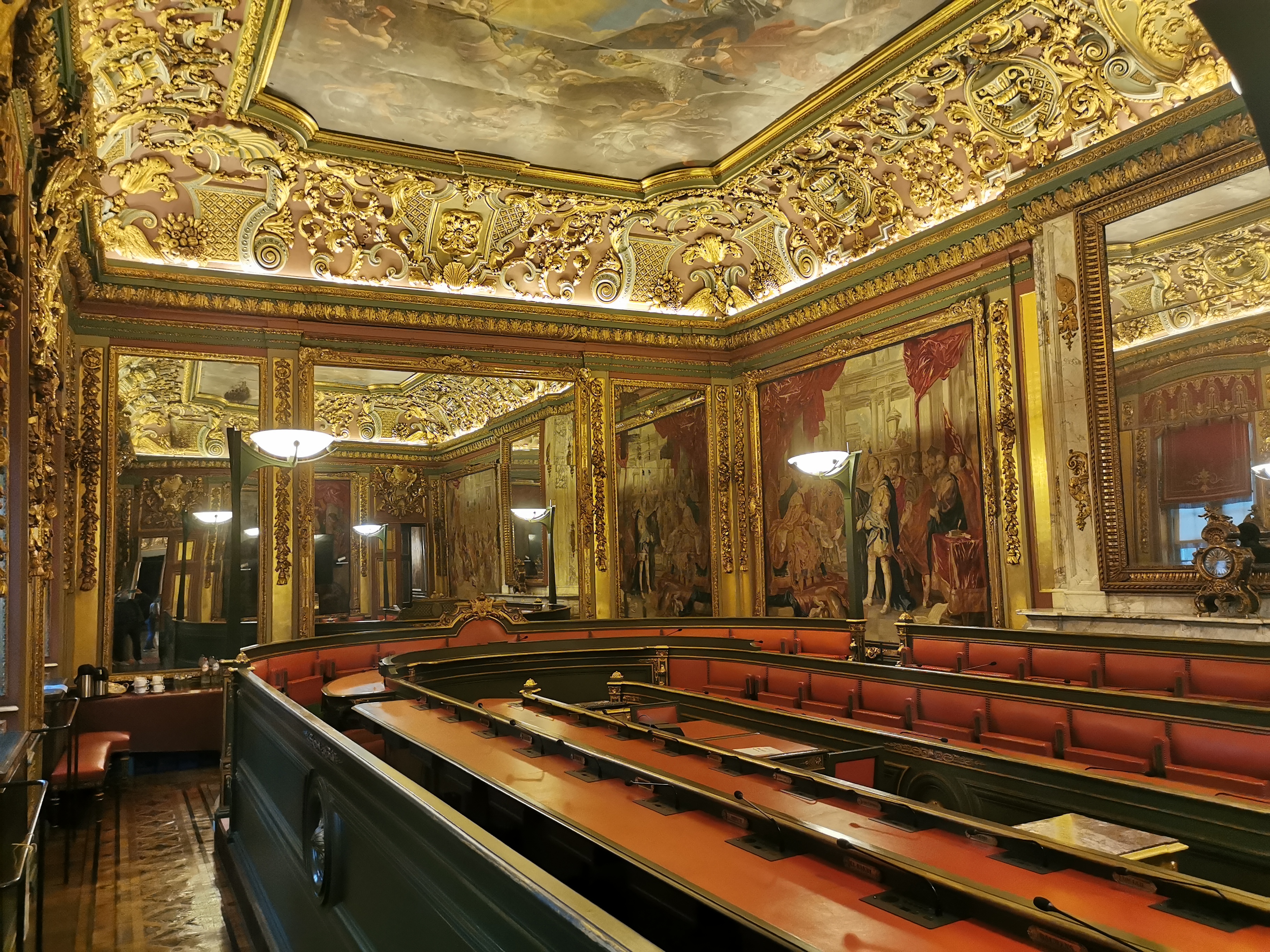
Step into the inner courtyard and find a star embedded in the pavement. It marks the geographical center of Brussels. Two marble fountains, sculpted in 1715 by Pierre-Denis Plumier and a collaborator, personify the Meuse and the Scheldt — the great rivers framing Belgian geography. Inside, the rooms layer political history. The States of Brabant Room, with its ceiling Assembly of the Gods by Victor Honoré Janssens, hosted the three estates of nobility, clergy, and commoners until 1795. In 1830, during the Belgian Revolution that split Belgium from the Northern Netherlands, the provisional government worked from inside these walls. In August 1914, the German army hoisted its flag at the Town Hall's left side. Through all of it the building remained the seat of the City of Brussels — which it still is. Vienna's City Hall and Munich's New Town Hall both took their cues from this façade. The Town Hall has been imitated, but never quite copied.
From the Air
Brussels Town Hall stands at 50.846°N, 4.352°E in the heart of Belgium's capital, on the south side of the Grand-Place. The 96-meter tower with its gilt Saint Michael weathervane is one of the most distinctive vertical landmarks in central Brussels and is visible from much of the lower town. Brussels Airport (EBBR) lies about 12 km northeast; Brussels South Charleroi (EBCI) is roughly 50 km south. Surrounding terrain is gentle and low-lying, with the Senne valley (now mostly culverted) running just west of the Grand-Place. Brussels' typical maritime climate often produces low overcast — best views of the tower from cruising altitude come in clearer continental high-pressure conditions.