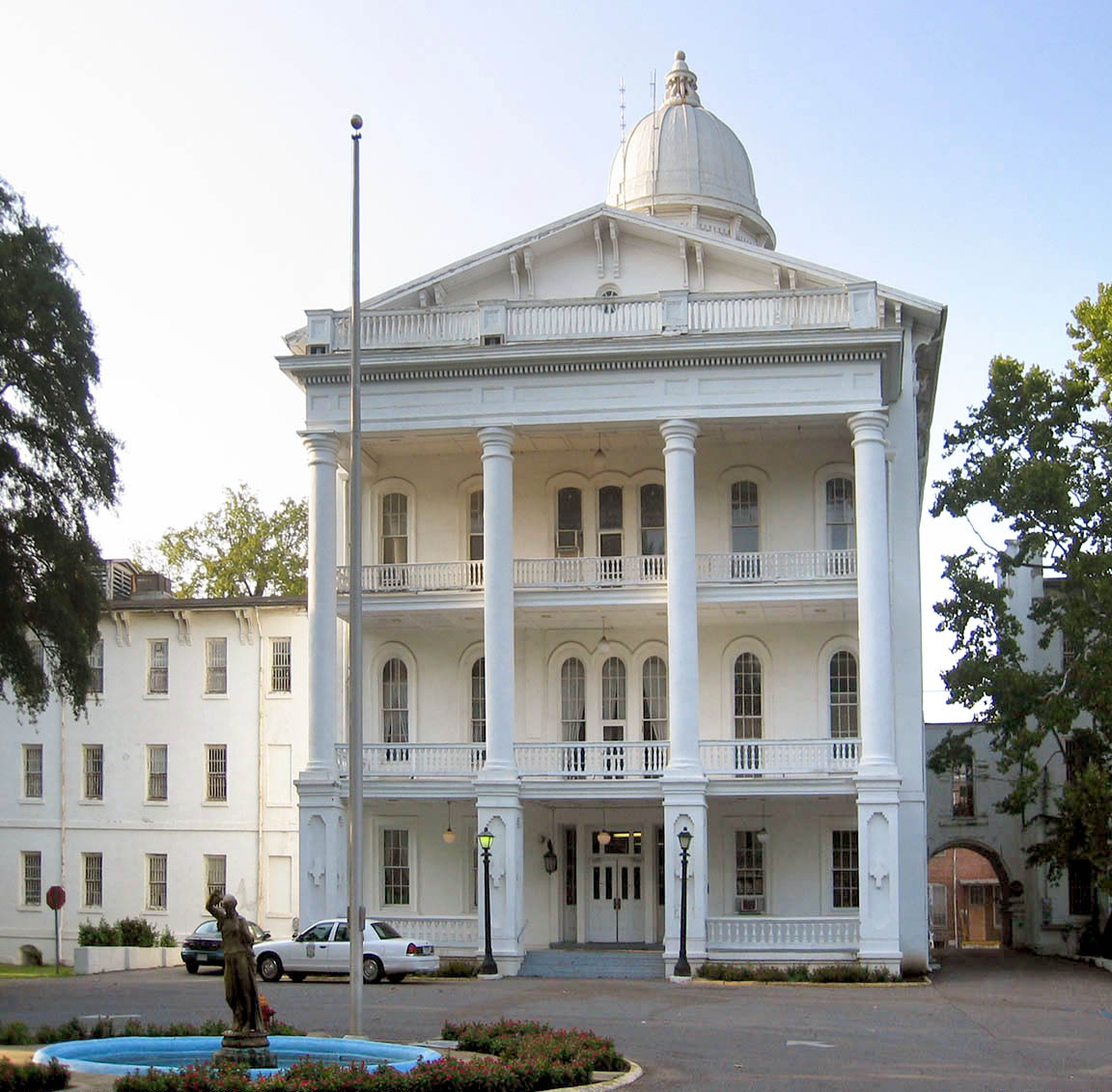
Bryce Hospital
Dorothea Dix arrived in Alabama in 1852 with a single demand: the state must build a proper asylum. Within a year, Governor Henry W. Collier and Senator Robert Jemison Jr. secured the funding. Architect Samuel Sloan drew up plans following the Kirkbride model, a revolutionary design philosophy that treated the building itself as a tool for healing. Construction began in 1853 on a hilltop in Tuscaloosa, and by 1861 the Alabama State Hospital for the Insane opened its doors, the first building in the city with gas lighting and central heat, all clad in a fashionable Italianate exterior. Its first superintendent was a 27-year-old South Carolinian named Peter Bryce, whose name the hospital would eventually carry. What happened inside those walls over the next century and a half would shape the rights of every institutionalized person in America.
A Pioneer of Moral Treatment
Peter Bryce was a young psychiatrist who believed in what the era called moral treatment: the idea that kindness, structured activity, and a humane environment could do more for the mentally ill than chains and isolation. He served as superintendent for 32 years, longer than most of his contemporaries held similar posts. Under his leadership, the use of shackles, straitjackets, and other physical restraints was discouraged and finally abandoned altogether in 1882. Patients published their own internal newspaper, The Meteor, between 1872 and 1881, a remarkable enterprise for any asylum of the era. Bryce held offices in several professional organizations and was considered a national authority on institutional care. The hospital that bore his name became a model, designed from the ground up around Kirkbride's linear plan: a domed central pavilion flanked on either side by three stepped-back wings joined by cross halls, giving every ward access to natural light and fresh air.
Five Thousand Patients and a Concentration Camp
By 1970, the vision of Peter Bryce had been crushed under the weight of neglect. Alabama ranked dead last among all fifty states in mental health funding. Bryce Hospital held 5,200 patients, crammed into spaces designed for a fraction of that number, living in conditions a Montgomery Advertiser editor compared to a concentration camp. That same year, a cigarette tax earmarked for mental health treatment was cut, and one hundred employees were laid off, including twenty professional staff. The University of Alabama's psychology department tried to sue on behalf of the fired workers, but Federal Judge Frank M. Johnson found no legal standing for that claim. He left open, however, a far more consequential possibility: a suit filed on behalf of the patients themselves.
Ricky Wyatt Takes on Alabama
In October 1970, a fifteen-year-old named Ricky Wyatt became the named plaintiff in a class-action lawsuit that would change American mental health law. Wyatt had been labeled a juvenile delinquent and housed at Bryce despite having no diagnosed mental illness. His aunt, Mildred Hunter Rawlins, was among those laid off. Together they testified about intolerable conditions and treatments designed only to make patients more manageable. The plaintiff class expanded to include patients at Searcy Hospital in Mount Vernon, Partlow State School in Tuscaloosa, and the Jemison Center in Coker. The resulting court-ordered agreement, known as the Wyatt Standards, established federal minimum standards for institutional mental health care: a humane environment, qualified staff, individualized treatment plans, and minimum restriction of patient freedom. The case of Wyatt v. Stickney ran for 33 years, the longest mental health case in United States history, before being dismissed in 2003 when Judge Myron H. Thompson found Alabama in compliance.
From Asylum to Campus
In 2009, a deal worth $72 million transferred the historic Bryce campus to the University of Alabama. The university paid $50 million in cash while the Alabama Department of Mental Health received another $22 million in state bond money. The university pledged an additional $10 million for environmental cleanup and restoration of the original 1853 building. In 2014, the remaining patients moved to a new Bryce Hospital built on the former Partlow Center grounds. The university launched an estimated $83.75 million restoration project, transforming the Italianate administration building into a welcome center and repurposing the former Women's Psychiatric Center as University Hall. Two museums are planned, one dedicated to mental health history and another to the history of the university. The entrance gate to the campus now bears the name Peter Bryce Preserve, a nod to the young superintendent who once insisted that every patient deserved courtesy, kindness, and respect.
From the Air
Bryce Hospital is located at 33.216N, 87.538W in Tuscaloosa, Alabama, on the western edge of the University of Alabama campus. The nearest airport is Tuscaloosa National Airport (KTCL), approximately 4 miles to the northwest. The large Italianate building complex is visible at lower altitudes (below 2,000 feet AGL) in clear conditions, identifiable by its distinctive domed central pavilion and symmetrical stepped-back wings. Birmingham-Shuttlesworth International Airport (KBHM) lies approximately 50 nm to the northeast.