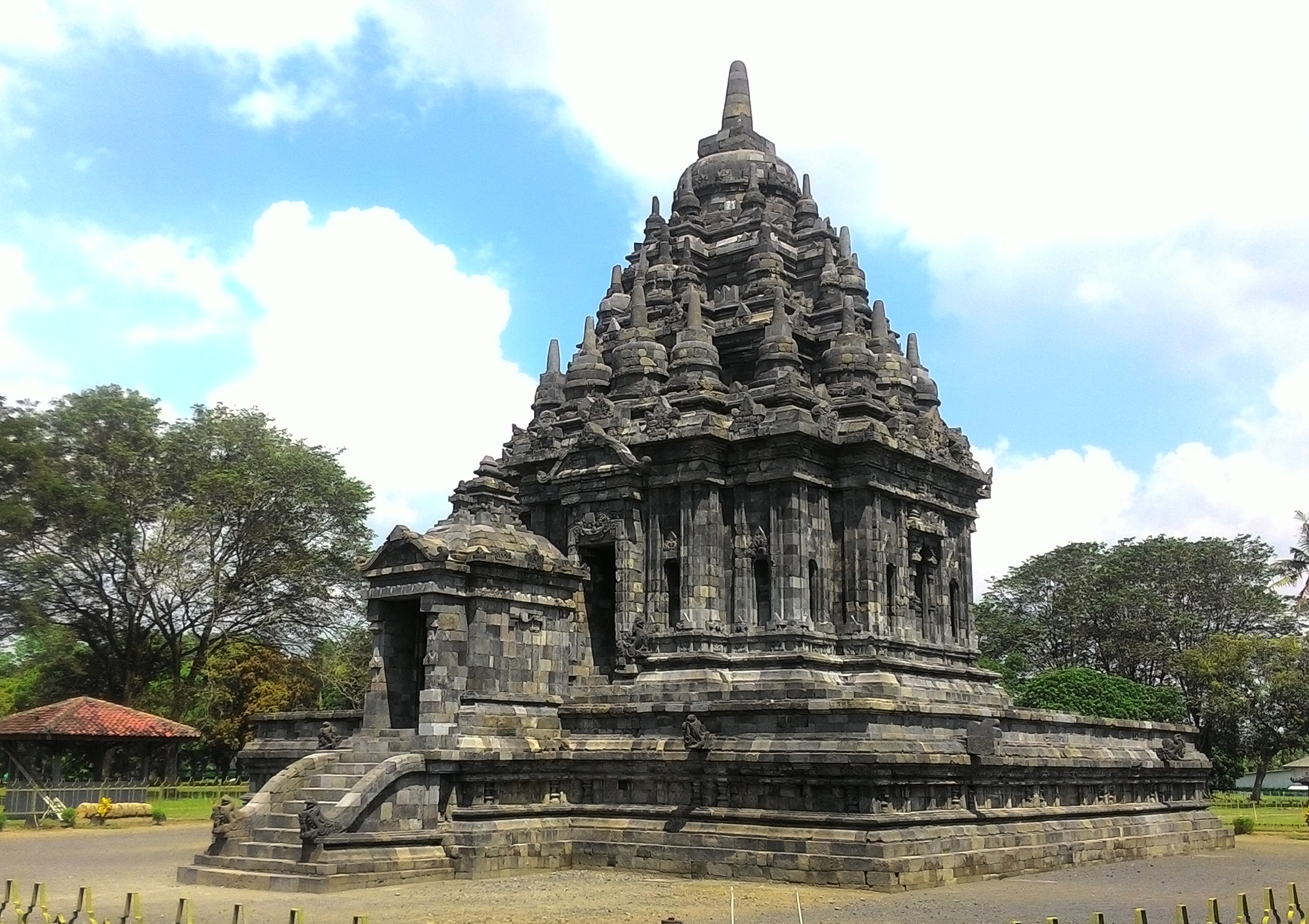
Bubrah
For more than a thousand years, this temple had no name anyone remembered. When the Javanese finally gave it one, they called it what they saw: Bubrah -- broken, ruined, a disorderly heap. The word was generous. What remained of the 9th-century Buddhist shrine was a mound of carved stone barely two meters tall, half-buried under volcanic debris from Mount Merapi, shaken apart by earthquakes, ignored by every dynasty that followed the one that built it. That the temple stands today, its stupa-crowned roof once again catching the Central Java sunlight, is the result of a seven-year reconstruction completed in 2017 -- a patient reversal of twelve centuries of neglect.
The Guardian at the Southern Gate
Bubrah was never meant to stand alone. Archaeologists believe it was one of four vanguard temples positioned at the cardinal points of the Manjusrigrha mandala, the sacred layout surrounding the great Sewu temple roughly 300 meters to the north. Bubrah held the southern station, a guardian of directions in the vajradhatu mandala tradition. A sister temple called Candi Gana marked the eastern point. On the northern and western sides, ruins have been found, but the stones are too scattered to reconstruct. Of the four sentinels, only Bubrah has been brought back to its full form. The temple measures 12 by 12 meters and faces east, its entrance framed by a flight of stairs, a portico, and a carved portal. The roof rises in stepped tiers lined with rows of smaller stupas, crowned by a single larger stupa at the pinnacle. In design, it closely resembles the Apit temples within the Sewu compound and the Sojiwan temple farther south.
Built by the Ornament of a Dynasty
The Sewu complex -- of which Bubrah is a satellite -- was built by Rakai Panangkaran, a ruler of the Mataram kingdom hailed as Shailendra Wamsatilaka, the ornament of the Shailendra dynasty. Panangkaran's builders created Manjusrigrha as a Buddhist-style mandala, with the main Sewu temple at the center and smaller shrines radiating outward in geometrical precision. Bubrah appears to have been added slightly later, possibly during the reign of Dharanindra or Samaragrawira in the early 9th century, to complete the mandala's directional scheme. Together with the nearby Lumbung temple to the south, these Buddhist structures occupied the Kewu Plain alongside the towering Hindu temples of Prambanan -- a remarkable landscape where two faiths built in stone within sight of each other, each monument a declaration of devotion and political ambition.
Twelve Centuries Underground
When the Mataram court relocated to eastern Java around the 11th century, the temples of the Kewu Plain were left without patrons. Mount Merapi, the active volcano looming to the north, did the rest. Eruptions blanketed the region in ash and volcanic debris. Earthquakes loosened what the ash had not buried. By the time European and Javanese scholars rediscovered the site in the early 19th century, Bubrah was indistinguishable from a natural feature of the landscape -- a low mound that happened to be made of carved stone rather than earth. Throughout the entire 20th century, the stones were simply left where they lay. Restoration teams focused on the larger, more spectacular Prambanan and Sewu complexes nearby. Bubrah waited.
Seven Years of Reassembly
The reconstruction began in 2011 and advanced through seven painstaking stages. Each stone had to be identified, cataloged, and fitted back into position, a process governed by the principle of anastylosis -- rebuilding only with original materials in their original configuration. On 14 December 2017, Indonesian Minister of Education and Culture Muhajir Effendy inaugurated the completed temple. The project had cost 11 billion rupiah. The temple that had been nothing more than a name for destruction was, at last, no longer bubrah. Today, visitors reach it through the Prambanan Temple Archaeological Park, walking north from the main Prambanan compound. In 1992, the area was registered as part of the Prambanan Temple Compound, a UNESCO World Heritage Site. Bubrah sits quietly among its famous neighbors, a small structure that nonetheless completes a cosmic diagram first drawn in stone more than 1,200 years ago.
From the Air
Located at 7.75S, 110.49E on the Kewu Plain in Central Java, within the Prambanan Archaeological Park. The temple sits roughly 300 meters south of the Sewu temple complex and several hundred meters north of Prambanan's main compound. Mount Merapi (2,930 m) dominates the northern horizon. Nearest airport: WAHH (Adisucipto International Airport), approximately 5 km to the west. At moderate altitude, the Prambanan and Sewu temple clusters are clearly visible; Bubrah is a smaller structure between the two larger complexes.