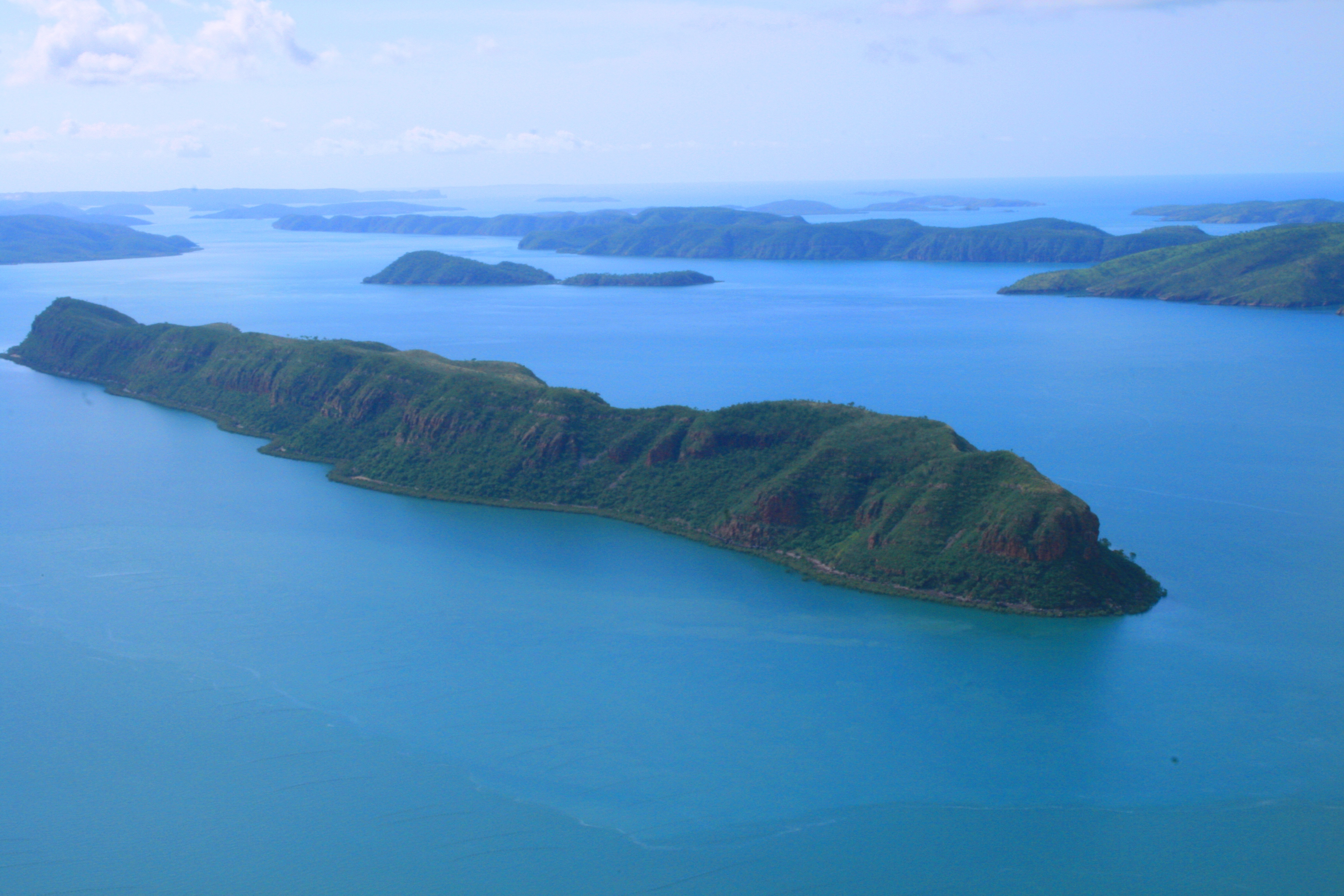
Buccaneer Archipelago
William Dampier was an English buccaneer and privateer who became one of history's most accomplished naturalists — a man who sailed with pirates, recorded species unknown to European science, and charted coastlines that others had never seen. In 1688 he crossed these waters off the Kimberley coast and noted them in his journal. In August 1821, the surveyor Philip Parker King formally named the island group after him. The Buccaneer Archipelago: a name that belongs to colonial cartography, imposed on a place whose rocks are two billion years old and whose people have known it for far longer.
Eight Hundred Islands
The archipelago covers more than 50 square kilometres at the head of King Sound, packed between King Sound and Collier Bay near Yampi Sound. About 800 islands make up the group, ranging from large rocky masses with high cliffs to tiny formations barely breaking the surface at low tide. The rocks are ancient Precambrian sandstones — among the oldest exposed rock formations in Australia — and the coastline they belong to is similarly ancient. The islands themselves are younger: they formed as sea levels rose after the last ice age, drowning a prehistoric coastline and leaving its high points as islands.
Many are steep and rocky, sparsely vegetated, fringed where silt has accumulated with mangroves. The area is in almost pristine condition. The reason is practical: access is extremely difficult. The tidal range here reaches more than 12 metres, the channels are complex, and the currents unpredictable. The pearling fleet that once worked these waters in the early twentieth century learned the cost of the archipelago's tides firsthand.
The Country and Its People
Aboriginal Australians have lived in the Kimberley region for thousands of years, and the archipelago has been part of that world throughout. The traditional owners of the islands are the Mayala group, comprising the Yawijibaya and Unggarranggu peoples. The Bardi people hold traditional rights to fish and harvest trochus shells in these waters — a right maintained across the centuries, including through the colonial period when such relationships were often suppressed or ignored.
Macleay Island, which the Encyclopaedia Britannica identifies as the largest in the group, anchors the northeast cluster. Other named groupings include the southeast islands — among them Cockatoo and Bathurst islands, both with significant industrial histories — and the west group, which includes Horizontal Falls, one of the most dramatic natural phenomena in Australia, where tidal flows force an enormous volume of water through narrow rock gaps in a matter of hours.
A New Marine Future
For most of the twentieth century, the archipelago was known primarily for mining and pearling. That is changing. In December 2020, the Western Australian government published indicative joint management plans for a new marine park to be known as the Mayala Marine Park, co-designed with traditional owners and the Department of Biodiversity, Conservation and Attractions. Three Indigenous land use agreements were signed as part of the process.
The new park is part of a broader expansion of the Lalang-gaddam Marine Park network, which brings together Lalang-garram/Camden Sound, Lalang-garram/Horizontal Falls, and the North Lalang-garram marine parks. The Maiyalam Marine Park covers other islands in the group. Together, these overlapping protections represent a significant shift — from an archipelago defined by industrial extraction to one managed in partnership with the people whose ancestors named it long before any buccaneer arrived.
From the Air
The Buccaneer Archipelago is centred at approximately 16.12°S, 123.33°E, north of Derby (YDBY) and west of Koolan Island. At 3,000–6,000 feet, the scale of the island group becomes clear — hundreds of red-rock islands scattered across blue-green water, separated by channels that run visibly fast even from the air. The extreme tidal range is visible as broad bands of exposed rock and mud at low water. Helicopter tours from Broome and Derby frequently overfly the archipelago; fixed-wing aircraft should be aware of the Yampi Sound Training Area to the east.