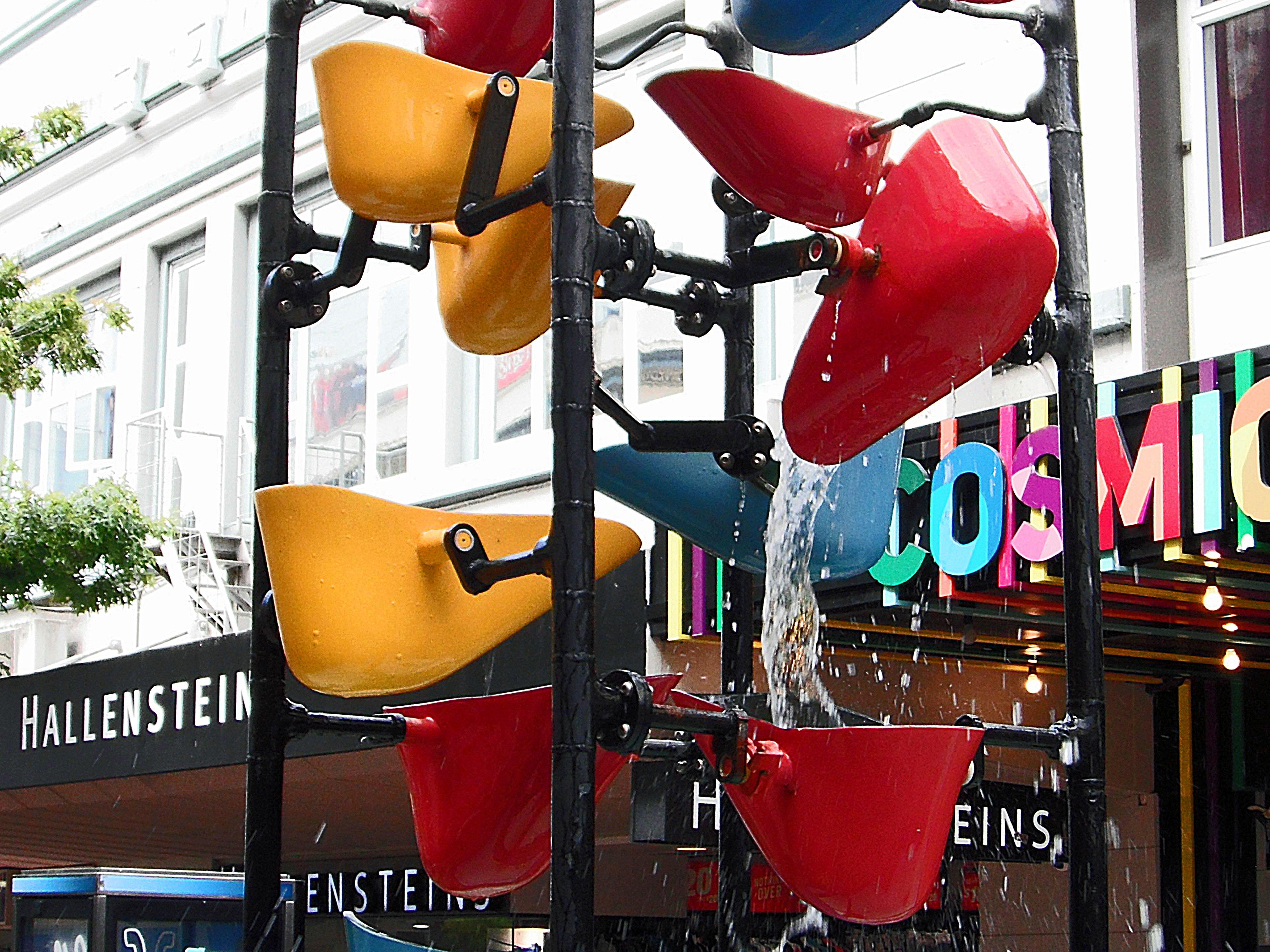
Bucket Fountain
Someone keeps stealing the buckets. Not all of them, mind you - just the big yellow ones near the bottom, the ones that catch the most water before tipping their load onto whoever happens to be walking past. In 2016, one disappeared overnight and turned up days later at the base of the fountain, painted in psychedelic swirls. In 2021, another vanished and was found months later painted gold with a dragon on it. The thieves always bring them back. That is the kind of affection Wellington reserves for its most improbable landmark: a kinetic sculpture on Cuba Mall that the city once called an "engineering joke" and now cannot imagine living without.
The Water Mobile
When Graham Allardice of Burren and Keen designed the sculpture for the pedestrianisation of Cuba Street in 1969, he called it the "Water Mobile." The concept was simple: a vertical arrangement of buckets that fill with water, tip under their own weight, and spill cascading sheets into the buckets and pool below. The execution was steel, aluminium, and fibreglass, assembled for the modest sum of $2,000. It bears a strong resemblance to a fountain erected in Liverpool two years earlier by designer Richard Huws - but Wellington's version gained something its English cousin never managed: a personality. The buckets were all painted yellow. The water, in a city famous for its wind, rarely landed where it was supposed to. Critics called it a "monstrosity." None of that mattered. Cuba Street had its centerpiece.
Bubbles, Oil Spills, and Psychedelic Paint Jobs
The Bucket Fountain's history reads less like a public art maintenance log and more like a police blotter crossed with a comedy script. On Friday and Saturday nights, Wellingtonians routinely dump dishwashing detergent into the water, sending clouds of bubbles billowing across the mall. In 2006, artist John Radford coated the entire structure in a mud-like substance. In 2014, protesters turned the water black to simulate an oil spill, protesting deep-sea drilling off Wellington's coast. By 1981 the fountain had fallen into what was diplomatically described as a "sorry state of repair" before being rescued by the Cuba Mall manager. Wellington City Council upgraded it in 2003, turning some buckets around so they intentionally dump water onto the pavement - a grudging acknowledgment of what the wind had been doing for decades. The buckets, once uniformly yellow, were repainted in new colours. Each intervention only deepened the city's attachment.
The Bucket Heists
The 2016 theft became a minor national event. Wellington City Council issued a public plea for the bucket's return. When it reappeared in the fountain's pool, painted in an intricate psychedelic pattern, Mayor Celia Wade-Brown responded with characteristic Wellington understatement: "I'm unequivocally blissful they brought it back unscathed and apparently enhanced. We consider it an utterly appealing small paint job." The bucket was reinstalled on 17 March. Five years later, history repeated itself when another large bucket disappeared in October 2021. This one was eventually tracked down through social media - someone spotted a photo of it, painted gold and adorned with a dragon, in what the Council called a "Christmas miracle." The replacement bucket the Council had already begun fabricating would have cost $2,000 - exactly what the entire fountain cost to build in 1969.
An Interdimensional Portal on Cuba Mall
The fountain's cultural footprint extends well beyond the splash zone. It appeared in the first episode of Wellington Paranormal, the mockumentary television series, where it served as an interdimensional portal. Musician Bic Runga featured it in a music video. When Elijah Wood appeared on The Tonight Show during the Lord of the Rings press tour, even he mentioned it. For a collection of tipping buckets on a pedestrian mall in a small capital city at the bottom of the world, the Bucket Fountain punches well above its weight. Perhaps that is because it does what the best public art does: it refuses to behave. The water goes where the wind takes it. The buckets get stolen and returned more interesting than they left. Detergent turns it into a bubble machine. It is perpetually broken and perpetually beloved, which may be the most Wellington thing about it.
From the Air
Located at 41.29S, 174.78E in the heart of Wellington's Cuba Street pedestrian mall. From the air, Cuba Mall runs north-south through the Te Aro district. The fountain sits mid-block and is not individually visible from altitude, but the pedestrian mall is identifiable as a traffic-free strip in the urban grid. Nearest airport: Wellington International (NZWN), approximately 5 km southeast. Viewing altitude: 1,500-3,000 ft for urban context. Wellington's wind is a defining feature - expect turbulence on approach.