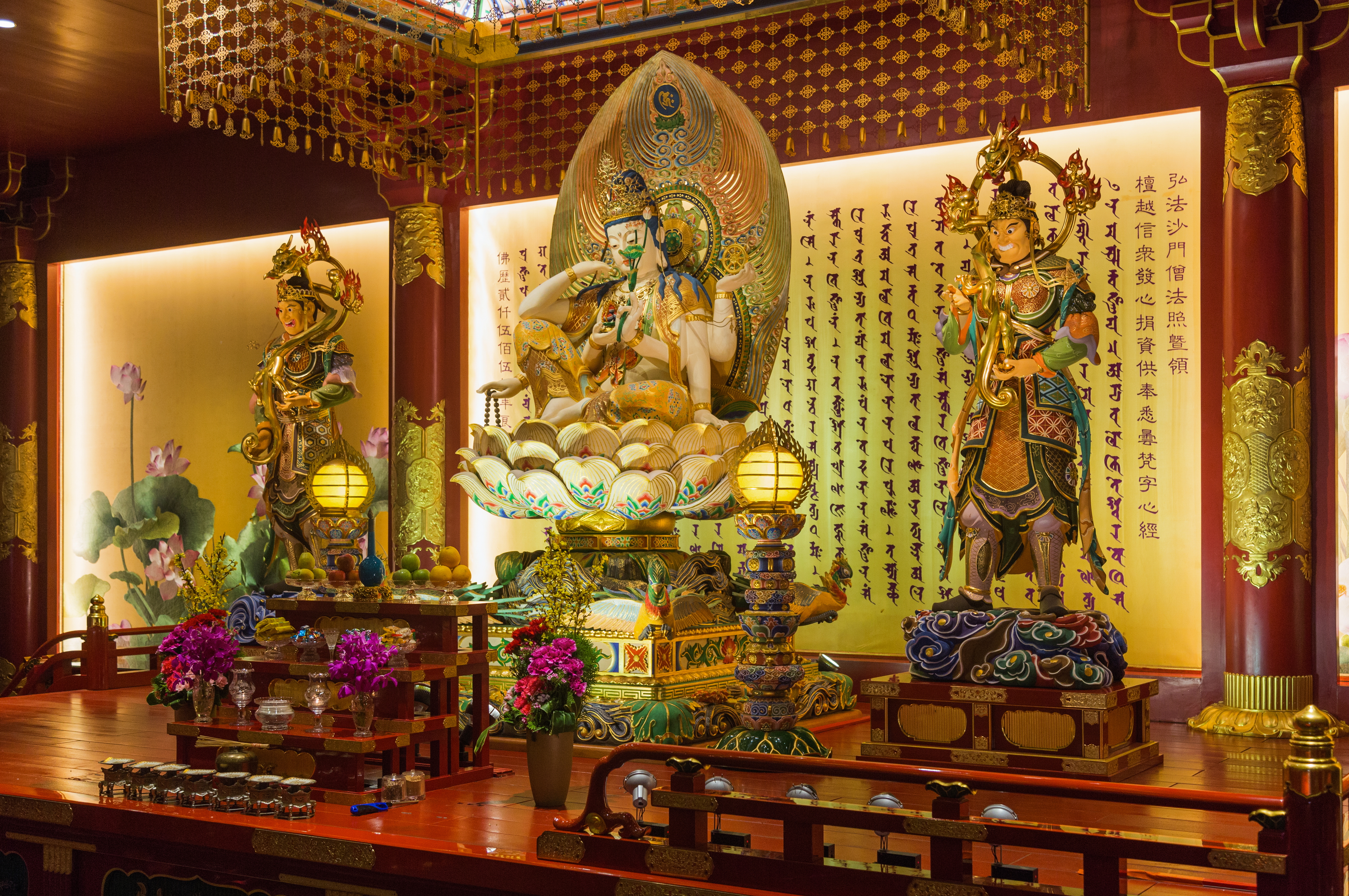
Buddha Tooth Relic Temple and Museum
The tooth measures 7.5 centimeters -- far too large for any human mouth. Whether it truly belonged to the historical Buddha remains a matter of faith rather than forensics, but that ambiguity has not dimmed the reverence surrounding it. Since the relic was reportedly recovered from a collapsed stupa, it has drawn devotees and the merely curious alike to an ornate five-story temple tucked into Singapore's Chinatown, where incense smoke drifts past red lacquered doors and the hum of chanting fills halls lined with gold.
Nine Proposals and a Vision
The Buddha Tooth Relic Temple and Museum exists because of one monk's stubbornness about aesthetics. When the Singapore Tourism Board approached Venerable Shi Fa Zhao to redevelop the site, they asked for something traditional that would serve both locals and tourists. What followed were nine rejected architectural proposals. Shi Fa Zhao dismissed a contemporary design as out of place amid Chinatown's shophouses. He turned down Southern Chinese typology too -- the style most historically authentic to Singapore's migrant communities -- because he wanted something that would stand apart from the older temples already lining the neighborhood. The final design draws from Northern Chinese architecture of the Tang dynasty, with subtle Japanese and Tibetan Buddhist influences woven into certain rooms. The result is a building that looks as though it belongs to a different century and a different latitude entirely, which is precisely the point.
Ascending Through Devotion
Each floor of the temple unfolds a different dimension of Buddhist practice and art. Enter through the Shanmen -- the Mountain Gate -- and its three heavy red lacquered doors fitted with gilt bronze studs and lion door knockers. The center gate stays closed except for important guests. Beyond it, the Hundred Dragon Hall rises 27 feet to accommodate a 15-foot statue of the Buddha Maitreya, hands posed in mudras of protection and generosity. Climb higher and the spaces grow more intimate: the Manjushri Hall on the second floor, where a black-skinned crouching lion lurks beneath a bodhisattva's throne; the Nagapuspa Buddhist Culture Museum on the third, housing 278 exhibits spanning Gandharan sculpture from the 2nd century to modern expressionist works. At the top, the Sacred Light Chamber holds the tooth relic itself, enshrined in a stupa adorned with 189 sets of gemstones, 36 dragon statuettes, and a solid gold Buddha Maitreya at its center. Gold tiles line the floor. The walls bear painted images of the Twenty Devas.
Eleven Thousand Buddhas on the Roof
The rooftop is the temple's most unexpected space. The Ten Thousand Buddha Pagoda -- despite its name, it actually holds approximately 11,111 gilt statues of Buddhas and Bodhisattvas -- sits at the center, each figure in lotus position on a phoenix throne with flaming aureoles encircling their heads. A large Vairocana Buddha Prayer Wheel, inspired by Tibetan Buddhist tradition, anchors the pavilion, containing more than 3,000 calligraphed copies of the Vairocana Mantra. Surrounding pavilions house the Five Tathagatas, each positioned according to its cardinal direction: Amoghasiddhi to the north, Amitabha to the west, Ratnasambhava to the south, Akshobhya to the east, and Vairocana at the center. The pavilion walls hold over 12,300 small statuettes of the Buddha of Infinite Life. Standing on this rooftop, surrounded by thousands of identical golden figures gleaming in equatorial sunlight, the effect is less architectural than hypnotic.
Faith and Welfare
Shi Fa Zhao, the temple's abbot and president, is also the founder of the Metta Welfare Association, a nonprofit that provides special education, medical care, and welfare services to the intellectually disabled, the elderly, and the terminally ill. This dual role shapes the temple's identity as more than a place of worship. The basement holds a vegetarian dining hall that serves complimentary meals to anyone who walks in -- donations accepted but never required. The Eminent Sangha Museum on the mezzanine profiles monks, both local and foreign, who devoted themselves to social service and charity alongside Buddhist scholarship. In a Chinatown increasingly defined by souvenir shops and heritage branding, the temple operates as a living institution: monks and nuns chant in the Hundred Dragon Hall while laypeople sit behind them, and the smell of free vegetarian food rises from below.
A Chinatown Landmark From Above
From the air, Singapore's Chinatown reads as a dense grid of shophouse rooftops, their terracotta tiles aging under tropical rain. The Buddha Tooth Relic Temple breaks this pattern -- its crimson and gold roofline, distinctly Tang dynasty in profile, stands out against the low-slung commercial architecture surrounding it. The temple sits along South Bridge Road at 1.28 degrees north, 103.84 degrees east. Singapore Changi Airport (WSSS) lies roughly 17 kilometers to the east. Seletar Airport (WSSL) sits to the north. For pilots approaching from any direction, the Chinatown district is identifiable by its tight street grid between the Singapore River and the Tanjong Pagar area, with the temple's traditional roofline marking the neighborhood's spiritual center amid one of Asia's most modern skylines.
From the Air
Located at 1.28155°N, 103.844°E in Singapore's Chinatown district. Singapore Changi Airport (WSSS) lies approximately 17 km east. Seletar Airport (WSSL) is to the north. The temple's distinctive crimson and gold Tang dynasty-style roofline is visible amid the low shophouse rooftops of Chinatown. Best viewed at 2,000-3,000 ft AGL. The Chinatown district sits between the Singapore River and Tanjong Pagar, identifiable by its dense grid pattern contrasting with the modern towers of Marina Bay to the east.