Buddhas of Bamiyan
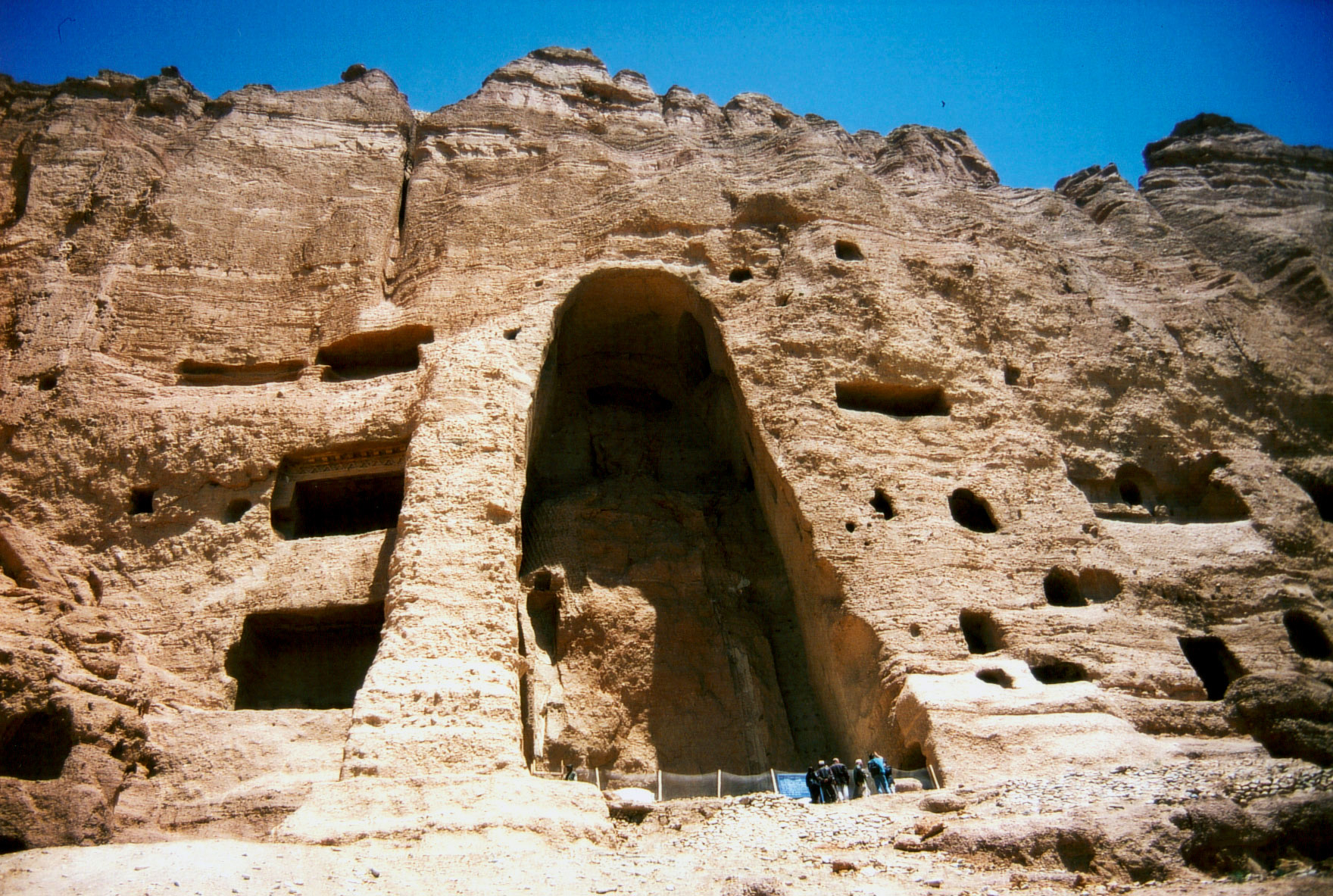
For fourteen centuries, two enormous figures gazed out across the Bamiyan Valley from their sandstone alcoves. The larger stood 55 meters tall -- roughly the height of a 17-story building -- carved directly into the cliff face around 618 CE. The smaller, completed about half a century earlier, rose 38 meters beside it. Together they were the largest standing Buddha carvings in the world, their robes once painted in vivid carmine red and bright polychrome, their faces likely fitted with massive wooden masks. In March 2001, it took the Taliban weeks of artillery, anti-tank mines, and carefully placed explosives to bring them down. The niches they left behind remain, two hollow wounds in a sandstone cliff at 2,500 meters elevation, framing nothing but Afghan sky.
Where Silk Met Stone
Bamiyan sits 130 kilometers northwest of Kabul, high in the Hindu Kush along one of the Silk Road's most important corridors. By the 2nd century CE, under the Kushan Empire, it had become a thriving Buddhist center. Monks carved small caves into the cliff walls, embellished them with brightly colored frescoes, and lived as hermits above one of the ancient world's busiest trade routes. When Chinese pilgrim Xuanzang visited on April 30, 630 CE, he described more than ten monasteries and more than a thousand monks, noting that both Buddha figures were decorated with gold and fine jewels. He also mentioned a third, even larger, reclining Buddha statue -- a figure archaeologists have sought for decades but never found. The great statues were commissioned during Hephthalite rule, when local principalities governed Tokharistan and northern Afghanistan. Ceiling murals depicted a solar deity riding a golden chariot pulled by four horses, surrounded by royal sponsors and devotees. The paintings vanished with the statues in 2001.
The Art of Carving Mountains
The Buddhas were technically reliefs rather than freestanding sculptures -- at the rear, each figure merged into the living rock. Artisans hewed the main bodies directly from the sandstone, then modeled finer details in mud mixed with straw, coated with painted stucco. The larger statue, called Salsal -- meaning 'the light shines through the universe' -- was referred to as male. The smaller, called Shah Mama or 'Queen Mother,' was considered female, though scholars remain uncertain. Arms were built from mud and straw over wooden armatures. Over centuries, the painted surfaces wore away, but the forms endured. They survived Mughal emperor Aurangzeb's artillery in the 17th century. They survived the Soviet invasion. In their later years, 50 additional caves were discovered nearby, some containing wall paintings dating from the 5th to 9th centuries -- works by artists who had traveled the Silk Road. Analysis of these murals revealed something remarkable: oil-based paint techniques, centuries before their supposed invention in Europe.
Twenty-Six Days of Dynamite
On February 26, 2001, Taliban leader Mullah Muhammad Omar ordered the destruction of all statues in Afghanistan so that, in his words, no one could worship or respect them in the future. The international response was immediate and nearly unanimous. All 54 member states of the Organisation of the Islamic Conference protested, including Pakistan, Saudi Arabia, and the United Arab Emirates -- the only three nations that recognized the Taliban government. India offered to transfer the artifacts to safety. Japan proposed moving the statues, covering them, or paying money to preserve them. Every appeal was rejected. The destruction proved harder than the Taliban expected. Anti-aircraft guns and artillery caused severe damage but could not bring the figures down. Taliban Information Minister Qudratullah Jamal acknowledged the difficulty: the Buddhas were firmly attached to the mountain. Anti-tank mines were placed at the base of the niches. Finally, men were lowered on ropes to pack explosives into drilled holes. When one blast failed to obliterate a face, a rocket finished the job. Local civilians later reported being forced to assist. Mullah Omar's response to the outcry was blunt: 'What are you complaining about? We are only waging war on stones.'
What Remains
The outlines of both Buddhas are still visible in the cliff recesses. Visitors can still explore the monks' caves and the passages connecting them. Since 2002, international teams have sorted fragments ranging from boulders weighing several tons to pieces the size of tennis balls, sheltering them from the elements under a $1.3 million UNESCO-funded project. In 2013, the German branch of ICOMOS rebuilt the foot section of the smaller Buddha using iron rods, bricks, and concrete -- only for UNESCO to halt the work, insisting that reconstructions use original material. Two years later, a wealthy Chinese couple funded a 3D light projection that beamed an artist's rendering of the larger Buddha into its empty niche for one night, then donated their $120,000 projector to Afghanistan's culture ministry. The site was inscribed as a UNESCO World Heritage Site in 2003 and remains listed as World Heritage in Danger. When the Taliban retook Afghanistan in 2021, they permitted tourists to visit but halted preservation work. In February 2023, UNESCO restoration resumed with new Italian government funding. The debate continues: should the niches be left empty as monuments to fanaticism, or should the Buddhas rise again?
From the Air
Located at 34.832N, 67.827E in the Bamiyan Valley at 2,500 meters elevation. The cliff face and empty niches are visible from the air, set against the Hindu Kush range. Nearest airport is Bamyan Airport (OABN). Approach from the southeast for the best view of the cliff face. Mountain weather can be severe; maintain safe altitude above 3,500 meters AGL when transiting the area.