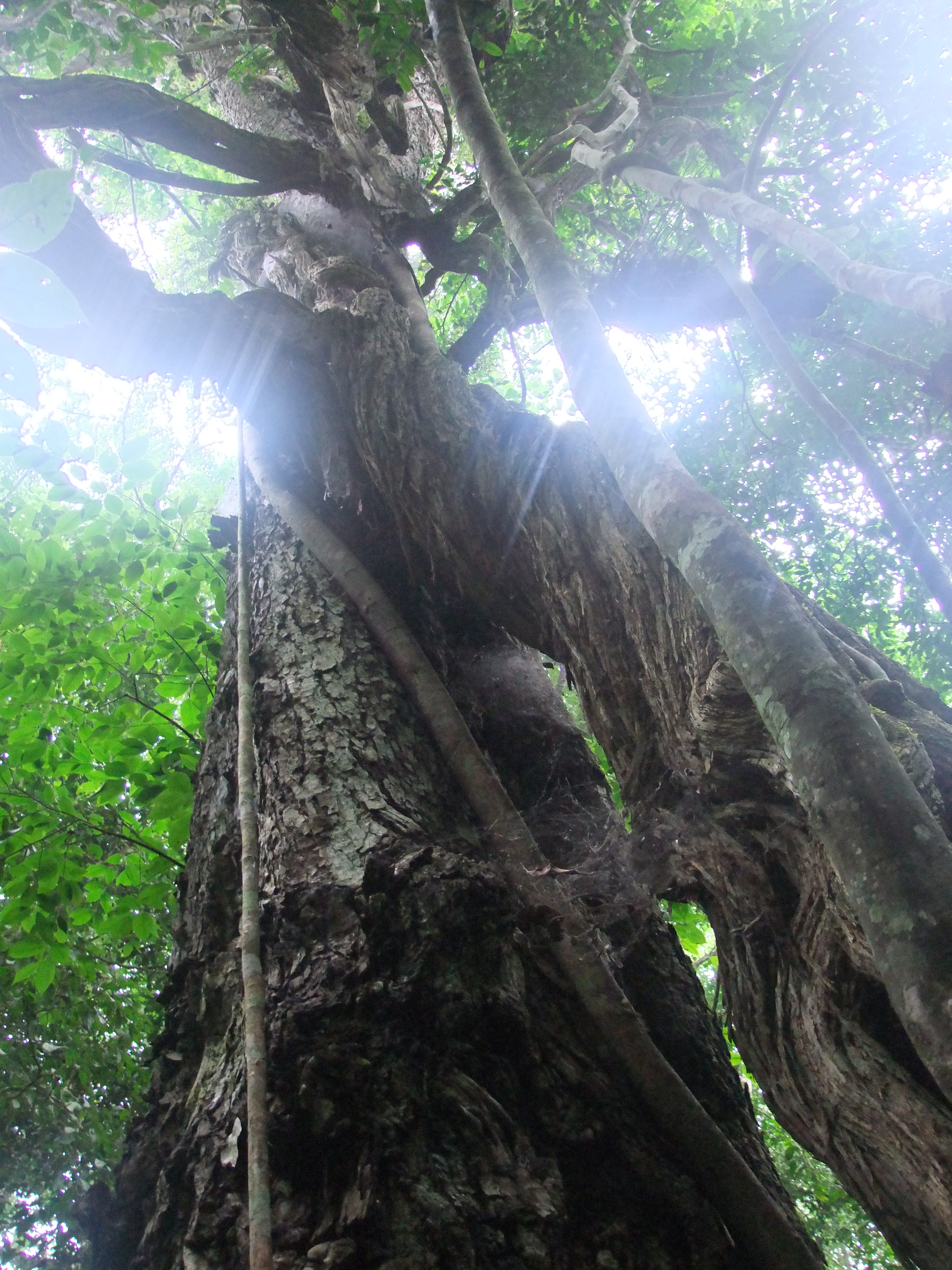
Budongo Forest
In 1962, a young Oxford anthropologist named Vernon Reynolds walked into a dense mahogany forest in western Uganda and began watching chimpanzees. He could not have known that the forest would soon be engulfed by civil war, that the chimps he studied would be hunted and their infants trafficked to collectors on three continents, or that he would return nearly three decades later to find out whether any had survived. Budongo Forest, draped across the escarpment northeast of Lake Albert and rolling down toward the East African Rift, is a place where the persistence of both science and nature has been tested repeatedly -- and where both have refused to give in.
Cathedral of Mahogany
Budongo covers 435 square kilometers of moist, semi-deciduous forest in Uganda's Hoima and Kikuube districts, making it one of the largest remaining natural forests in East Africa. The canopy is defined by East African mahogany trees, some of which were spared from commercial logging decades ago and now stand up to 60 meters tall with enormous buttressed trunks. One exceptional specimen reaches more than 80 meters in height and 20 meters in circumference. Four streams -- Waisoke, Sonso, Kamirambwa, and Siba -- drain through the forest and flow into Lake Albert. The six forest blocks that compose Budongo -- Siba, Waibira, Busaju, Kaniyo-Pabidi, Biiso, and Nyakafunjo -- receive between 1,200 and 2,200 millimeters of annual rainfall, feeding a landscape that slopes gently westward toward the Rift Valley floor.
Wings in the Understory
What makes Budongo exceptional among East African forests is the presence of bird species found almost nowhere else in the region. The checklist includes 60 west or central African bird species known from fewer than five locations in East Africa, a biogeographic puzzle that hints at ancient forest connections across the continent. The yellow-footed flycatcher, typically associated with ironwood trees, has not been recorded at any other site in Uganda. The Ituri batis, lemon-bellied crombec, white-thighed hornbill, black-eared ground thrush, and chestnut-capped flycatcher are each known from only one other East African forest. For birders and biologists alike, Budongo is a living archive of a time when the forests of central and eastern Africa were not so thoroughly separated by savanna.
The Chimps That Endured
Reynolds was one of three pioneer field researchers who set out in the early 1960s to study wild chimpanzees -- the others being Jane Goodall at Gombe and Adriaan Kortlandt in the Congo. He published a book about Budongo's chimpanzees in 1965, but the decades that followed brought devastation. Civil war consumed Uganda through the 1970s and 1980s, and with the breakdown of law and order came poaching on an industrial scale. Chimpanzee mothers were shot so their infants could be seized and smuggled to collectors in Asia, Europe, and America. When Reynolds returned in 1990, the central question was grim: did a viable population still exist? By 1995, researchers had identified about fifty individuals. That number held steady until around 2000, when it began to rise -- likely due to chimpanzees migrating in from surrounding areas where habitat was shrinking.
A Field Station Rises
The research team that rebuilt Budongo's scientific presence did so in repurposed buildings originally constructed for Budongo Sawmills Ltd. -- a fitting irony, given that logging had been one of the forest's chief threats. In 2005, Edinburgh Zoo and the Royal Zoological Society of Scotland provided major funding, and the Budongo Forest Project was reconstituted as a Ugandan NGO renamed the Budongo Conservation Field Station. Researchers including Richard Byrne and Cat Hobaiter have since made the station a center for studying chimpanzee communication, documenting dozens of distinct gestures that chimps use to coordinate behavior. In 2011, BBC News reported on work from the station that catalogued 66 chimpanzee gestures -- evidence of a gestural vocabulary far richer than previously understood. Today, eco-tourists follow trails originally cut for researchers, walking through corridors of towering mahogany under strict behavioral guidelines designed to minimize disturbance to the animals that have already survived so much.
From the Air
Budongo Forest is located at 1.72N, 31.55E, on the escarpment northeast of Lake Albert in western Uganda. From altitude, look for a large block of dense forest canopy contrasting with surrounding cultivated land and savanna. The forest sits northwest of Kampala en route to Murchison Falls National Park. The nearest significant airstrip is at Pakuba (within Murchison Falls NP). Elevation ranges around 1,000-1,200 meters ASL. Best viewed in clear conditions during dry season (December-February).