The Hungarian Who Planted California's Dreams
Agoston Haraszthy was running from one revolution and about to start another. The Hungarian nobleman had already fled Budapest's political upheaval, tried his hand at farming in Wisconsin, and failed at an assay office in San Diego before arriving in the Sonoma Valley in the mid-1850s with an idea that most of his neighbors considered foolish. He wanted to prove that California could make wine worthy of Europe. In 1857, on rolling land just east of the town of Sonoma, he founded Buena Vista Winery and began digging cellars by hand into the hillside. Those caves still exist, carved from the same earth that Haraszthy's workers broke open more than 160 years ago.
A Nobleman's Gamble
Haraszthy was not the first person to plant grapes in Sonoma County, but he was the first to treat winemaking as something more than a sideline. Born into a minor aristocratic family in Budapest, he had an emigrant's restless ambition and a promoter's gift for spectacle. After founding the town of Haraszthy in Wisconsin (later renamed Sauk City), he moved to California during the Gold Rush, served briefly as the first sheriff of San Diego, and eventually turned north toward the wine country. At Buena Vista, he imported cuttings from European vineyards and championed varieties like Zinfandel that would define California wine for generations. He built a Palladian villa overlooking his vineyards and dug caves into the limestone hills for aging. By the early 1860s, Buena Vista was producing sparkling wine that Eadweard Muybridge photographed being bottled, capturing one of the earliest visual records of California winemaking.
Ruin Underground
Wine built empires in Sonoma, but nature dismantled them with a creature smaller than a grain of rice. Phylloxera, a root-feeding aphid native to the eastern United States, arrived in the region's vineyards in the late 19th century and destroyed them systematically. The pest chewed through rootstock without discrimination, and by the time World War I approached, Buena Vista's vines had been devastated. The winery that had once represented the promise of California viticulture fell into disrepair. Its caves went silent. The press house emptied. For decades, the property languished, its historical significance preserved more by memory than by maintenance. What saved Buena Vista from vanishing entirely was not another entrepreneur but the stubborn fact of its architecture: the hand-dug caves and stone buildings refused to collapse even when no one was tending them.
Stones That Remember
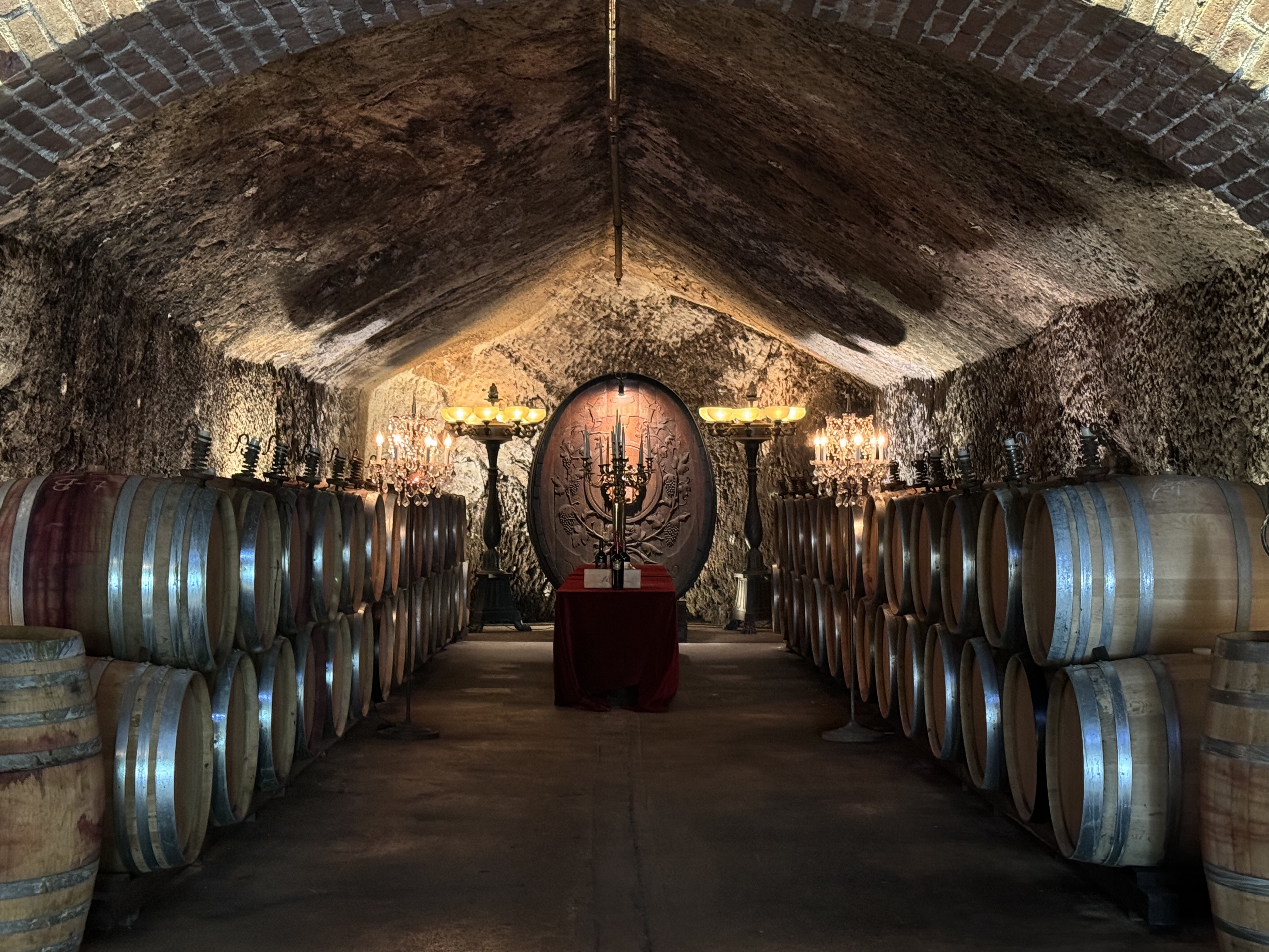
Buena Vista's original wine press house still stands at the center of the property, a stone structure that now serves as the visitor center. Walk inside and you descend into the original champagne cellar, where Haraszthy once aged his sparkling wines in the cool darkness of the hillside caves. These are not recreations. The cave walls bear the tool marks of the workers who carved them in the 1850s, and the air carries the mineral dampness of more than a century and a half of aging. The property holds designations as a National Register of Historic Places site, a California Historical Landmark, and a Sonoma County Historic Landmark. A reconstruction of Haraszthy's Palladian Villa stands on nearby Castle Road, commissioned by Antonia Bartholomew in 1988 to recall the original building that once overlooked the vineyards. It gazes down at the same rows that Haraszthy planted, though the vines themselves have been replaced many times over.
The Second-Oldest Question
Buena Vista holds the distinction of being the second-oldest winery in California, established in 1857, one year after D'Agostini Winery in Amador County. The ranking is a matter of some local pride and occasional debate, but the raw chronology is clear enough. What distinguishes Buena Vista from its slightly older rival is continuity of place: the winery still operates on its original grounds, and its production today reaches approximately 100,000 cases per year. The range spans cabernet sauvignon, syrah, pinot noir, merlot, sauvignon blanc, zinfandel, and chardonnay, alongside historical varietals bottled under the Vinicultural Society label. The French wine company Boisset led a reconstruction effort that reopened the original caves to visitors, completing a circle that Haraszthy began when he first drove a pick into the Sonoma hillside. He would likely appreciate the irony: a Frenchman finishing what a Hungarian started, on land that the Spanish missionaries first cultivated.
From the Air
Located at 38.30N, 122.42W, just east of the town of Sonoma in the heart of Sonoma Valley wine country. The winery grounds and vineyards are visible from low altitude, nestled against hillsides east of town. Nearby airports include Sonoma Skypark (0Q9) approximately 3nm northwest and Napa County Airport (KAPC) approximately 15nm northeast. Best viewed at 1,500-2,500 feet AGL. The surrounding valley vineyards provide clear visual references.