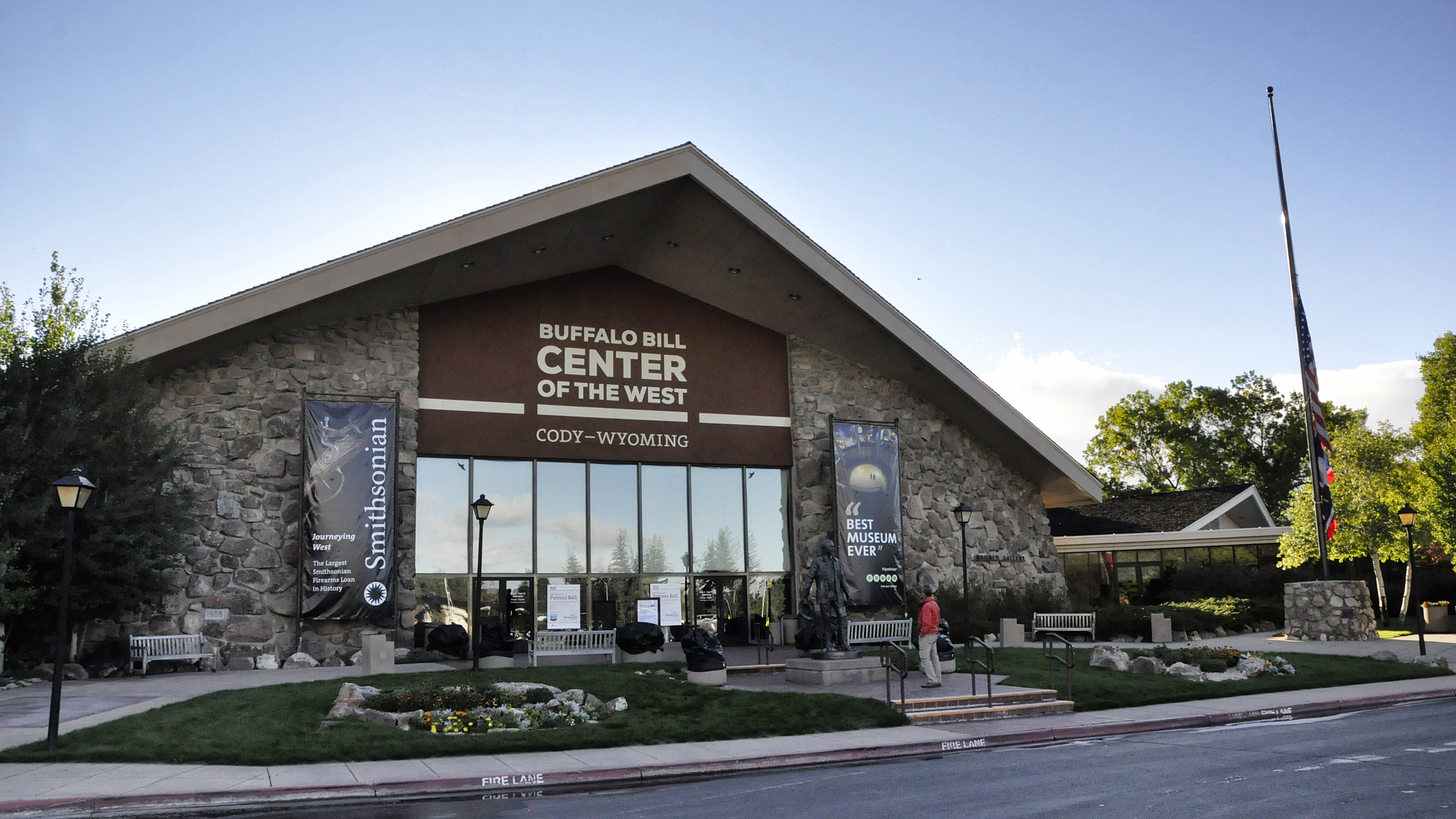
Buffalo Bill Center of the West
When William F. Cody died in 1917, his admirers faced a question: how do you preserve the legacy of a man who had already spent decades turning himself into a living legend? Their answer was the Buffalo Bill Memorial Association, a modest beginning that would grow into the largest museum complex of the American West. Today the Buffalo Bill Center of the West sprawls across seven acres in Cody, Wyoming, the town Cody himself founded near the gateway to Yellowstone. Five interconnected museums and a research library hold more than 50,000 artifacts, everything from Lakota star quilts to the complete factory collection of the Winchester Repeating Arms Company. Since 2008, it has held Smithsonian Affiliate status, the first museum in Wyoming so recognized.
The Showman's Town
Buffalo Bill Cody did not just lend his name to this place. He founded the town of Cody in 1896, envisioning it as a gateway to Yellowstone National Park. The museum that now bears his name began simply enough, established in the year of his death to honor the man whose Wild West show had introduced millions of Europeans and Americans to a romanticized vision of frontier life. The Buffalo Bill Museum, redesigned in 2012, tells his story through Western ephemera and historic objects. Here you find the artifacts of a man who was simultaneously a real frontier scout, a Medal of Honor recipient, and the creator of his own mythology through spectacular theatrical productions that toured the world.
Canvas and Bronze
The Whitney Western Art Museum opened its gallery in 1959 and features paintings and sculptures that defined how the world imagined the American West. Visitors can step into replicas of the studios where Frederic Remington and Alexander Phimister Proctor worked, examining the spaces where bronze cowboys and galloping horses took shape. The collection reads like a roll call of Western art masters: George Catlin documenting Native peoples in the 1830s, Thomas Moran capturing the landscapes that helped establish Yellowstone as a national park, Albert Bierstadt rendering the dramatic light of the frontier. The works of N. C. Wyeth, Joseph Henry Sharp, and Edgar Samuel Paxson share walls with contemporary artists like James Bama and sculptor Grant Speed.
Seven Thousand Firearms
The Cody Firearms Museum was completely redesigned in 2019 and contains the most comprehensive firearms collection in the United States. The story begins with 16th-century hand cannons and continues through guns of modern manufacture, with 7,000 individual firearms, 4,200 on display, and approximately 20,000 related artifacts. The heart of the collection arrived in 1976 when the entire Winchester Repeating Arms Company factory collection made the journey from New Haven, Connecticut to Wyoming. The museum explores firearms as tools that shaped human endeavors, from hunting to warfare to sport, contextualizing each weapon within the broader narrative of technological and social change.
Living Cultures
The Plains Indians Museum holds artifacts primarily from the early reservation period, spanning 1880 to 1930, with pieces from Northern Plains tribes including the Arapaho, Lakota, Crow, Cheyenne, Blackfeet, and Pawnee. But this is no static collection frozen in the past. The holdings include important contemporary objects ranging from abstract art to star quilts, and each June the Robbie Powwow Garden hosts an annual powwow that draws dancers, artisans, and visitors from across North America. The Draper Natural History Museum complements the human story with the natural one, featuring interactive exhibits on geology, wildlife, and human presence in the Greater Yellowstone region, complete with specimens of grizzlies, wolves, and bighorn sheep.
A Million Images
The McCracken Research Library, named for Harold McCracken, the writer and artist who helped develop the center, houses 36,000 books, more than 600 manuscript collections, and over a million photographic images. The collections support research on Buffalo Bill himself, the Wild West shows, Plains peoples' history, cattle and dude ranching, fishing and hunting industries, the oil industry, Yellowstone National Park, and the Winchester Repeating Arms Company. Scholars come here to trace the threads that connect entertainment to history, mythology to reality, and the imagined West to the one that actually existed on these high plains and mountain passes.
From the Air
The Buffalo Bill Center of the West is located at 44.525N, 109.073W in Cody, Wyoming. The museum complex is visible on the western edge of town, identifiable by its large building footprint and parking areas. Cody sits in the Bighorn Basin approximately 52 nm east of Yellowstone National Park's East Entrance. Yellowstone Regional Airport (KCOD) is located just 2 nm southeast of town. The town sits at approximately 5,000 feet elevation with the Absaroka Range rising dramatically to the west.