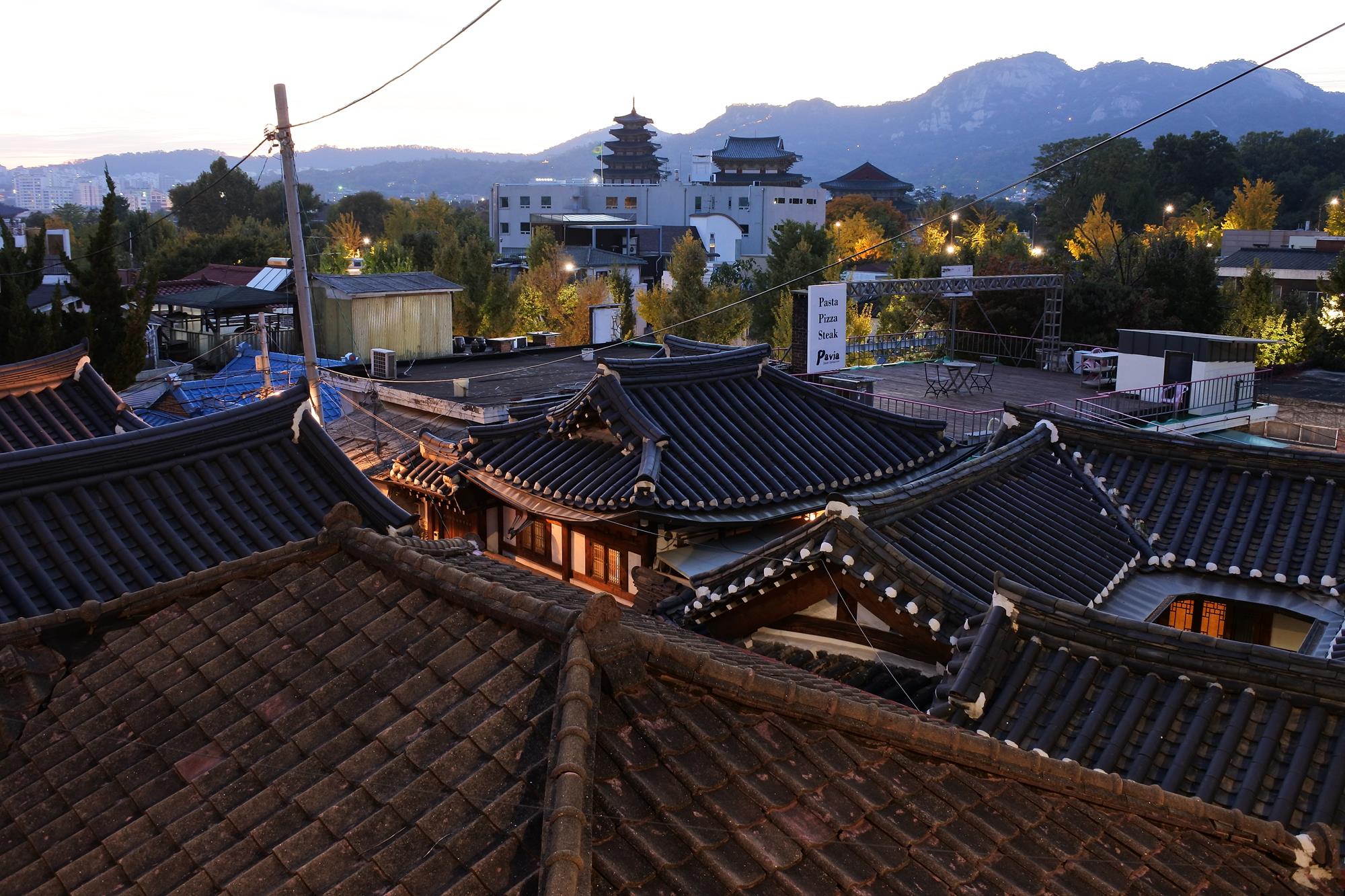
Bukchon Hanok Village
Six million visitors descended on Bukchon Hanok Village in 2024. Roughly six thousand people actually live there. That ratio -- a thousand tourists for every resident -- captures the impossible tension at the heart of this Seoul neighborhood, a place where traditional Korean houses line narrow alleys that were never designed for selfie sticks and tour groups, but where the beauty of those very houses is what draws the world in.
The North Village
Bukchon means "north village," named for its position north of the Cheonggyecheon stream and the avenue Jongno. The neighborhood sits in a remarkable sliver of geography, cradled between Gyeongbokgung Palace to the west and Changdeokgung Palace to the east. This was not accidental. For centuries, the area served as the residential quarter of high-ranking government officials and Joseon-era nobility. A family register from 1906 recorded that nearly 44 percent of Bukchon's population were aristocrats or senior officials. The village's five constituent neighborhoods -- Wonseo-dong, Jae-dong, Gye-dong, Gahoe-dong, and Insa-dong -- each developed their own character, from artisan workshops pressing gold leaf onto silk to quiet courtyard homes where yangban scholars composed poetry.
A Developer's Act of Defiance
The hanok that visitors see today are largely products of the early twentieth century, and their survival is no accident. During the Japanese colonial period, Seoul's population surged and a housing crisis emerged. By the 1920s, Japanese settlers were steadily acquiring land in Bukchon and displacing Korean residents. A Korean entrepreneur named Chong Segwon responded by establishing Konyangsa, the first Korean-owned modern real estate company, around 1920. According to his descendants, Chong deliberately focused on redeveloping the Bukchon area to prevent it from falling entirely into Japanese hands. His daughter recalled that he insisted on building traditional hanok rather than Japanese-style structures, defying pressure from the colonial government. The result was a neighborhood of compact, updated hanok fitted with modern amenities like running water and electricity, but built in a distinctly Korean vernacular that became its own quiet form of resistance.
Preservation and Its Discontents
During Seoul's rapid postwar redevelopment, when much of the city was razed and rebuilt in concrete and glass, Bukchon's low-slung rooflines survived through a combination of preservation regulations and community advocacy. Building heights were strictly limited -- one story for single-family homes, two for multi-family, three for commercial. The restraint paid off aesthetically but created a different problem. As domestic and international tourism boomed in the late 2000s, the photogenic alleys became overwhelmed. Between October 2016 and June 2017 alone, an estimated 37,100 visitors arrived on weekdays and 54,200 on weekends. From 2018 to 2023, the resident population dropped by 27.6 percent, and complaints from those who remained rose from 56 to 202 annually.
Living With the Gaze of Strangers
Beginning in November 2024, Seoul imposed visiting hours on Bukchon: tourists who are not staying in local guesthouses may only enter between 10 am and 5 pm. Signs ask visitors to keep voices low, travel in groups of fewer than ten, and respect the privacy of each home. These are not abstract guidelines -- they are pleas from people whose front doors have become backdrops for strangers' photographs. The tension is real but so is the affection. Artisan businesses like Kum Bak Yeon, which has been working gold leaf onto clothing for generations, continue to operate in the neighborhood. The homes themselves, with their curved clay tile rooflines and warm wooden floors heated by the ondol underfloor system, remain lived-in architecture rather than museum exhibits. From certain vantage points in the higher alleys, you can see both Gyeongbokgung and Changdeokgung framing the village on either side -- a geography that has defined this neighborhood's identity for six centuries. Bukchon's challenge is that its authenticity is precisely what threatens it. The question Seoul has not yet answered is how to share a living neighborhood with the world without loving it to death.
From the Air
Located at 37.583N, 126.984E in the Jongno District of central Seoul, between Gyeongbokgung and Changdeokgung palaces. Best viewed at 2,000-3,000 ft AGL. The traditional rooftops are distinguishable from surrounding modern buildings. Nearby airport: Gimpo International (RKSS), approximately 12 nm west.