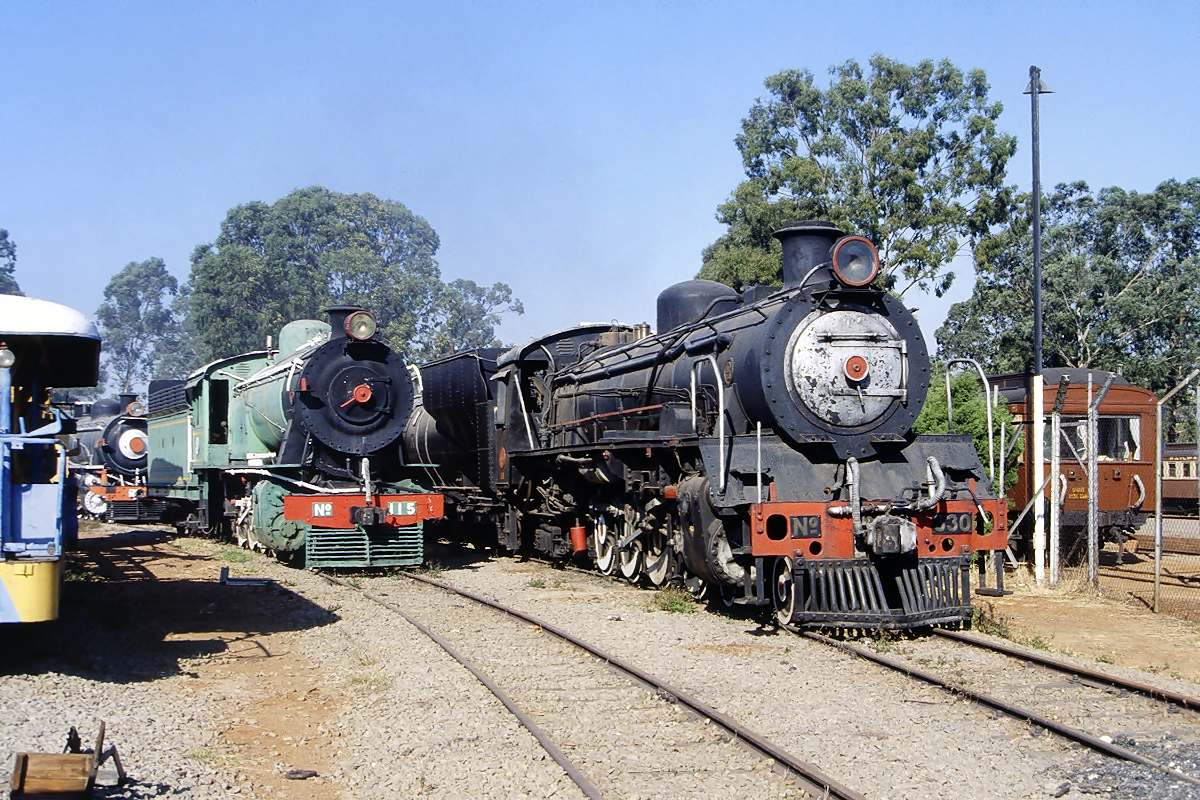
Bulawayo Railway Museum
Cecil Rhodes' private railway coach still sits in the Main Hall, its teak paneling and brass fittings preserved alongside a chronicle of Rhodes' death and the furniture he used on his final journeys. It is the kind of artifact that makes the Bulawayo Railway Museum feel less like a collection of old machines and more like a time capsule of southern African ambition -- the belief, shared by empire builders and independence movements alike, that whoever controlled the rails controlled the future.
Iron Horses of a Vanished Country
Established in 1972 by Rhodesia Railways, the museum's oldest exhibits date to 1897, when the rail line first reached Bulawayo. The steam locomotive collection reads like a genealogy of industrial ambition: a Lawley built by Falcon, small-class engines named 'Rhodesia' and 'Jack Tar,' and a parade of increasingly powerful Garratt articulated locomotives -- Classes 14, 16, 20, and 20A -- that once hauled freight and passengers across a country that no longer exists under the name it bore when they were built. The Garratts are the stars. These double-boilered giants, designed for tight curves and steep grades on narrow-gauge track, were the workhorses of central and southern Africa's rail networks. Beside them stand diesel-electrics from English Electric, Brush, and the Austrian firm SGP, tracing the transition from steam to diesel that reshaped railway operations across the continent.
A Station Rebuilt, A Workshop Remembered
The museum occupies two key structures. The first, greeting visitors at the entrance, is the Shamva Station -- a typical Rhodesian Railways station building dismantled from the town of Shamva and reconstructed here brick by brick. Its ticketing office preserves the notice boards, rain gauge, and fire extinguishers that every station was expected to maintain. It is a portrait of bureaucratic order applied to the African bush. The Main Hall behind it was once the mechanical workshop of Bulawayo station itself, and still contains much of the heavy equipment used there. A wall of fame lists the Chief Mechanical Engineers from the founding of Rhodesia Railways through 2013, linking the colonial and post-independence eras in an unbroken chain of engineering succession. The hall houses the most significant exhibits, including Rhodes' coach and a collection of railway art, photographs, ticketing machines, and destination boards.
Coaches, Cranes, and Curiosities
Beyond the locomotives, the collection sprawls. Dining Car No. 660, named Chimanimani, stands alongside enginemen's cabooses, a guards' van, and a chaplain's service coach. An eye surgery coach -- number 1823 -- hints at the railway's role as a mobile social service in remote areas. First- and second-class balcony coaches preserve the era's class distinctions in varnished wood and riveted steel. The goods wagons tell a more utilitarian story: short wooden livestock wagons, explosives wagons marked EOZ, and aluminium freight cars. Two railway cranes by Booth Bros and Ransomes & Rapier round out the heavy equipment. Photographs on the walls capture the day the Queen of the United Kingdom visited Rhodesia and the legendary 'white train' that carried dignitaries across the territory.
Running on Memory
The Bulawayo Railway Museum is owned by the National Railways of Zimbabwe, and that fact carries its own story. NRZ has faced chronic rolling stock shortages since the economic crises of the 2000s, and some of the museum's steam locomotives have been pulled from display, refurbished, and returned to active service -- heritage pressed back into duty because the present cannot supply what the past preserved. The museum is managed by Gordon Murray, a retired NRZ employee, and sustained in part by a Friends of the Museum group. It is a modest operation in a country where institutional memory often struggles against economic reality. But the locomotives still stand, the coach still holds Rhodes' furniture, and the Shamva Station ticket office still looks ready to sell a fare to anywhere the line once ran.
From the Air
Located at 20.164S, 28.574E, at Bulawayo railway station in central Bulawayo, Zimbabwe. The station and rail yards are visible from moderate altitude as a concentration of parallel tracks on the city's eastern side. Nearest major airport is Joshua Mqabuko Nkomo International Airport (FVBU). The railway line extends southeast toward Esigodini and northwest toward Hwange and Victoria Falls.