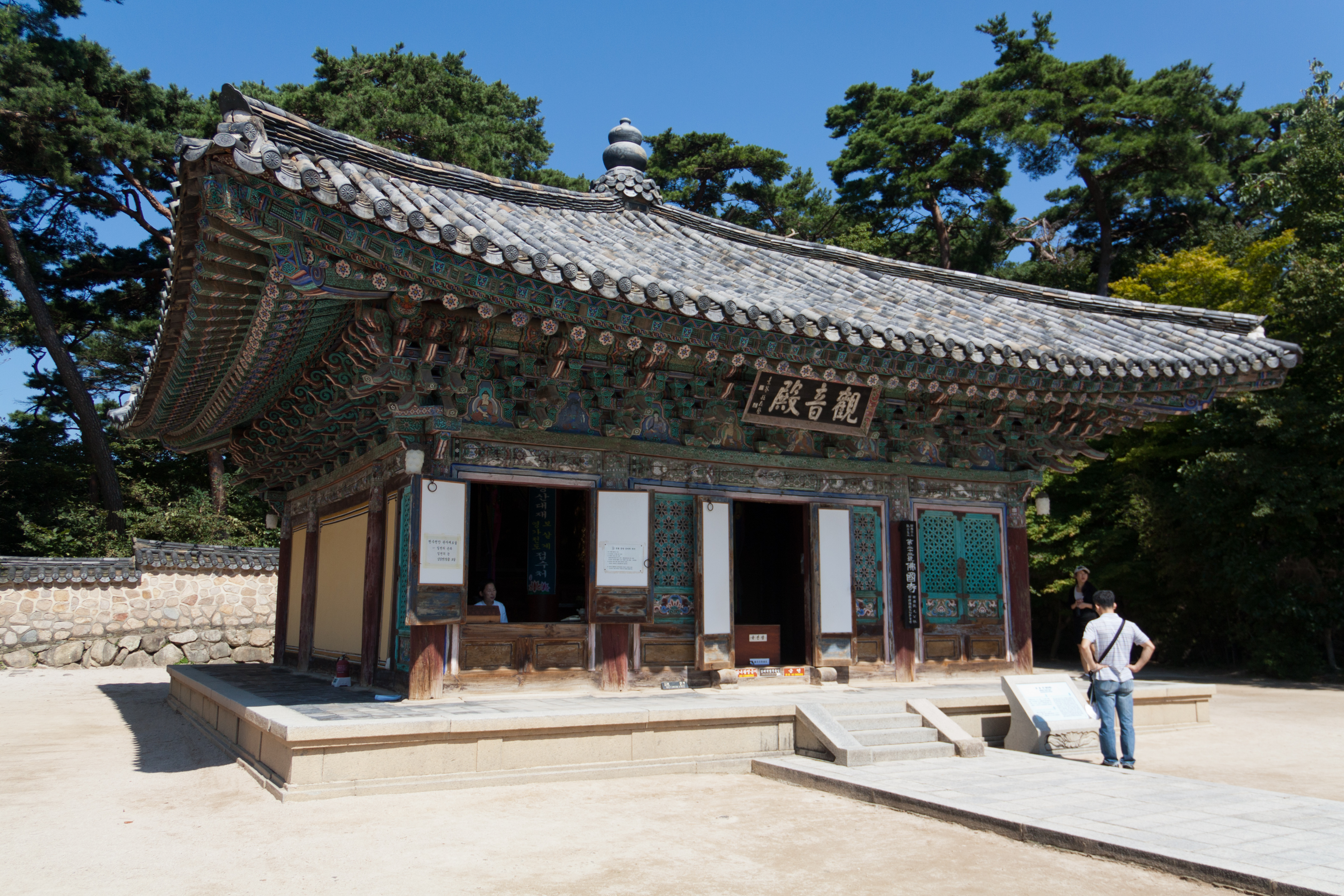
Bulguksa
Two stone pagodas stand side by side in front of Bulguksa's main hall, and they could not look more different. Seokgatap is austere -- three stories of clean lines and minimal ornament, the embodiment of restrained Korean style. Dabotap, right beside it, is elaborately carved, almost baroque in its complexity, its image reproduced on the South Korean 10-won coin. Together they represent the twin poles of Buddhist philosophy: the simple and the ornate, the earthly and the heavenly. They have stood this way for over thirteen centuries, which is longer than most civilizations last.
From a Minister's Devotion
The temple's records trace its origins to 528 AD, when a small temple was built on this site under King Beopheung. But the Bulguksa that visitors encounter today began taking shape in 751, when the Silla kingdom's chief minister, Kim Daeseong, ordered its construction to pacify the spirits of his parents. Kim did not live to see it finished. After his death, the royal court completed the work in 774 and gave it the name Bulguksa: Temple of the Buddha Land. The Samguk Yusa, Korea's chronicle of ancient kingdoms, records these details with the matter-of-fact tone of a civilization documenting its own spiritual architecture. Bulguksa was not simply a place of worship; it was a statement that the Silla kingdom could build something worthy of the Buddha Land itself.
Bridges to Enlightenment
The entrance to Bulguksa is not a door but a staircase. The Cheongungyo, or Blue Cloud Bridge, and Baegungyo, or White Cloud Bridge, together form a 33-step ascent to the Jahamun, the Mauve Mist Gate. The number is deliberate: 33 steps correspond to the 33 stages of enlightenment in Buddhist teaching. Beneath the staircase, a stone arch testifies to Silla-era engineering -- a construction technique that appears nowhere else in Korea from this period with such refinement. This bridge-staircase combination is National Treasure No. 23, designated in 1962. A second pair of bridges on the western side -- the Lotus Flower Bridge and the Seven Treasures Bridge -- once bore delicate carvings of lotus flowers on each step, though centuries of pilgrims' feet have worn them smooth. Today, visitors are no longer permitted to walk on these bridges. The pilgrims' devotion, preserved in the erosion of stone, was the last offering the bridges could accept.
Six National Treasures Under One Roof
Bulguksa contains six objects designated as National Treasures of South Korea. The twin pagodas -- Seokgatap (No. 21) at 8.2 meters and Dabotap (No. 20) at 10.4 meters -- anchor the main courtyard. Inside the halls sit two gilt-bronze Buddha statues from the ninth century: a seated Vairocana Buddha (No. 26) in the Birojeon hall and a seated Amitabha Buddha (No. 27) in the Geuknakjeon. In 1966, during restoration work, workers discovered inside Seokgatap a version of the Dharani sutra printed on mulberry paper -- one of the oldest surviving woodblock prints in the world, dated between 704 and 751 AD. The print predates Gutenberg by seven centuries and sits as quiet evidence that Korea's printing tradition runs deeper than most of the world suspects.
Burned and Reborn
The famous stone structures at Bulguksa survived the centuries, but the wooden buildings did not. During the Imjin Wars of 1592, Japanese forces burned every wooden structure to the ground. Reconstruction began in 1604 and continued through roughly 40 renovations until 1805. After World War II and the Korean War left the temple diminished again, a partial restoration in 1966 led to a comprehensive rebuilding ordered by President Park Chung Hee between 1969 and 1973, which brought Bulguksa to its current form. The stone pagodas, bridges, and foundations that visitors see today are original Silla construction -- survivors that outlasted invasions, occupations, and civil wars. Everything wooden is newer, rebuilt on the footprints left by what came before.
The Buddha Land on Tohamsan
Bulguksa sits on the forested slopes of Mount Tohamsan in Gyeongju, the ancient capital of the Silla kingdom. In 1995, UNESCO added Bulguksa and the nearby Seokguram Grotto to the World Heritage List, recognizing the temple as a masterpiece of the golden age of Buddhist art in Korea. The South Korean government had already designated it Historic and Scenic Site No. 1 -- not second or third, but first. The temple complex manifests three realms of Buddhist cosmology: the terrestrial, embodied by the Shakyamuni Buddha and the Lotus Sutra in Daeungjeon; and the celestial, embodied by the Amitabha Buddha and the Avatamsaka Sutra in Geungnakjeon. Pilgrims and tourists climb the same mountain, pass through the same gates, and stand before the same stone pagodas that have anchored this site since the eighth century. The Buddha Land, Bulguksa suggests, is not somewhere else. It is here.
From the Air
Coordinates: 35.79°N, 129.33°E on the slopes of Mount Tohamsan near Gyeongju. The temple complex is nested in forested terrain east of the Gyeongju basin. Nearest airport: RKTN (Daegu International Airport, ~80 km northwest) or RKPU (Ulsan Airport, ~50 km south). The Seokguram Grotto is located higher on the same mountain to the east. Best viewed at 3,000-5,000 ft; the temple rooflines and cleared courtyard are distinguishable against the surrounding forest canopy.