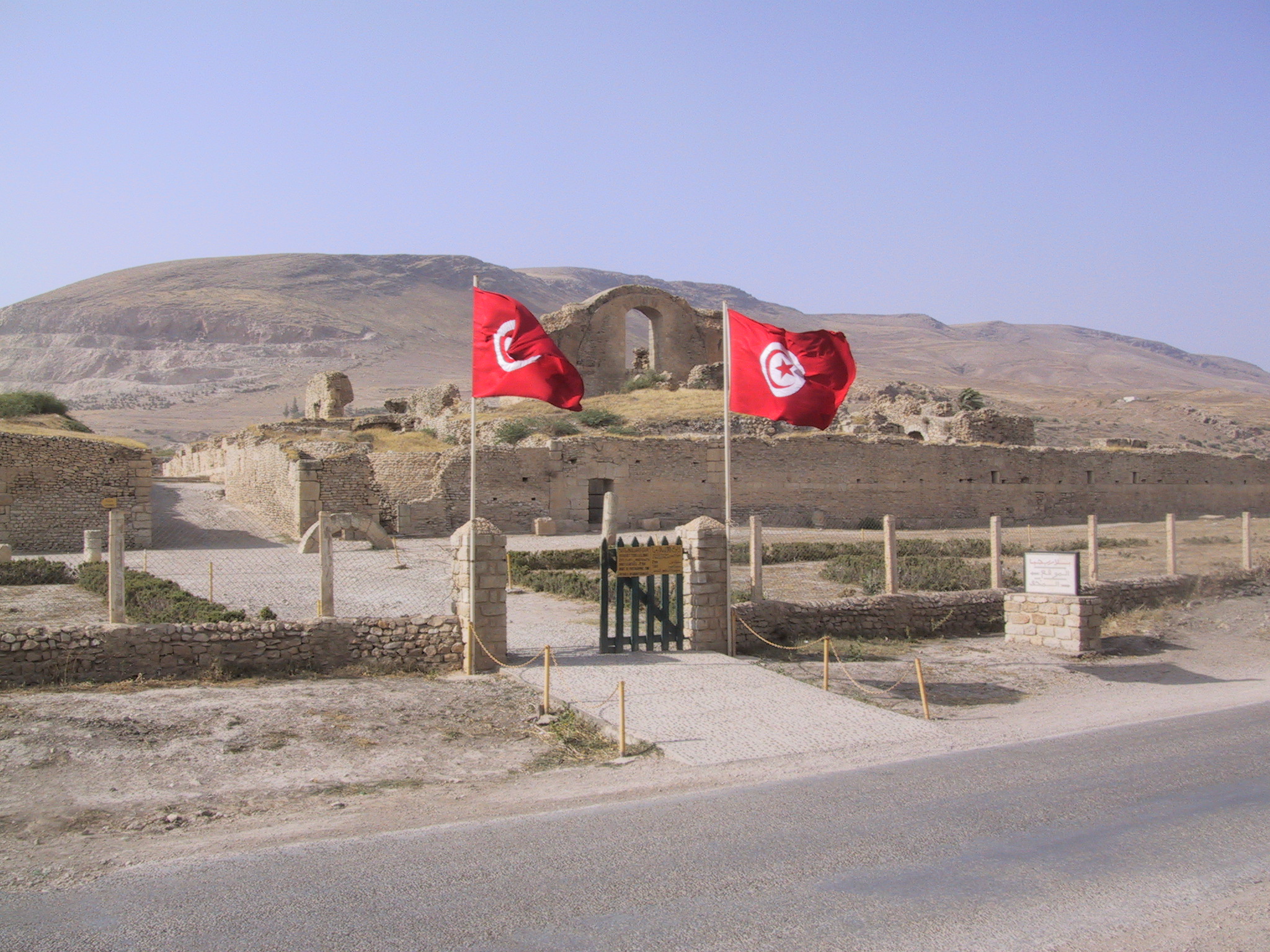
Bulla Regia
Water sprinkled on mosaic floors evaporated in the darkness and cooled the rooms below. Two thousand years ago, the residents of Bulla Regia in northern Tunisia devised what might be the ancient world's most elegant answer to brutal summers: they built their homes underground. Each house had a conventional ground floor open to winter sunlight, but beneath it lay a subterranean level arranged around a two-story atrium, where the heat of the North African sun could not reach. The mosaics they laid in those underground rooms are among the finest ever produced in Roman Africa.
Temple of Baal, Capital of Kings
The name Bulla Regia means "Royal Bulla" in Latin, referring to its status as a Numidian capital. But the city's roots reach deeper. Its Punic currency renders the name as characters suggesting "House of Baal" or "Temple of Baal," connecting it to the Phoenician trading networks that crisscrossed North Africa. A Berber settlement likely predated the Punic one -- imported Greek ceramics from the 4th century BC have been found. Carthage gained control in the 3rd century BC, and inscriptions from that era record worship of Baal Hammon and Punic-style urn burials. After Scipio Africanus's victory in 203 BC during the Second Punic War, the Numidian king Masinissa made Bulla his capital in 156 BC. One of his sons maintained a palace in the city, and a Hellenistic grid street plan was imposed over the earlier irregular layout.
Underground Architecture of Survival
The subterranean houses that make Bulla Regia unique were a Hadrianic-era innovation, dating to the 2nd century AD when Emperor Hadrian elevated the city to colony status. Open-bottomed terracotta bottle-shapes were built into the vaulting to reduce weight. The underground levels featured elaborate polychrome mosaics -- many still in their original positions, allowing modern visitors to see them in their intended architectural context. The mosaic of a haloed Amphitrite in the House of Amphitrite is the site's most famous image, its subtle colors and three-dimensional shading unsurpassed by any floor mosaic in North Africa. The Roman drainage system has been restored to prevent the underground rooms from flooding, a problem the original builders also had to manage.
The Slave Collar in Apollo's Temple
Not everything preserved at Bulla Regia speaks to beauty. In the courtyard of the Temple of Apollo, archaeologists found the remains of a woman wearing a lead slave collar. The tag instructed anyone who found her to detain her, stating that she had fled from Bulla Regia. It included the words "Adultera meretrix" -- a term scholars debate as either a degrading slave name or an insulting descriptor. The collar is a stark reminder that the civilization capable of producing exquisite mosaics and sophisticated underground architecture was also one built on the forced labor of enslaved people. Scholar Jennifer Trimble has studied the collar as an artifact of the systems of control that undergirded Roman daily life, even in provincial cities far from Rome.
Buried, Forgotten, Rediscovered
Under Byzantine rule, Bulla Regia's wealthy families expanded their houses at the expense of public space -- the House of the Fisherman consumed two separate city blocks, turning a thoroughfare into a dead end. Then an earthquake collapsed the ground-level stories into the subterranean floors, and drifting sand buried everything. The city was forgotten until excavations began in 1906. The forum was unearthed between 1949 and 1952, revealing a public basilica with an apse at each end and a cruciform baptismal font inserted in its nave when it was converted to a cathedral. The amphitheater, which Augustine of Hippo once condemned in a sermon, emerged with its edges and steps remarkably crisp in 1960-61 -- preserved by the centuries of sand that had buried it. Today, visitors can descend into the underground houses and walk across mosaics that the Romans themselves walked across, an experience available almost nowhere else in the ancient world.
From the Air
Located at 36.56°N, 8.76°E near present-day Jendouba in northern Tunisia. The archaeological site is visible from altitude as an irregular pattern of excavated ruins in the agricultural landscape. Recommended viewing altitude: 3,000-5,000 feet AGL. Nearest airport: Tabarka-Ain Draham International (DTKA) approximately 80 km northwest. The terrain is rolling farmland in the Medjerda River valley.