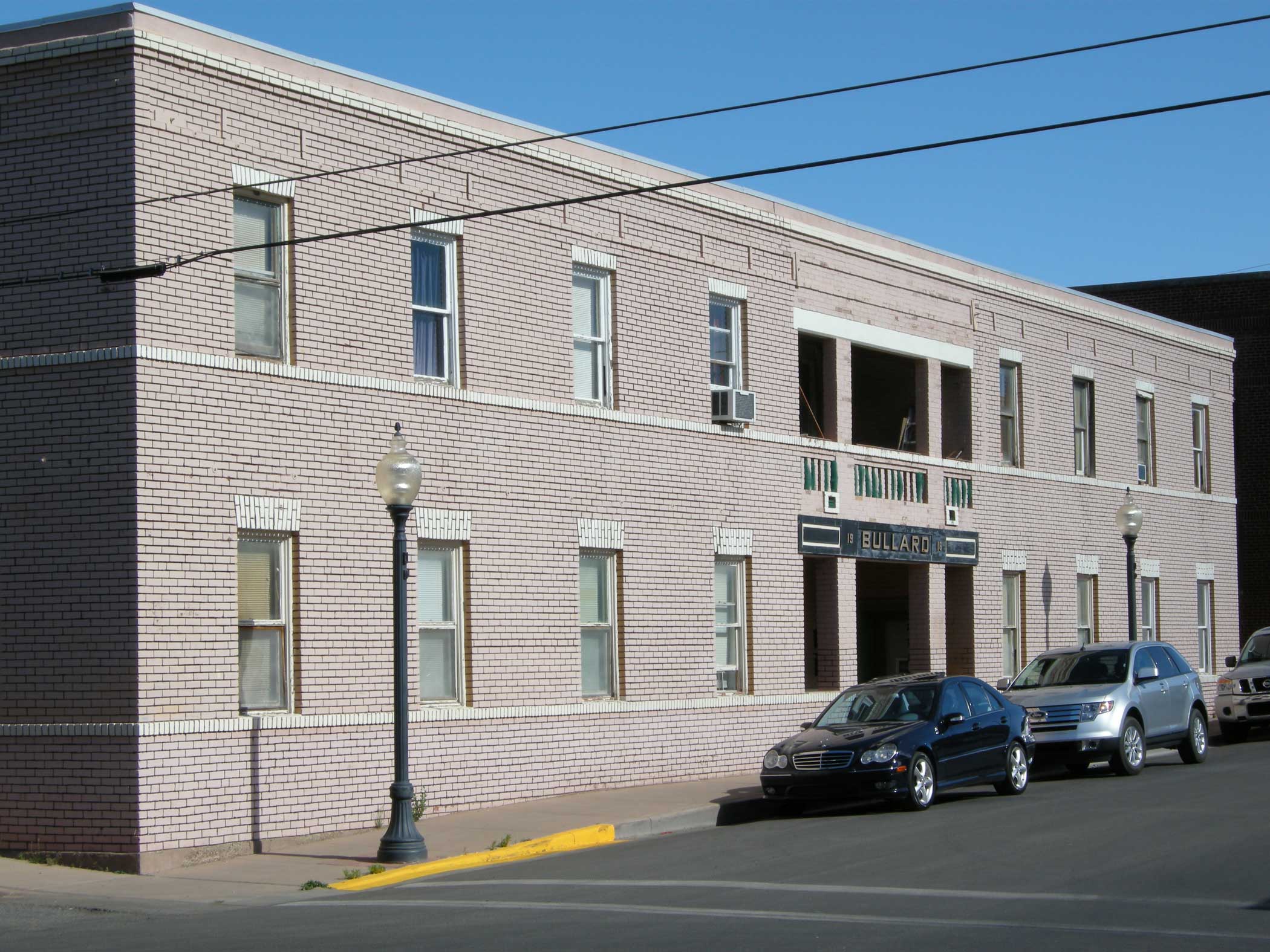
Bullard Hotel
Three of Silver City's grand hotels were destroyed by floods. The Broadway lost pieces to the first heavy flooding in 1895. The Tremont House vanished in 1899. The Timmer House fell in 1904. When the Bullard Hotel opened its doors in March 1916, it arrived as the last standing monument to a town that kept betting on growth even as flash floods carved away its Main Street. Today, it remains the only surviving hotel from Silver City's final economic boom, a brick testament to optimism that World War I would soon render obsolete.
Steam Heat and Running Water
Mr. and Mrs. Thomas W. Ward, successful grocery merchants from Illinois, announced the Bullard Hotel as Silver City's most modern accommodation. Every room featured steam heat and hot and cold running water, luxuries that marked the hotel as forward-thinking in 1916. Mrs. Ward herself managed the establishment, which would continue operating as a hotel for the next fifty years. The Wards contracted Hugh S. Gilbert, Silver City's most prolific builder, for construction. Gilbert had arrived in 1905 and would spend the next half-century shaping the town's architectural landscape. Later that same year, 1916, he built Fleming Hall on the Western New Mexico University campus from plans by Henry Trost, the renowned El Paso architect. The unique entryway Gilbert constructed for the Bullard Hotel may reflect Trost's influence, though no conclusive evidence survives. Hidden within the new hotel's walls was a ghost: the Palace Hotel, a narrow two-story brick structure built in 1883, was incorporated into the Bullard. Its distinctive older brickwork remains visible to observant visitors.
The Silver City That John Bullard Found
The hotel's namesake, John Bullard, recognized something familiar in the rocky outcroppings near a summer camp called San Vicente Cienega. He had seen similar formations at Ralston, fifty miles southwest, where silver had been discovered. His hunch proved correct. By 1870, hopeful miners were flocking to the Silver Flat Mining District, and the settlement that became Silver City was born. The early miners lived in log cabins and adobe huts until they discovered that local clay was ideal for brick manufacturing. A town ordinance in 1880 prohibited frame construction within city limits, mandating brick and adobe to prevent fires. When the Atchison, Topeka and Santa Fe Railroad reached Silver City in 1883, a building boom began. Grand hotels rose to accommodate the streams of visitors arriving for district court sessions, mining business, and frontier commerce. But Silver City sat deep in Apache territory. Not until Geronimo's surrender in 1886 could the town fully focus on prosperity rather than survival.
The Healthseekers
Silver City's transformation from mining town to health resort began in the 1890s when doctors discovered what tuberculosis patients already suspected: the high altitude and dry climate proved curative. St. Joseph's Sanatorium opened in 1902, a substantial brick building that signaled the seriousness of this new industry. Healthseekers arrived by train, some searching for temporary quarters while seeking long-term lodging, others building substantial homes when they decided to stay permanently. Between 1900 and 1907, healthseekers doubled the town's population. The New Mexico Normal School, forerunner of Western New Mexico University, had been established in 1896, adding education to the economic mix of mining and medicine. Silver City bustled with travelers seeking silver, health, and learning, all requiring places to sleep. The transportation and lodging industries hummed with activity, and developers saw no end to the growth.
The Floods That Reshaped Downtown
Main Street once ran through the heart of Silver City along the San Vicente Arroyo. Then came the floods. The first heavy flooding in 1895 carried away pieces of the Broadway Hotel. Four years later, the Tremont House was destroyed entirely. Flash floods returned in 1902 and continued every year for the next four years, each one claiming more of Silver City's oldest business buildings. The Timmer House fell in 1904. By the time the waters receded, downtown Silver City had been fundamentally transformed. Main Street itself was gone, replaced by a drainage channel that remains today. Of the grand hotels from the late 1800s, only the Palace and the Southern survived. The Palace would be absorbed into the Bullard Hotel in 1916. The Southern stood until the early 1960s before finally being demolished. The new railroad depot, rebuilt at the south end of Bullard Street in 1915, prompted warehouses to spring up nearby. The Bullard Hotel rose at this commercial crossroads, positioned to catch travelers arriving by rail.
Optimism's Last Monument
The Bullard Hotel was built when Silver City believed its best years lay ahead. The town paved streets, installed a storm sewer, and modernized buildings throughout the downtown. Plate glass replaced multiple-lite windows in storefronts. Adobe homes received fashionable new gabled roofs. Even old mansions were remodeled to reflect current styles. The Bullard, with its two stories and approximately thirty rooms, was built on a grand scale befitting those expectations. No one in 1916 could know that the aftermath of World War I would bring a cure for tuberculosis, eliminating the healthseeker industry that had doubled the population. No one could predict that automobiles would eventually replace the railroad that had brought so many visitors to Silver City. The Bullard Hotel was listed on the National Register of Historic Places in 1988, recognized as the sole surviving hotel from Silver City's last economic boom. It stands today at 105 South Bullard Street, an imposing reminder of a moment when a frontier town dared to believe the future would be even brighter than the past.
From the Air
Located at 32.77N, 108.28W in downtown Silver City, New Mexico, the Bullard Hotel sits at the south end of Bullard Street near the former railroad depot area. Silver City lies in the foothills of the Pinos Altos Mountains in southwestern New Mexico. From the air, the town's grid pattern and brick downtown district are visible against the surrounding semi-arid landscape. Grant County Airport (KSVC) is located approximately 10 miles southeast of downtown. Recommended viewing altitude of 2,000-4,000 feet AGL for best appreciation of the historic downtown and its setting against the Gila National Forest to the north.