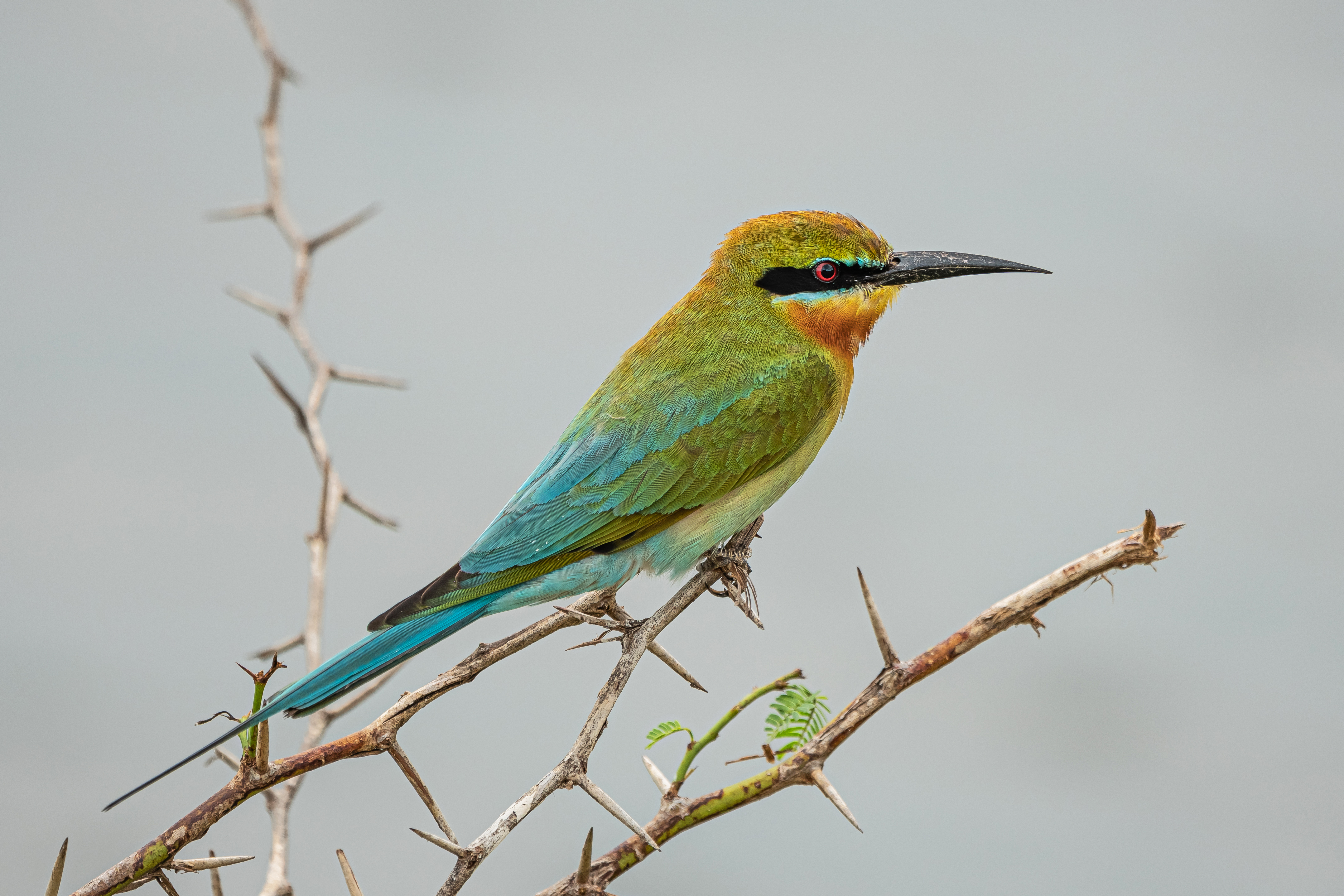
Bundala National Park
Every winter, the lagoons at Bundala turn pink. Greater flamingos arrive in flocks numbering over a thousand, their long legs folding beneath them as they settle onto the shallow waters of Sri Lanka's dry southeast coast. They have flown from the Rann of Kutch in northwestern India, crossing hundreds of kilometers of open ocean to reach these brackish lagoons where brine shrimp concentrate in the evaporating shallows. The flamingos are the headline act, but Bundala's 197 recorded bird species ensure that the spectacle never depends on a single performer.
A Wetland of International Standing
Bundala holds a rare double distinction. In 1991, it became the first wetland in Sri Lanka designated under the Ramsar Convention, the international treaty that protects wetlands of global importance. Fourteen years later, in 2005, UNESCO added Bundala to its Man and the Biosphere Programme, making it the fourth biosphere reserve on the island. These designations reflect what birdwatchers had known for decades: that this relatively small patch of coastal habitat, situated 245 kilometers southeast of Colombo, punches far above its weight in ecological significance. The park encompasses seven terrestrial habitat types and six distinct wetland types, supporting 324 recorded vertebrate species in an area that has shrunk from its original 6,216 hectares to 3,698 hectares after being regazetted in 2004.
Wings Over the Lagoons
The birdlife at Bundala reads like a catalog of South Asian waterbirds. Lesser whistling ducks congregate on open water while garganeys, migratory visitors from Central Asia, dabble in the shallows. Grey herons stand motionless at the lagoon edges. Eurasian spoonbills sweep their flattened bills through the mud in slow arcs, and painted storks wade through the deeper sections with deliberate, stilt-legged precision. Among the rarer sightings, the black-necked stork and the lesser adjutant make occasional appearances, their size and scarcity lending a sense of event to any encounter. The small and medium-sized waders are harder to distinguish individually, but their collective effect transforms the mudflats into a shifting, busy mosaic of movement. Black-headed ibises probe the soft ground while Asian openbills, with their distinctive gap-billed silhouette, search for freshwater snails.
Between Sand and Salt
The park owes much of its resilience to geography. Sand dunes along the coast act as natural barriers, shielding the interior lagoons from storm surges and, during the 2004 Indian Ocean tsunami, limiting the damage that reached Bundala's core wetlands. Behind these dunes, the landscape transitions from coastal scrubland into dry-zone evergreen forest, the type of thorny, drought-adapted woodland that once covered much of southern Sri Lanka. This gradient of habitats, from open beach to dune to lagoon to scrub to forest, packed into a narrow coastal strip, creates the ecological diversity that sustains such a wide range of species. But the boundaries are under pressure. Invasive plants, particularly Prosopis juliflora and the prickly pear Opuntia dillenii, have colonized portions of the park, and conservation teams work to remove them before they displace native vegetation.
Guardianship and Growing Pains
Bundala's history as a protected area stretches back to 1969, when it was first declared a wildlife sanctuary. The upgrade to national park status came on January 4, 1993, bringing stricter protections but also new management challenges. Families living within the park boundaries, sludge discharge from nearby salt production into Bundala lagoon, irrigation water flowing in from agricultural land, and livestock grazing all compete with conservation goals. The proposed solutions are ambitious: resettling residents, re-demarcating boundaries to include the northern scrubland buffer zone, building irrigation structures to control water inflows, and expanding the invasive species eradication program. A turtle conservation project also operates within the park, protecting nesting beaches along the coast. These efforts reflect the central tension of conservation in densely populated landscapes: the wetland that the world recognizes as internationally significant sits within a working agricultural region where livelihoods depend on the same water and land.
From the Air
Bundala National Park sits at 6.21N, 81.23E on the southeastern coast of Sri Lanka in Hambantota District. From altitude, look for the chain of coastal lagoons and salt pans glinting in the sun, bordered by sand dunes to the south and scrubland to the north. The flamingo flocks are visible as pink concentrations on the shallow lagoon surfaces during winter months. Nearest major airport: Mattala Rajapaksa International (VCRI) approximately 15 km northeast. Best viewing altitude: 2,000-3,500 feet AGL for the lagoon and wetland mosaic. The park is 245 km southeast of Colombo (VCBI).