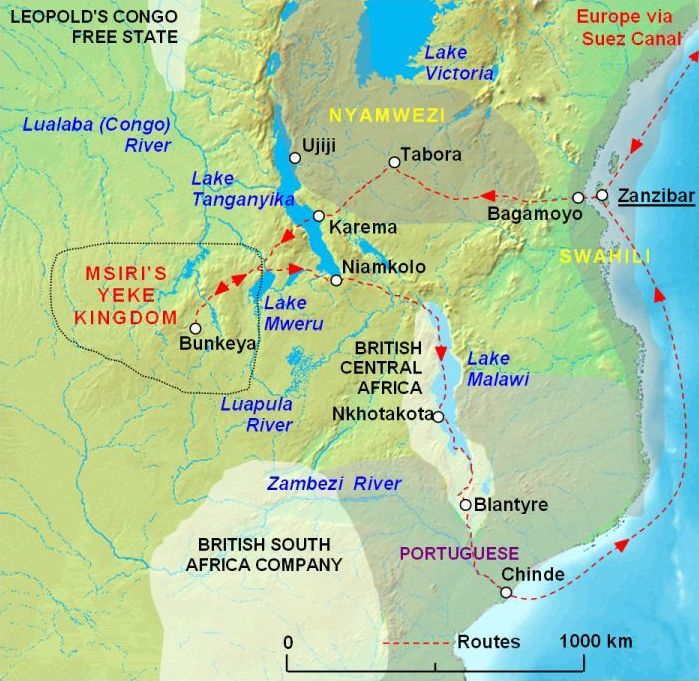
Bunkeya
The German scientist Paul Reichard was the first European to reach Bunkeya, arriving on 20 January 1884. What he found was not a backwater village but the capital of an empire. Msiri, the son of an East African trader, had built a state that stretched from the Luapula River to the Lualaba, from Lake Mweru to the Congo-Zambezi watershed. Traders arrived from the Zambezi and Congo basins, from Angola, Uganda, and Zanzibar. Bunkeya sat at the center of it all -- a crossroads of copper, ivory, salt, and iron ore on a huge plain near the Lufira River in what is now the Lualaba Province of the Democratic Republic of the Congo.
The Trader's Son Who Built an Empire
Msiri's father had made his living buying copper ore in Katanga and transporting it to the east coast of Africa for resale. As a young man, Msiri stayed behind as his father's agent and never left. He became leader of the Bayeke people and, through a combination of trade, diplomacy, and force, assembled a state that controlled a vast central African trading network. The economy ran largely on the slave trade, supplemented by ivory, salt, copper, and iron. Arab traders from the east coast supplied guns and ammunition, which Msiri used to maintain his grip. His compound at Bunkeya was surrounded by a stockade topped with the skulls of his enemies -- a grim advertisement of the cost of resistance. The power was real, but so was the brutality. Msiri's rule had become tyrannical even before the Europeans arrived to challenge it.
Missionaries and Mercenaries
After Reichard came a parade of Europeans, each with a different agenda. Portuguese explorers Capello and Ivens passed through, seeking a trade route between Angola and Mozambique. In February 1886, the Scottish missionary Frederick Stanley Arnot arrived alone, without food or trade goods. Msiri welcomed him but discouraged him from preaching. Other missionaries followed: William Henry Faulknor, a young Canadian from Hamilton, Ontario, arrived in 1887 with the Plymouth Brethren. Dan Crawford came in 1890 and would later witness Msiri's assassination. Msiri used the missionaries as symbols of his influence -- "errand boys," he called them -- while Faulknor quietly taught and converted a small group of formerly enslaved people. Then came the agents of empire. Cecil Rhodes sent Alfred Sharpe to obtain a treaty in 1890. When a missionary read the treaty's full text aloud and Msiri understood what he was being asked to sign away, Sharpe barely escaped with his life.
Three Expeditions and an Assassination
The Berlin Conference of 1884 had awarded the territory to Belgium on paper, but Msiri had never agreed. Alarmed by Rhodes's maneuvering, King Leopold II dispatched three expeditions to Bunkeya. Paul Le Marinel arrived first in April 1891 with 300 men. Msiri received him courteously, sat through seven weeks of persuasion, and refused to submit. Le Marinel left a small garrison and retreated. Alexandre Delcommune came next and fared no better. The third expedition was decisive. William Grant Stairs, a 28-year-old Canadian-born soldier who had served under Henry Morton Stanley, marched 336 porters and askaris from Zanzibar to Bunkeya. When Msiri again refused to accept Leopold's sovereignty, he fled to a nearby village. There, Omer Bodson, a member of Stairs's force, shot and killed him. Resistance ended. Katanga became Belgian.
What Followed the Fall
Msiri's death ended a tyranny but destroyed the stability that tyranny had maintained. Trading caravans stopped coming. Famine and disease swept through the population, and many people abandoned the town. The Belgians recognized Msiri's son Mukanda Bantu as a successor but stripped him of real power, confining his authority to the territory immediately surrounding Bunkeya. Then they forced Mukanda Bantu and his followers to relocate to Lukafu, where they remained for eighteen years before being allowed to return. The Belgians, meanwhile, began exploiting the region's enormous mineral wealth -- the copper and uranium that would make Katanga one of the most strategically valuable territories in Africa. Bunkeya itself settled into a quieter existence. Conditions improved slowly; piped potable water arrived under the leadership of Musamfya Ntanga between 1940 and 1956. After 1976 the population grew rapidly, sustained by productive agriculture yielding maize, cassava, sweet potatoes, and peanuts. Today Bunkeya has a hospital and a tuberculosis clinic, though the water supply remains insufficient and healthcare is limited.
From the Air
Located at 10.40S, 26.97E on a broad plain near the Lufira River in Lualaba Province, DRC. The settlement is visible from altitude as a cluster on the plain with the river system to the east. No major airport nearby; the closest significant airfield is at Likasi to the southeast (FZQG) or Kolwezi to the northwest (FZQM). Recommended viewing altitude: 10,000-15,000 ft to appreciate the plain and river setting. Clear-weather visibility is good in the dry season (May-October).