Bunny Man
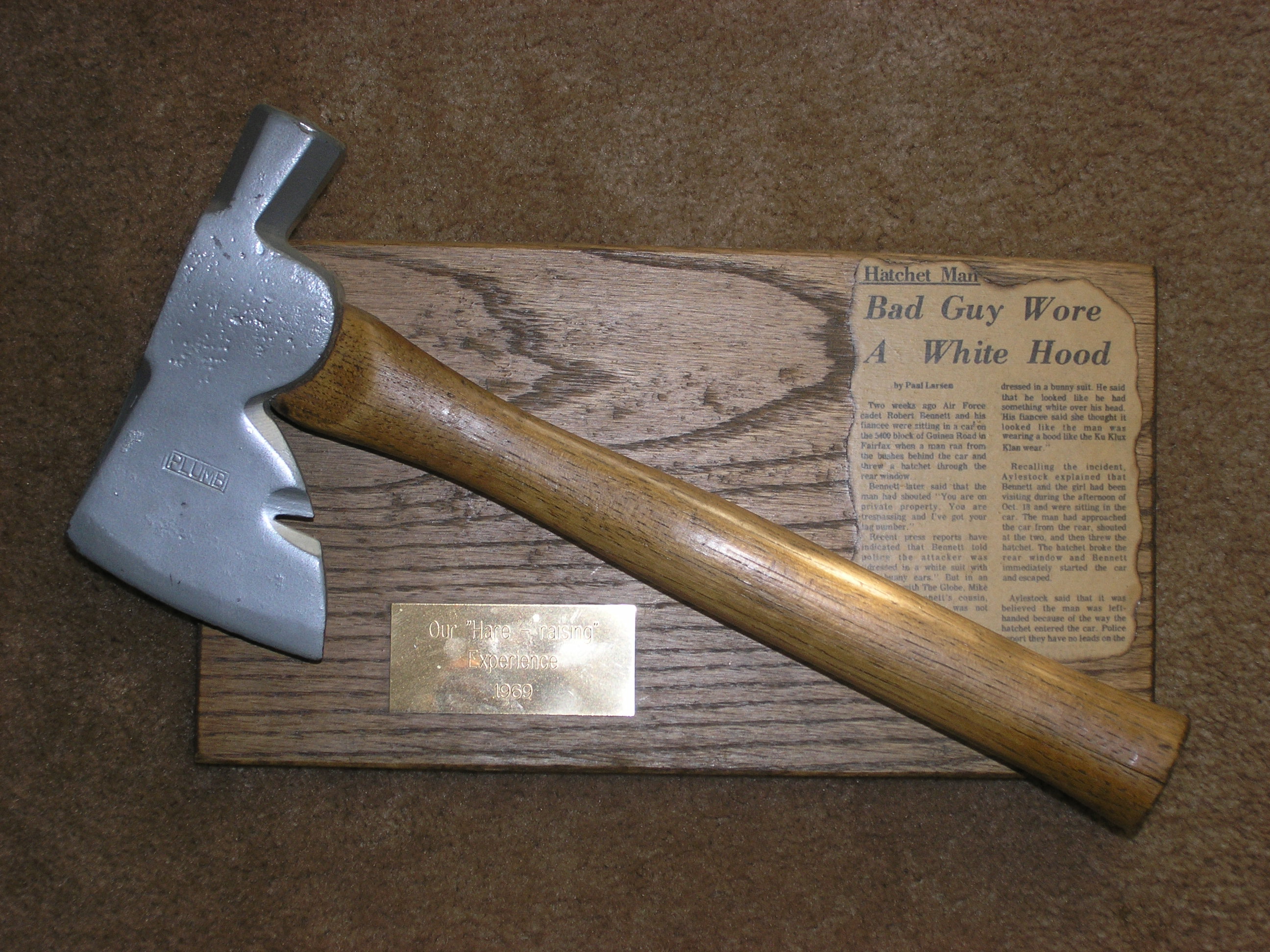
On the evening of October 19, 1970, Air Force Academy Cadet Robert Bennett and his fiancee sat in their parked car on Guinea Road in Burke, Virginia, engine running, when something moved outside the rear window. A figure burst from the bushes dressed in a white suit with long bunny ears, screaming about trespassing and license plate numbers. Then the hatchet came through the passenger-side window. Bennett and his fiancee fled uninjured, the hatchet still on the floorboard. When police asked for a description, Bennett was adamant: the attacker wore a bunny suit. His fiancee disagreed about the ears but agreed about the white costume. The investigation went nowhere. And an urban legend was born.
Two Incidents, Ten Days Apart
Fairfax County Public Library historian-archivist Brian A. Conley spent years tracking down the real Bunny Man. He found exactly two verified incidents, both filed as vandalism reports in October 1970 in Burke, Virginia. The first was Bennett's hatchet encounter on the 19th. The second came on October 31, Halloween night, when the figure reappeared. Police obtained and examined the hatchet from the first incident but turned up no leads. They returned the weapon to Bennett and eventually closed the case. That was it: two police reports, one hatchet, no arrests, no identification. From those bare facts, northern Virginia generated one of the most persistent and elaborate urban legends in American folklore.
The Legend Grows Teeth
The real story was strange enough, but it was far too simple for the legend it became. Through decades of retelling, the Bunny Man acquired a name, a backstory, a body count, and a haunted bridge. Versions multiply: in some, he is an escaped psychiatric patient. In others, mutilated bodies hang from the overpass. His weapon shifts between axe and hatchet. His costume changes. His ghost returns every Halloween. Conley found that the most widely circulated version was posted to the website Castle of Spirits in 1999, and he noted that "all of the specifics given in the Forbes version are false." Key institutions cited in the tale, including the Old Clifton Library supposedly used as a source, never existed in the first place. The legend mutated through schoolyard retellings for three decades before the internet supercharged it into a regional phenomenon.
The Bridge That Draws Them In
Most versions of the legend center on the Colchester Overpass, a Southern Railway bridge spanning Colchester Road near Clifton, Virginia, which locals know simply as Bunny Man Bridge. The overpass sits near the site of Sangster's Station, a Civil War-era railroad stop on the old Orange and Alexandria Railroad, lending the location layers of historical atmosphere that thicken the myth. Interest spikes every October. Starting in 2003, local authorities began controlling access to the bridge during Halloween season. During Halloween 2011, over two hundred people, some from as far away as the Pennsylvania-Maryland state line, were turned away during a fourteen-hour traffic checkpoint. The legend had grown so powerful that a single-lane railroad overpass on a quiet rural road required police crowd control.
Across the Atlantic
The Bunny Man did not stay in Virginia. A variant surfaced in England, where detainees at a police station in Wembley were said to have been beaten by an assailant in a bunny mascot costume. In one version, when the station closed years later, a locker was forced open to reveal the blood-stained costume still inside. The English variant demonstrates how the legend follows the classic pattern of urban folklore: a kernel of unease, a costume that makes the threatening absurd, and details that shift to fit local geography. Whether in the suburbs of Fairfax County or north London, the Bunny Man taps into the same primal discomfort, the idea that something ridiculous can also be genuinely menacing.
What Remains
The hatchet is real. The police reports are real. Bennett's testimony is in the Fairfax County archives. Beyond those facts, almost everything attached to the Bunny Man legend is invention. But that has never diminished its hold on northern Virginia. The Colchester Overpass still draws hundreds of visitors each fall. The story has inspired rock operas, ghost-hunting expeditions, and countless local news segments. It endures because the original incident is just plausible and just bizarre enough to resist debunking. A man in a rabbit suit threw a hatchet through a car window on a dark road in suburban Virginia, and no one ever found out who he was or why he did it. Fifty-five years later, that unsolved strangeness is still enough.
From the Air
The Bunny Man Bridge (Colchester Overpass) sits at approximately 38.79N, 77.36W near Clifton, Virginia, in the western suburbs of the Washington, D.C. metropolitan area. The overpass itself is a small Southern Railway bridge over Colchester Road and is not visible from high altitude, but the Clifton area and surrounding wooded terrain of Fairfax County are identifiable. The nearest airports are Manassas Regional (KHEF) about 12 nm to the west and Davison Army Airfield (KDAA) at Fort Belvoir about 8 nm to the east. Washington Dulles International (KIAD) lies roughly 18 nm to the north. Pilots should be aware of the Washington SFRA when operating in this area.