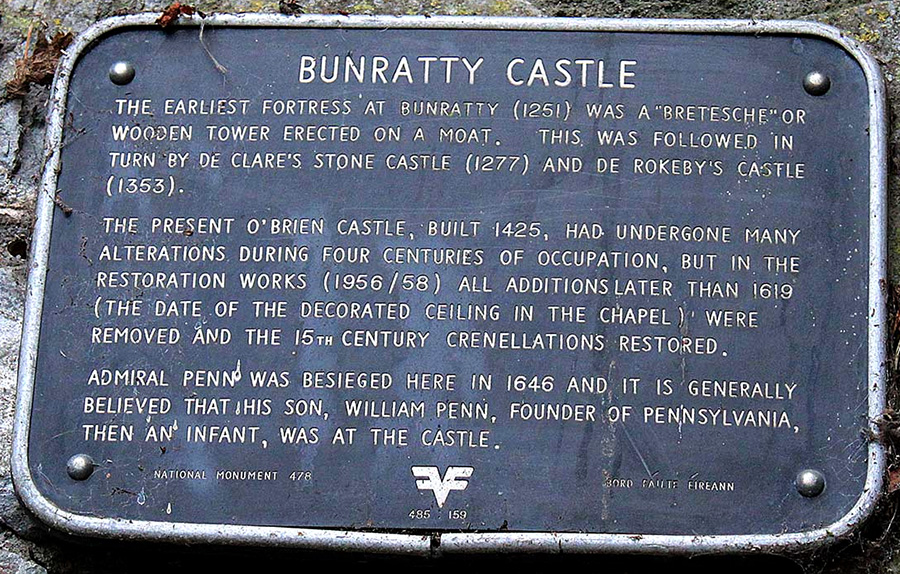
Bunratty Castle
Brian Boru destroyed the first settlement at Bunratty in 977. Or so the Annals of the Four Masters record -- a Norse trading camp on a rise southwest of the present castle, raided and burned by the High King of Ireland as part of his campaign to drive the Vikings from the Shannon Estuary. No trace of that camp has ever been found. Its existence remains unproven, its exact location unknown. What is certain is that people have been fighting over this spot at the mouth of the Ratty River for more than a thousand years, and the castle that stands here now -- a massive fifteenth-century tower house -- has outlasted every one of them.
Layers of Conquest
The site changed hands with each wave of invaders. Around 1250, King Henry III of England granted the district to Robert De Muscegros, who felled 200 trees from the King's wood at Cratloe -- possibly to build the first timber motte-and-bailey castle here, though again, its exact location has never been confirmed. By 1253, Bunratty had the right to hold markets and an annual fair, making it the centre of early Norman control in southeastern Clare. The current stone castle, a large tower house, dates from the fifteenth century and reflects the power of the families who built and rebuilt on this contested riverbank. The Owenogarney River flows past the castle into the Shannon Estuary, the same waterway that made the site valuable to Norse traders, Norman lords, and Irish chieftains alike.
Decline and Decay
By the nineteenth century, Bunratty Castle had been abandoned by the Studdert family, who left around 1804 for the comfort of a modern house they built adjacent to the medieval tower. They called it Bunratty House, and the castle was left to weather and neglect. For a time it served as a barracks for the Royal Irish Constabulary. Then the roof of the Great Hall collapsed. The castle stood open to the sky and the Clare rain for decades, its stonework slowly crumbling, its history apparently ending not with a siege but with indifference. What happened next was unusual: the castle was rescued, not by the state but by an antiquarian named John Hunt, who in the 1950s led a restoration that returned Bunratty to something resembling its medieval form.
From Ruin to Tourist Draw
Today Bunratty Castle sits beside the N18 road between Limerick and Ennis, minutes from Shannon Airport, and operates as one of Ireland's most-visited heritage sites alongside an adjoining folk park that recreates nineteenth-century Irish rural life. The castle hosts medieval banquets where visitors eat with their hands and are entertained by musicians and storytellers -- a theatrical version of a past that was considerably less charming in practice. The folk park reconstructs farmhouses, a village street, and workshops from the period, giving visitors a sense of the daily life that existed in the shadow of the great tower houses. In 2023, ownership transferred from Shannon Heritage to Clare County Council, part of a broader restructuring after the COVID-19 pandemic caused unsustainable losses at heritage tourism sites across the region.
The River's Mouth
Bunratty means "mouth of the Ratty River" in Irish, and the name captures the essence of the place. This was always about the water -- the river that powered trade, the estuary that connected the interior of Ireland to the Atlantic, the Shannon that carried goods and armies inland. The castle's position commanded access to all of it. From the air, Bunratty resolves into a grey stone block beside a green river, the N18 motorway curving past, Shannon Airport's runways visible to the west. A thousand years of human ambition, compressed into a tower house that a Viking would still recognise as a stronghold worth fighting over.
From the Air
Bunratty Castle is located at 52.70N, 8.81W, between Limerick and Ennis along the N18 motorway in County Clare. From the air, the large tower house is visible near the Owenogarney River just before it enters the Shannon Estuary. Shannon Airport (EINN) is approximately 5 km to the west, making this one of the most easily spotted landmarks on approach. Best viewed at 1,500-3,000 feet.