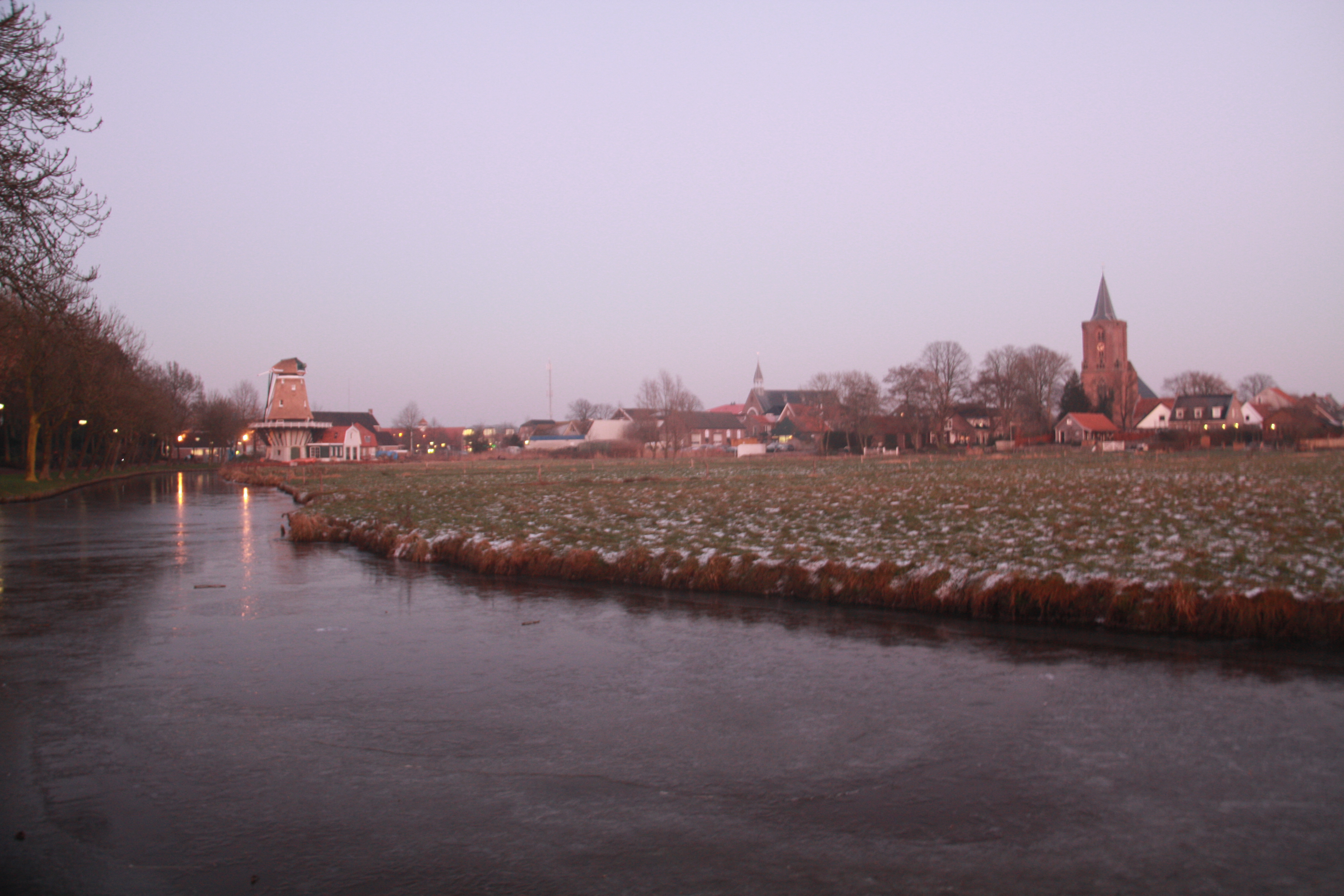
Bunschoten
On a market day in Spakenburg, you can still see them - perhaps a dozen women in stiff floral bodices and starched white caps, walking past the smoked-eel stalls along the Oude Haven. The number was around 85 in 2021, and it falls a little each year. They wear what their mothers and grandmothers wore, in a town where the costume was never a performance but a way of getting dressed in the morning. Bunschoten is the inland half of a strange Dutch pairing: an old medieval town set a kilometer back from the water, fused administratively with Spakenburg, the fishing village that once outgrew it. Together they sit on the southern shore of what used to be the Zuiderzee, a place where one historical era is still folded inside another.
A Border Town, Often Burned
Bunschoten enters the written record in 1294 as a settlement straddling a contested edge. The bishops of Utrecht held it on one side; the dukes of Guelders pressed against it from the other. For more than a century the town suffered raids and reprisals from the eastern frontier. In 1383 the bishop of Utrecht finally granted Bunschoten city rights, which gave the townspeople the legal authority to throw up an earthen wall and defend themselves. The wall did not save them. At Christmas 1427, during a war between two rival bishops competing for the diocese, soldiers tore through the fortifications and burned a portion of the town. Bunschoten never rebuilt its walls. The medieval idea of a fortified frontier town simply ended there, and a quieter rural identity took its place.
How Spakenburg Outgrew Its Parent
For centuries Spakenburg was a footnote to Bunschoten, a small fishing settlement at the end of a dike road that ran north to the Zuiderzee. By the eighteenth century the relationship had flipped. The shallow waters off the coast suited a specific kind of boat, and Spakenburg's builders perfected it: the botter, a flat-bottomed wooden sailing vessel with a hinged leeboard, designed to glide over sandbanks and ride out the storms of an inland sea. By 1900, more than two hundred botters set out from Spakenburg's harbors. The town's fish - eel, herring, and Zuiderzee anchovy - traveled by rail to Amsterdam and beyond. Fishing was the whole economy. Then, in 1932, the Afsluitdijk closed the Zuiderzee off from the North Sea. The salt water became fresh. The herring vanished. The Zuiderzee fishery was over almost overnight.
The Costume
The Spakenburg dress did not survive by accident. It survived because Spakenburg, isolated on its strip of coastline, developed a culture distinct enough to hold onto things other Dutch towns let go of. The full costume is layered and specific - a kraplap, a stiff embroidered piece of fabric that fans out from the shoulders, paired with a checked or floral bodice in colors that signal mourning, half-mourning, or celebration. Older women wear it daily. Younger women may wear it on Spakenburg Days, the summer festivals when the harbor fills with restored botters and the streets fill with visitors. The instinct here is not nostalgia, exactly. It is something closer to inheritance - a way of carrying a place forward by wearing it. The point is not to look at the costume; the point is that the people inside it are still there.
The Old Harbor
Walk down the dike road from Bunschoten and the Oude Haven opens up like a museum that forgot it was a museum. Botters line the quay, masts angled in every direction, their black hulls and tan sails the same shape as photographs from 1910. Most are restorations, lovingly maintained by a community of volunteer shipwrights who have kept the old skills alive. Some still sail. The harbor is also working - modern fishing boats unload alongside the heritage vessels, and the smokehouses along the quay still turn out eel that locals queue for on Saturday mornings. The rebuilt flour mill De Hoop, originally from 1899 and reconstructed in 2009, stands a few streets back from the water. From any vantage point in Spakenburg you can see at least one mast and at least one chimney - the two emblems of a town that has refused to choose between past and present.
Inland Lives
The municipality has produced its share of modern Dutch names. The conceptual artist Job Koelewijn, born in Spakenburg in 1962, has shown work at the Stedelijk and the Venice Biennale. The professional darts player Aileen de Graaf, born in 1990, competed for the Dutch national team. The footballer Kevin van Diermen, born in 1989, has more than 200 club appearances. None of them work the water. The Zuiderzee gave Spakenburg its identity and then, with the closing of the Afsluitdijk, took the fishery away. What it left behind is what you see from the air: a town shaped like a fishhook, the harbor curling inward, the old village clinging to its dike, the new houses spreading inland toward Bunschoten across what used to be sea.
From the Air
Bunschoten and Spakenburg sit together at 52.25 degrees north, 5.37 degrees east, on the southern edge of the Eemmeer 7 km north of Amersfoort. From the air, the twin towns appear as a single built-up area, with Bunschoten the inland grid and Spakenburg's curved harbor poking north into the lake. The Eem river meets the Eemmeer just west of town. Look for the white windmill De Hoop near the historic center. Nearest airports: Lelystad (EHLE) lies 20 km north across the IJsselmeer, Hilversum (EHHV) sits 20 km west, and Schiphol (EHAM) is 45 km west. Recommended viewing altitude 2,500 to 4,000 feet for a clear read of the harbor and dike road. Best light is late afternoon when the masts in the Oude Haven cast long shadows across the water.