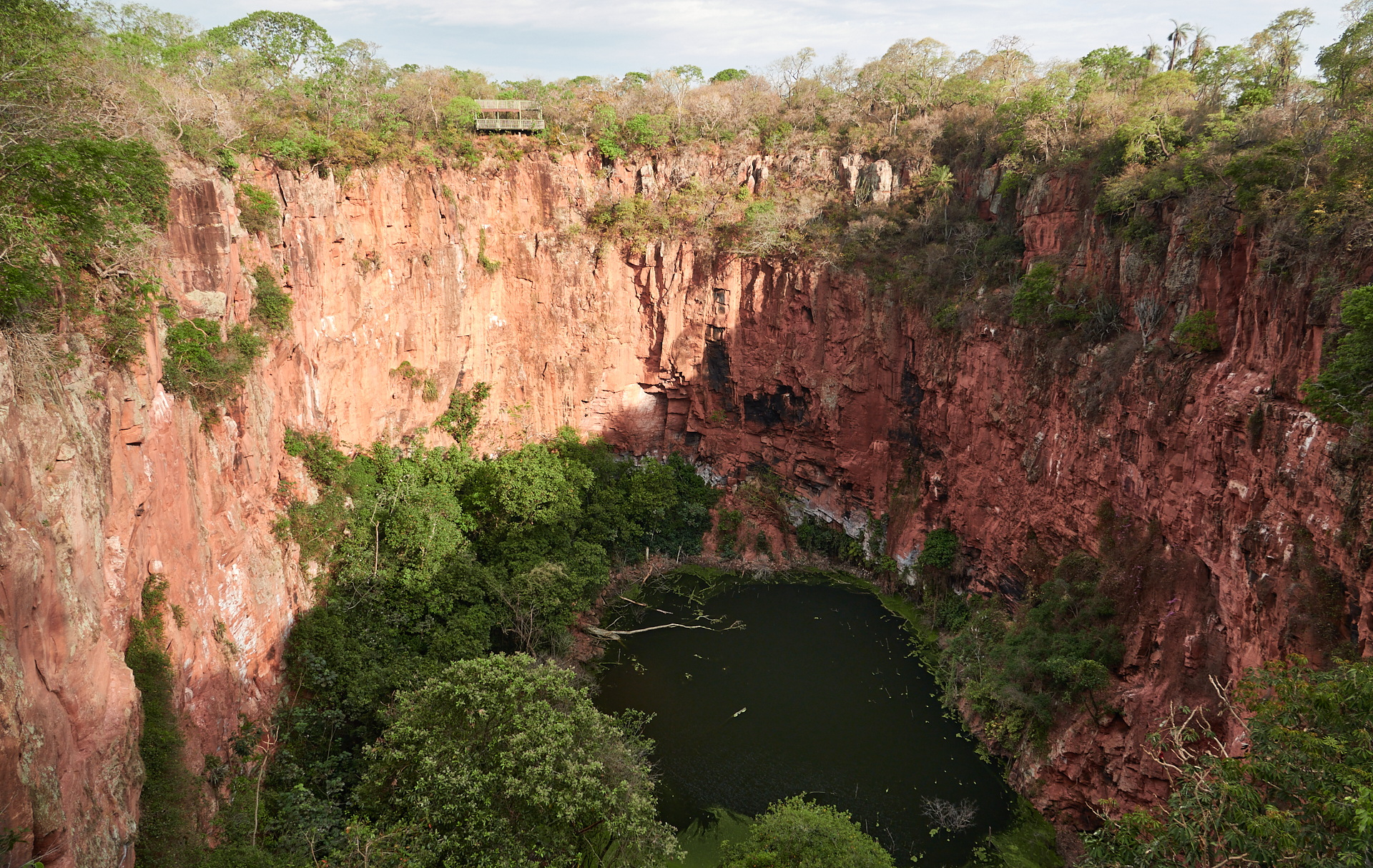
Buraco das Araras Private Natural Heritage Reserve
According to the ranchers who ruled this part of Mato Grosso do Sul, the Buraco das Araras had its uses. Cattle thieves, political enemies, anyone a local power broker wanted to disappear -- the hole swallowed them all, or so the legend goes. Stolen cars went in too, along with general rubbish, and for years the sinkhole's walls served as target practice for anyone with a gun and a low opinion of macaws. Then, in 2007, someone decided the hole deserved better. The privately owned reserve that resulted has turned one of Brazil's most abused natural features into one of its most carefully protected.
Five Hundred Meters Around, One Hundred Down
The sinkhole sits in the municipality of Jardim in the state of Mato Grosso do Sul, within the Cerrado biome -- the vast tropical savanna that covers much of central Brazil. It measures 500 meters in circumference and plunges 100 meters deep, a scale that makes the human figure on the rim look trivial. At the bottom, a vivid green lagoon gathers, surrounded by vegetation that thrives in the sheltered, humid microclimate the pit creates. The original inhabitants of the area would have known the hole long before a local worker rediscovered it in 1912 and named it after the macaws that circled endlessly above its rim. The geology is karst -- soluble limestone dissolved by millennia of groundwater, leaving behind a void that eventually collapsed into the funnel shape visitors see today.
From Dump Site to Sanctuary
The transformation required more than just fencing off the area. For decades, the sinkhole had absorbed abuse: gunfire pockmarked its walls, garbage accumulated at the bottom, and the macaw population suffered from constant harassment. The reserve was formally established on April 11, 2007, classified under IUCN Category IV as a habitat and species management area. At just 29 hectares, it is tiny by reserve standards, but the sinkhole's depth and isolation create an ecosystem disproportionate to the surface area. The owner manages the reserve personally and bears responsibility for meeting all legal requirements of a Brazilian private natural heritage reserve -- a designation that grants permanent protection to the land in exchange for the owner's stewardship commitment.
The Residents of the Hole
The macaws that give the sinkhole its name are the most visible inhabitants, their red, blue, and green plumage flashing against the pale rock walls as they wheel in thermals rising from the pit. But the ledges and lagoon below host a full community. Caimans patrol the green water. Armadillos and anteaters navigate the slopes. Coatis, gregarious and curious, appear along the rim trails. Foxes haunt the surrounding Cerrado scrub. Ibises and toucans add to a bird population that draws serious ornithologists from across Brazil. Visitors walk the rim in groups of no more than ten, accompanied by a guide or local environmental monitor -- a rule that keeps human pressure manageable and ensures the wildlife remains something experienced rather than merely observed.
The Cerrado's Hidden Depth
Brazil's Cerrado is often overshadowed by the Amazon in the global imagination, but it is one of the world's most biodiverse savanna ecosystems and one of its most threatened. The Buraco das Araras reserve preserves a sliver of this biome in a form that compresses its richness into a single dramatic feature. From the rim, the layered rock walls record geological time, while the lagoon at the bottom reflects a sky framed by the sinkhole's ragged edges. The contrast between the flat, dry Cerrado above and the lush, sheltered world below is the reserve's most striking quality -- a reminder that landscapes often hide their most interesting features underground. What the ranchers once treated as a convenient void turned out to be irreplaceable, a pocket of life that simply needed people to stop throwing things into it.
From the Air
Located at 21.49S, 56.40W in the municipality of Jardim, Mato Grosso do Sul, Brazil. The reserve lies within the Cerrado biome on relatively flat terrain. The nearest significant airport is Bonito (SJDB), a small airfield approximately 60 km to the northwest. Campo Grande International Airport (SBCG), the state capital's airport, is roughly 250 km to the north-northeast. The sinkhole itself, at 500 meters in circumference, may be faintly visible from low altitude as a dark depression in the otherwise flat, scrubby landscape. Elevation is approximately 350 meters. Climate is tropical with distinct wet and dry seasons.