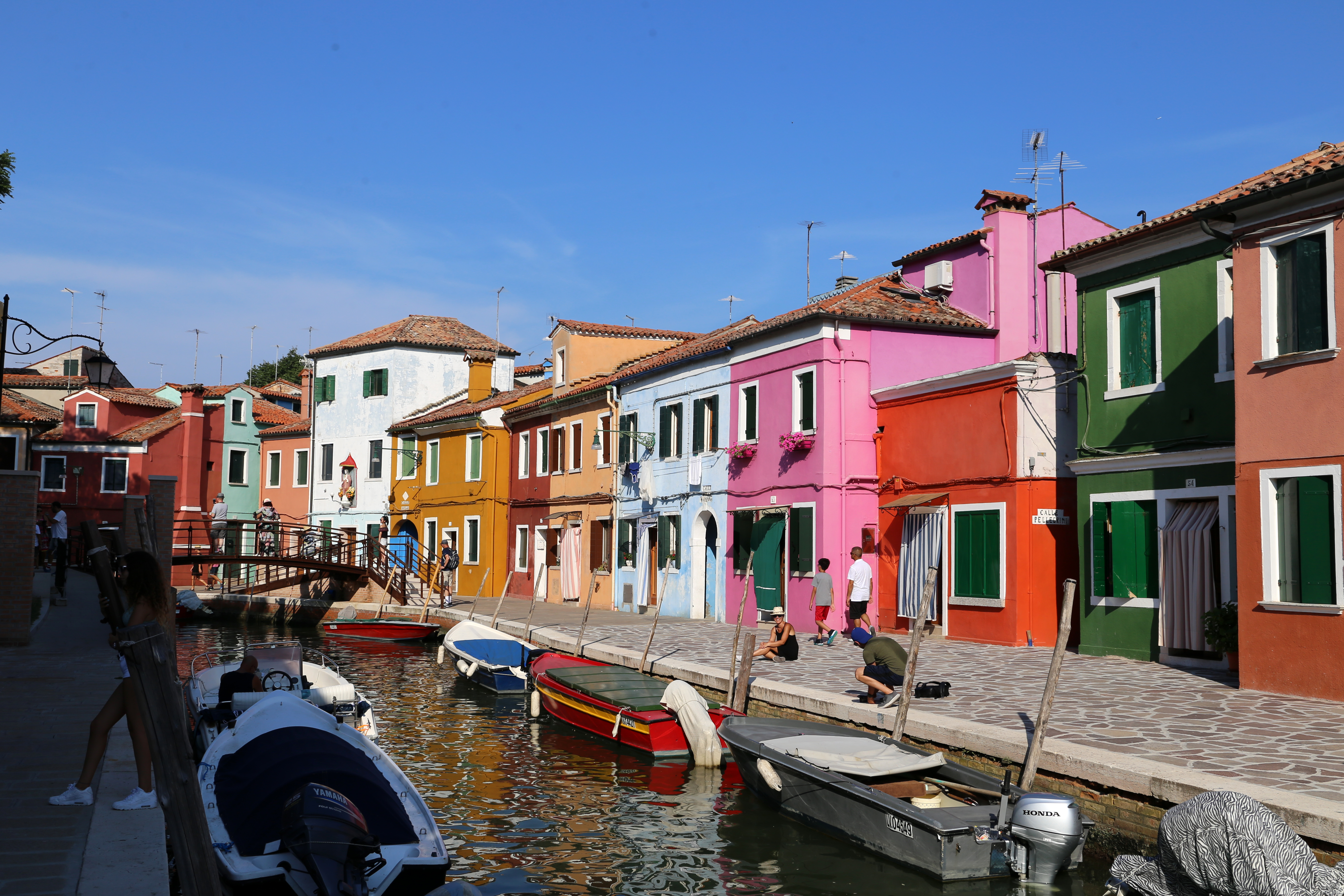
Burano
Want to paint your house on Burano? You must write to the government first. They will respond with the specific colors permitted for your lot. This is not bureaucratic overreach -- it is the maintenance of a tradition that has made this small island in the northern Venetian Lagoon one of the most photographed places in Italy. Every facade blazes in saturated color: mustard yellow beside cerulean blue, deep rose against mint green, the palette originating, according to local tradition, so that fishermen returning through the lagoon fog could identify their homes from the water. Whether or not the origin story holds, the result is an island that looks hand-painted, which in a literal sense it is.
Lace, Needles, and a Renaissance Shopper
Burano's other fame is lace, and the craft arrived by an unexpected route. In the sixteenth century, women on the island began making needle lace, a technique introduced through Venice's control of Cyprus, where the craft tradition ran deep. The work was intricate and slow -- a single tablecloth could take years -- and the results were soon exported across Europe as luxury goods. Leonardo da Vinci visited in 1481 and purchased a cloth for the main altar of Milan's Duomo, though the lace he admired came from the nearby town of Pano Lefkara on Cyprus rather than Burano itself. By the eighteenth century, the industry had declined, and it did not revive until 1872, when a school of lacemaking reopened on the island. Production boomed again, though today few artisans practice the traditional needle technique. The time required -- and therefore the cost -- makes handmade Burano lace a rarity rather than a commodity.
Five Islands Made One
Burano is actually five islands, though you would never know it walking through. A fourth canal was filled in to create the main street and square, via e piazza Baldassare Galuppi, which joined the formerly separate islands of San Martino Destra and San Martino Sinistra. The island is linked to neighboring Mazzorbo by a bridge. Despite its small size, Burano has a population density exceeding 13,000 per square kilometer -- more than twenty times that of Mazzorbo next door -- with nearly every square meter covered by residential buildings. The heart of the village is Piazza Baldassare Galuppi, the only square, named for the composer born here in 1706. The square holds the Lace Museum, the Town Hall, a well carved entirely from Istrian stone, and a statue of Galuppi sculpted by another Burano native, Remigio Barbaro, who was born on the island in 1911.
Artists and a Leaning Tower
The Church of San Martino offers Burano's version of Pisa: a campanile that leans visibly, tilting away from the church in a manner that looks precarious but has held for centuries. Inside hangs a Crucifixion painted by Giambattista Tiepolo in 1727, one of the Venetian master's earlier works. The Oratorio di Santa Barbara stands nearby. But Burano's real artistic legacy lives in its streets. The brightly painted houses have drawn painters for generations, and the island has produced its own: the composer Baldassare Galuppi, nicknamed Il Buranello, was a major figure in eighteenth-century opera buffa. Singer-songwriter Pino Donaggio, born in 1941, went on to score films for Brian De Palma. The island's visual appeal is inseparable from the discipline that maintains it -- each generation repainting in the colors the government approves, preserving a palette that is at once spontaneous-looking and entirely controlled.
A 45-Minute World Away
Burano sits 7 kilometers from Venice, a 45-minute ride by vaporetto from St. Mark's Square. The distance is not just geographic. Where Venice wrestles with overtourism, flooding, and population collapse, Burano retains something closer to a village character, its 2,800 residents living among the visitors rather than being displaced by them. The island was historically administered from neighboring Torcello, once a thriving Byzantine settlement, now nearly abandoned. Burano had none of Torcello's privileges and none of Murano's prestige. It was a fishing village that developed a luxury craft and painted its houses in colors that caught the light. Today the primary economy is tourism, the fishing industry that justified the painted facades having largely faded. The vaporetti of the Actv network connect Burano to Murano, Torcello, and Venice proper, making the island a day trip. But the colors hold better in the early morning, before the boats arrive, when the light off the lagoon is still soft and the facades glow without an audience.
From the Air
Burano (45.486N, 12.418E) is located in the northern Venetian Lagoon, approximately 7 km northeast of Venice's main island. From the air, the island is immediately recognizable by its brightly colored buildings, which create a patchwork visible even from moderate altitude. It sits near Torcello, another lagoon island, and is connected to Mazzorbo by a bridge. The compact rectangular shape of the island, its dense building coverage, and the vivid colors distinguish it from other lagoon islands. Venice Marco Polo Airport (LIPZ/VCE) lies approximately 6 km to the west. Best viewed from 1,000-3,000 feet, where the color patterns of the houses become visible.