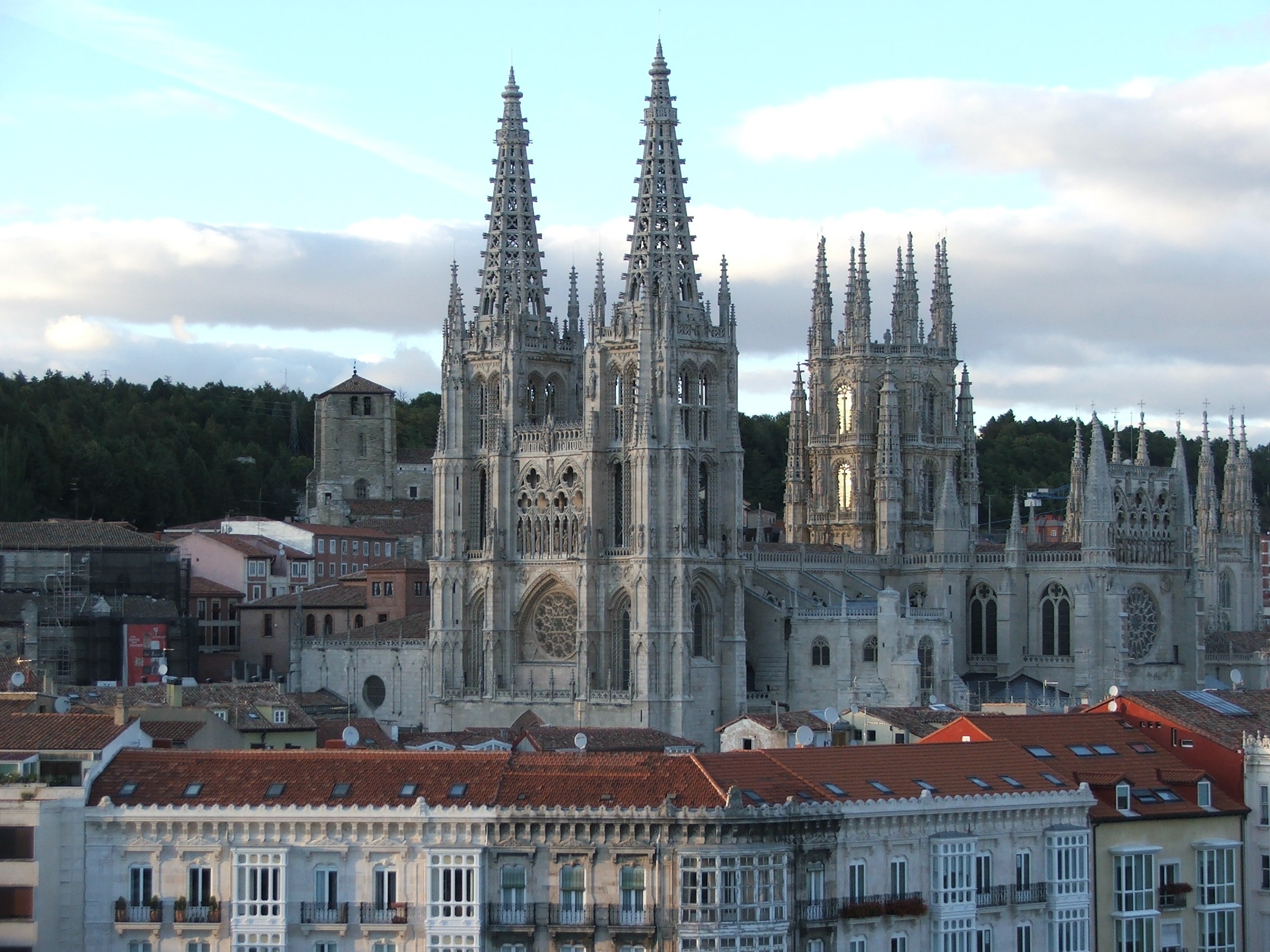
Burgos Cathedral
Walk into Burgos Cathedral and look up. The dome of the transept floats above you, an octagonal cage of stone and light designed by Juan de Colonia in the fifteenth century and so intricate that first-time visitors have been known to stop mid-step, mouths open, unable to process the geometry. This is a building that took eight centuries to complete, begun in 1221 in the style of the great French Gothic cathedrals and finished -- if a cathedral is ever truly finished -- with Baroque flourishes in the eighteenth century. UNESCO declared it a World Heritage Site in 1984, one of the few individual buildings in the world to receive the distinction on its own merits.
Stone from Hontoria
Construction began on July 20, 1221, under the patronage of King Ferdinand III of Castile and Bishop Maurice of Burgos, who had studied in Paris and wanted a cathedral to rival those rising across France. The architects modeled the plan on a Latin cross and drew heavily on French Gothic precedents, particularly the cathedrals of Bourges and Reims. The limestone came from quarries in the nearby town of Hontoria de la Cantera -- the same pale stone that gives the facade its warm, honeyed glow in afternoon light. The nave and side aisles were largely complete by the mid-thirteenth century, but then construction paused for nearly two hundred years, leaving the cathedral in a state of distinguished incompleteness.
The Colonia Dynasty
When building resumed in the fifteenth century, the cathedral entered its most creative period. The Colonia family -- Juan, Simon, and Francisco -- transformed the building over three generations. Juan de Colonia designed the openwork spires of the western facade, delicate stone lattices that seem too fragile to stand yet have survived more than five centuries of Castilian weather. His son Simon created the Chapel of the Constable, an octagonal space behind the high altar whose star-ribbed vault is considered a masterpiece of late Gothic engineering. The transept dome, also attributed to Juan de Colonia, rises on an octagonal drum pierced with windows, flooding the crossing with light. These additions shifted the cathedral from French sobriety to the exuberance of Flamboyant Gothic, giving it the unmistakable silhouette visible from every approach to the city.
El Cid Sleeps Here
Beneath the transept dome, a simple marble slab marks the burial place of Rodrigo Diaz de Vivar -- El Cid -- and his wife Jimena. The legendary Castilian knight, who fought both for and against Muslim and Christian rulers in eleventh-century Spain, was originally buried at the monastery of San Pedro de Cardena outside Burgos. His remains were moved to the cathedral in 1921. The placement is fitting: Burgos was El Cid's city, and the cathedral stands at the heart of the old quarter he would have known. Nearby, the Golden Staircase by Diego de Siloe -- a Renaissance masterpiece of gilded ironwork and carved stone -- connects the nave to the street-level door of the Coroneria, bridging a height difference of nearly eight meters with theatrical grandeur.
A Cathedral of Accumulation
What makes Burgos Cathedral extraordinary is not any single feature but the accumulation of centuries. The Gothic bones of the thirteenth century carry the Flamboyant ornament of the fifteenth, the Renaissance refinement of the sixteenth, and the Baroque additions of the eighteenth. The Chapel of Saint Thecla, the last major addition, wraps its interior in a riot of gilded plasterwork. The Sacristy, from the same period, is more restrained but no less accomplished. The cathedral preserves works by sculptors Gil de Siloe and Felipe Bigarny, paintings attributed to masters of the Spanish and Flemish schools, and carved choir stalls whose detail rewards an hour of close looking. From the air, the spires rise above the red-tile roofs of Burgos like two stone fingers pointing at the Castilian sky, their openwork tracery visible even from considerable altitude.
From the Air
Located at 42.34°N, 3.70°W in the historic center of Burgos, northern Spain. The cathedral's twin Gothic spires are the most prominent feature of the city skyline and visible from considerable distance. Best viewed at 3,000-5,000 ft AGL. Nearest airport: Burgos (LEBG), approximately 4 km northeast of the city center. The Arlanzon River runs along the southern edge of the old city. The Castilian meseta stretches flat in all directions.