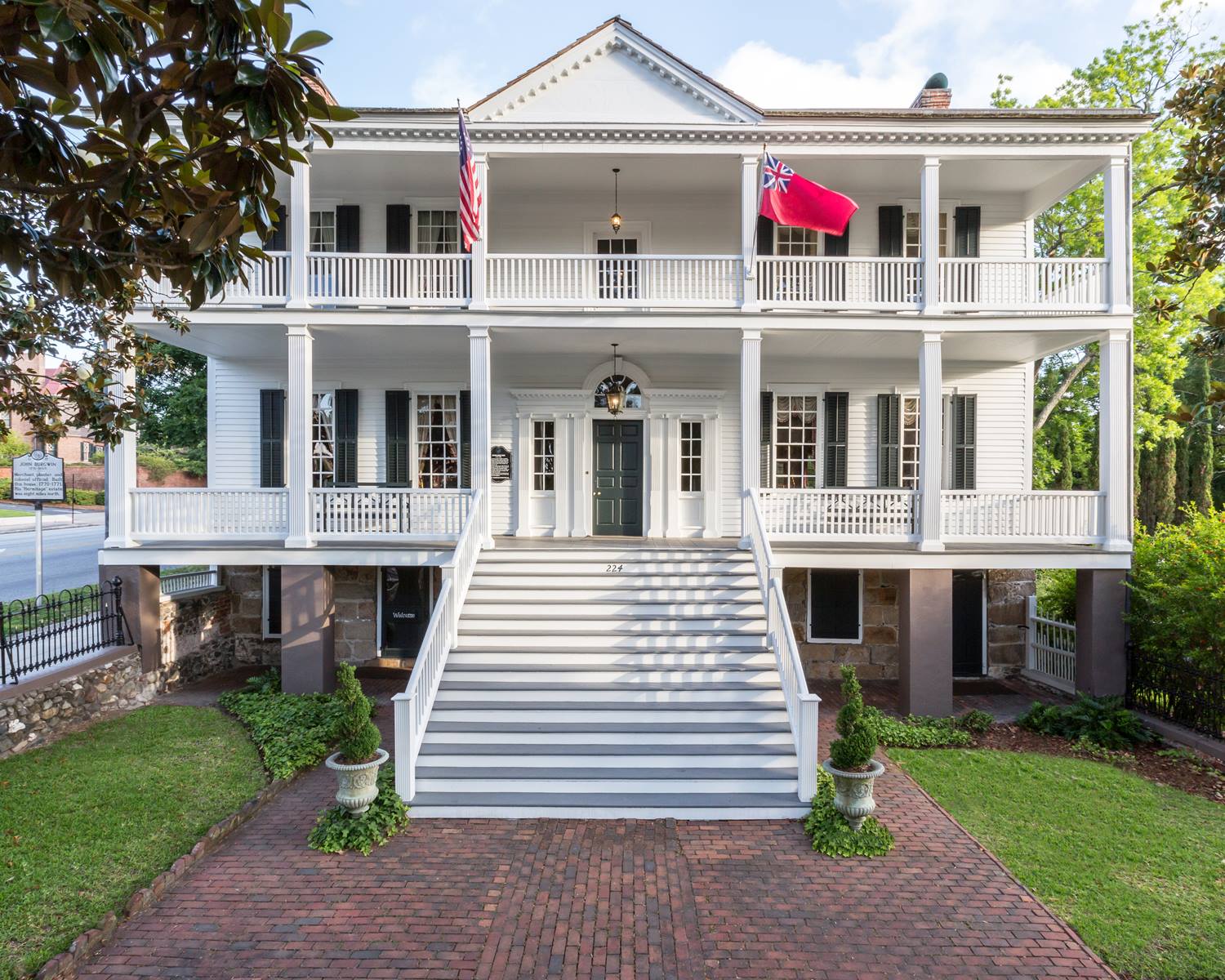
Burgwin-Wright House
Step through the front door of the Burgwin-Wright House and the original iron bars of a debtor's cell are still embedded in the walls beneath your feet. In 1769, when merchant John Burgwin bought the most prominent corner lot in Wilmington, North Carolina, he was buying a jail. The city's main gaol had occupied the site since 1744, and its ballast-stone walls and brick archways were still standing. Rather than demolish them, Burgwin built his elegant Georgian townhouse directly on top, incorporating the old structure into his foundations. Today the house is the only colonial-era building in Wilmington open to visitors -- a place where the architecture of punishment and the architecture of wealth literally sit one on top of the other.
A Second Son's Fortune
John Burgwin was born in Hereford, England in 1730, the second son in a family where the estate went to the eldest. He studied at Cambridge, then sailed for Charleston, South Carolina around 1750 with letters of introduction from his father. Within a year he was working for the mercantile firm of Hooper, Alexander & Co., which sent him to Wilmington on business. There he met Margaret Haynes, daughter of a wealthy planter, and married her in 1753. Margaret's mother soon transferred a thousand-acre plantation called The Hermitage to her new son-in-law. Burgwin climbed fast through colonial society -- quartermaster of the New Hanover County militia by 1754, clerk of the governor's council by 1760, private secretary to Royal Governor Arthur Dobbs by 1762, Treasurer of the Province of North Carolina by 1767. When Margaret died in 1770 without children, Burgwin was one of the most connected men in the colony.
Built to Impress
Burgwin purchased the jail corner at Market and Third Streets in 1769 and was likely occupying his new house by 1771. This was not his primary home -- that was The Hermitage plantation -- but rather his town house, designed for conducting business and entertaining the merchant class. In colonial Wilmington, it was considered gauche to boast about your prosperity aloud. You showed it through your house instead. Burgwin built in the Georgian style: symmetrical facades, a front door flanked by two windows on each side, columns along both the front and back porches. But he adapted the style for the Carolina coast. The house sits elevated above the street to escape Wilmington's chronic flooding, with tall ceilings, wide hallways, and cross-ventilation designed to pull breezes off the river. Architectural historian Catherine Bishir traces these features to Caribbean influence -- many Carolina settlers had roots in the tropics, and the constant trade in sugar, molasses, and enslaved people carried architectural ideas along with the goods.
From Burgwin to Wright
When Burgwin broke his leg in 1775, he sailed to England and rented the house to business partner Charles Jewkes. Jewkes brought along his wife Ann Grainger Wright, widow of Captain Thomas Wright, and her three young children. The family stayed through the entire American Revolution. After Burgwin decided to sell in 1799, and after a string of family deaths, it was Ann's youngest son Joshua Grainger Wright who purchased the house for 3,500 Spanish milled dollars. Joshua became a lawyer, a distinguished orator, and the first president of the Bank of Cape Fear when it was founded in 1809. He served in the legislature and was elected Speaker of the House. The Wright family held the property through the 19th century -- Joshua's son Thomas Henry raised eleven children within its walls, eight of whom survived -- until Dr. Adam Empie Wright sold it to William Hamilton McRary in 1869 for five thousand dollars.
Saved from the Wrecking Ball
When the last McRary heir died in 1930, the Burgwin-Wright House nearly became a gas station. The Wilmington Savings and Trust Company, which inherited the property, planned to demolish it. A New York businessman named Samuel Pryor offered to buy the house, disassemble it, and ship it to Connecticut. The National Society of the Colonial Dames of America in North Carolina, alarmed at both options, organized a campaign to save it. When Pryor learned of their efforts, he abandoned his own plans and donated 250 dollars to the cause. The Colonial Dames purchased the house in 1937 for 21,000 dollars. Exterior restoration began in 1939 and was nearly complete when Pearl Harbor was bombed four days after the last board meeting of 1941. The house was leased to the city as a recreational center for military officers, and the 'Lord Cornwallis Lounge' opened in February 1944.
Living History on Market Street
After the war, the Colonial Dames resumed their work. Architect Erling H. Pedersen led the interior restoration in 1949, installing plumbing and electricity while restoring original paint colors. Henry Jay MacMillan traveled to England to purchase period furniture. On March 30, 1951, the Burgwin-Wright House opened as a museum. The two-acre grounds feature seven distinct garden areas -- an orchard with pomegranate and fig trees, a kitchen garden, a rose garden -- all planted in the colonial style. A freestanding kitchen house with a massive hearth survives on the property. In 2018, the original Long-Leaf Pine floors were refinished and the walls repainted to match the colors Burgwin chose in 1770. That September, Hurricane Florence tore into the North Carolina coast and damaged the roof and chimneys. By early 2020, the roof had been completely rebuilt in eighteenth-century cedar shake. Beneath all the careful restoration, the bones of the 1744 jail remain, iron bars and all.
From the Air
The Burgwin-Wright House is located at 34.235N, 77.946W in downtown Wilmington, NC, at the corner of Market and Third Streets in the historic district. From the air, look for the Georgian-style house with columned porches on the north side of Market Street, surrounded by colonial gardens. The Cape Fear River waterfront is just two blocks east. Best viewed at 1,000-2,000 feet AGL. Nearest airport: Wilmington International (KILM) approximately 5 nm northeast of downtown.