Burhanpur
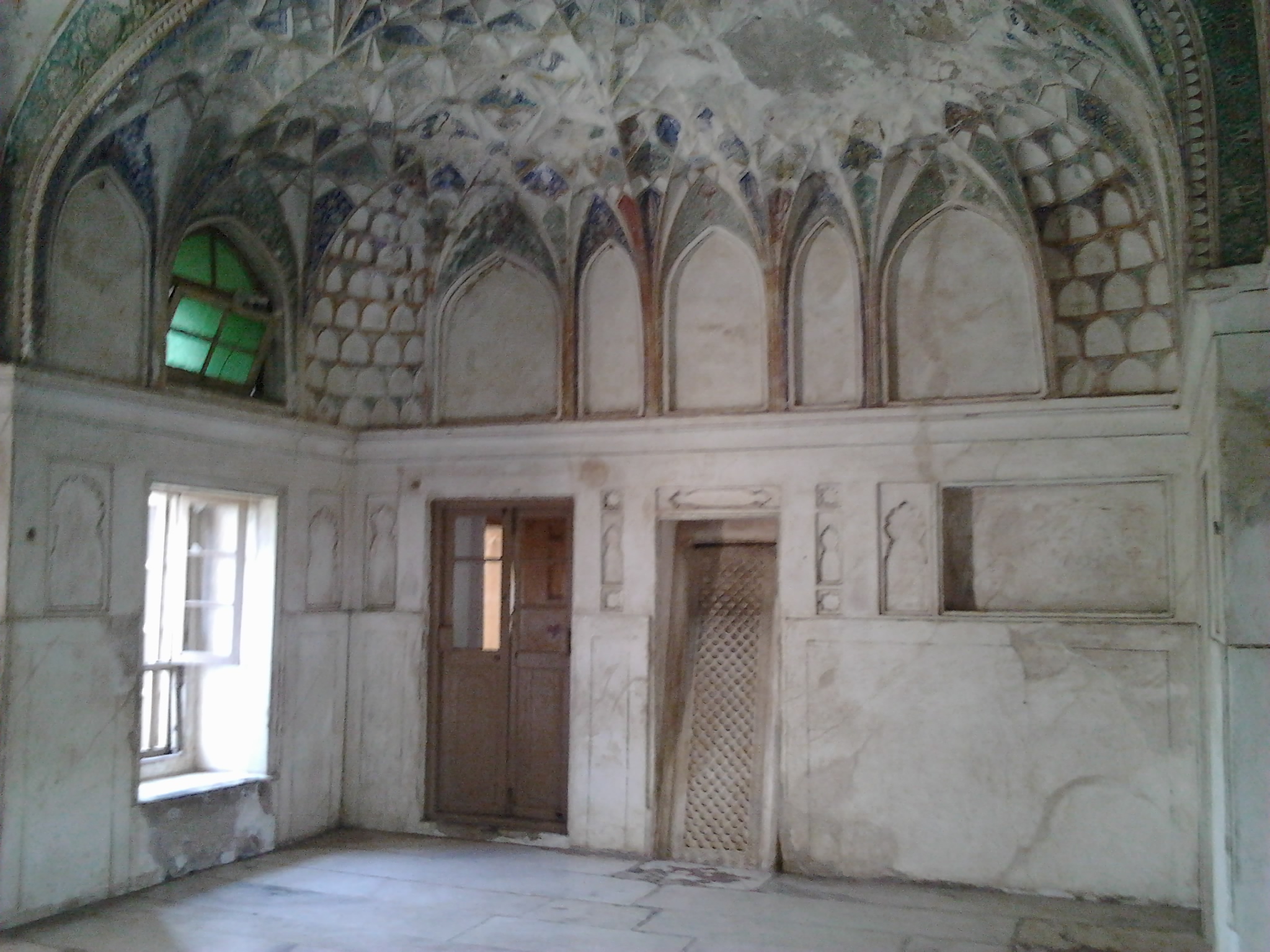
Mumtaz Mahal died in Burhanpur. She was giving birth to her fourteenth child in the Shahi Qila, the royal palace on the banks of the Tapti River, when she died on June 17, 1631. Shah Jahan, devastated, initially buried her in the palace grounds. For six months she lay in a grave called the Aahukhana while the emperor considered building her memorial right here, in this city he knew well. But Burhanpur lacked white marble in sufficient quantities. So he moved her body to Agra and built the Taj Mahal instead. Burhanpur got the grief. Agra got the monument. The Aahukhana still exists, in disrepair, at a palace that is mostly ruins -- but the hamam, the royal bath Shah Jahan built for Mumtaz, still has its ceiling paintings intact, including one that depicts a structure eerily resembling the tomb that would eventually be built 600 kilometers to the north.
Named for a Saint
Before the Mughals, before the grief, Burhanpur was a trading town that owed its existence to Sufi devotion. In 1388, Malik Nasir Khan of the Faruqi dynasty established the settlement at the urging of Shaikh Zainuddin and named it after the medieval Sufi saint Burhan-ud-Din. The Faruqi sultans made it the capital of the Khandesh sultanate. Under Miran Adil Khan II, who reigned from 1457 to 1501, Burhanpur grew from a settlement into a major center for trade and textile production -- a role the city continues to play, as modern Burhanpur remains the largest power loom hub in Madhya Pradesh. The city sits on the north bank of the Tapti River, positioned on the critical route connecting northern India to the Deccan plateau -- a geography that guaranteed both prosperity and conflict.
Gateway to the Deccan
In 1601, Emperor Akbar annexed the Khandesh sultanate and made Burhanpur the capital of a new Mughal province. The city became a staging ground for Mughal campaigns into southern India. Abdul Rahim Khan-i-Khanan, the governor during Akbar and Jahangir's reigns, constructed new water supplies and gardens. In 1609, Jahangir appointed his son Prince Parviz as governor of the Deccan provinces, and Parviz chose Burhanpur as his seat. Shah Jahan, who spent considerable time here, expanded the Shahi Qila on the Tapti's banks, adding the Diwan-i-Aam and Diwan-i-Khas on its terrace. The palace became one of the Mughal Empire's important provincial residences -- a place where emperors lived for months at a time, governing an empire's southern frontier while hunting Asiatic lions in the surrounding countryside.
Three Rivers, Many Faiths
Burhanpur sits at the confluence of three rivers: the Tapti, the Utavali, and the Mohna. Four small ghats line the riverbanks. The city's population of roughly 210,000 is almost evenly split between Muslim and Hindu communities, with small Sikh and Christian minorities, and this diversity is written into its architecture. The Jama Masjid, begun under Faruqi rule and completed by Akbar, features two large minarets and three round cupolas with extensive artwork on its symmetric pillars. A Sikh gurdwara serves the community. Churches and a world-renowned dargah dedicated to the Bohra saint Abdul Qadir Hakimuddin draw pilgrims from across India. Walking through Burhanpur's old quarters is an exercise in reading centuries of coexistence in stone, brick, and carved plaster.
The Maratha Storm
The Mughals held Burhanpur for over a century before the Marathas arrived. In 1681, a Maratha army sacked the city -- an event dramatic enough that it became a set piece in the 2025 Bollywood film Chhaava. By the 1720s, Peshwa Bajirao had taken the town during his expedition toward Malwa and Delhi. In the 1750s, Sadashivrao Bhau, fresh from defeating the Nizam of Hyderabad, secured Maratha control. As the Maratha Empire itself declined, Burhanpur passed between the Holkar and Scindia factions before being handed to the British in 1818. Each transition left architectural traces, but the city's Mughal character remained dominant -- the Shahi Qila, the mosques, and the hamam survived because they were built to outlast the dynasties that created them.
Looms and Legacy
Modern Burhanpur thrives on textiles, just as it did under Miran Adil Khan five centuries ago. The city is Madhya Pradesh's largest power loom center, producing interlining cloth, cambric, bleached dhoti, and other fabrics in factories that carry forward a manufacturing tradition older than the Mughal Empire. Cotton and oil mills line the industrial areas. But the past is never far away. Asirgarh Fort, the great hilltop fortress 20 kilometers to the north, guards the pass through the Satpura Range that made Burhanpur strategically vital. The Shahi Qila's terrace garden -- a rare fort with landscaping on its roof -- still overlooks the Tapti. And the hamam's painted ceiling still holds that tantalizing image: a building that looks remarkably like the Taj Mahal, sketched on a ceiling in the city where the idea for it was born.
From the Air
Located at 21.30°N, 76.23°E on the north bank of the Tapti River in Madhya Pradesh, India. From altitude, Burhanpur is visible as a midsize city along the Tapti River, with the old Mughal quarter and Shahi Qila identifiable near the riverbank. The city sits at the transition between the flat Deccan Plateau to the south and the Satpura Range to the north. Asirgarh Fort is visible on a hilltop 20 km to the north. Three rivers -- Tapti, Utavali, and Mohna -- converge near the city. The nearest major airport is Devi Ahilya Bai Holkar Airport (VAID) at Indore, approximately 180 km to the northeast. The Burhanpur-Khandwa Highway connects the city to the Satpura region.