Buried Pyramid
On June 26, 1954, Egyptian archaeologist Zakaria Goneim pried open an alabaster sarcophagus that had been sealed for over 4,600 years. It was carved from a single block, its vertical lid mortared shut, found deep inside an unfinished burial chamber beneath the sands of Saqqara. The room had never been decorated. The passage leading to it had been blocked with rubble and masonry. Every indication pointed to an undisturbed royal burial. The sarcophagus was empty. No mummy, no wrappings, no explanation. The Buried Pyramid, constructed for Pharaoh Sekhemkhet of the Third Dynasty, had guarded its most baffling secret: there was nothing to guard.
Found by Accident
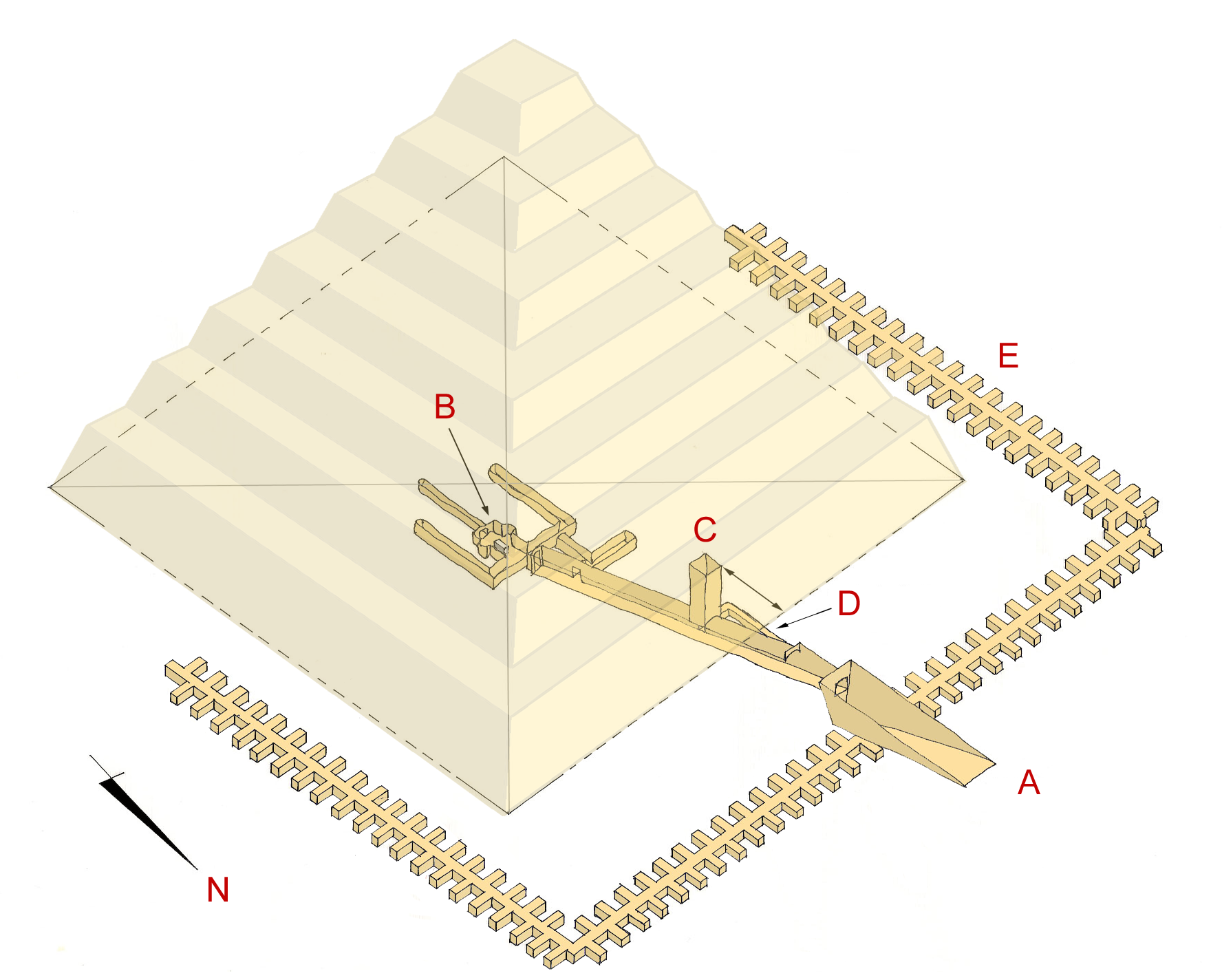
The pyramid was completely unknown until 1951, when Goneim noticed an odd rectangular outline in the desert while excavating the nearby Unas complex at Saqqara. Digging revealed a rubble-coursed enclosure wall, tall and thick, extending into a perimeter filled with false doors and niches. At the center of the complex stood what appeared to be a mastaba, a flat-topped structure rising only 2.43 meters above ground. Further excavation proved it was actually an unfinished pyramid with a base of 115 meters. Had it been completed, it would have risen to 70 meters in seven steps, surpassing the neighboring Step Pyramid of Djoser. The name Imhotep, the legendary architect of Djoser's pyramid, appears on the enclosure wall, though without titles, leaving his connection to this project uncertain.
Gold, Rubble, and an Empty Tomb
A descending passage on the north side led Goneim into a gallery blocked with rubble and masonry. The debris itself was rich: animal bones, demotic papyri, stone vessels from the Third Dynasty, and a decayed wooden casket containing gold bracelets, cosmetic cases, beads, and jars inscribed with Sekhemkhet's name. When workers breached the final blocked wall on May 31, 1954, they found the unfinished burial chamber with its alabaster sarcophagus. The anticipation was enormous. Here was a sealed royal tomb, apparently untouched since the Old Kingdom. When the lid was finally raised on June 26, the absence inside was as striking as any treasure would have been. Whether Sekhemkhet was buried elsewhere, whether the sarcophagus was ceremonial, or whether some other explanation accounts for the empty chamber remains debated.
The Fate of Goneim
The discovery should have made Zakaria Goneim's career. Instead, it destroyed him. Rumors spread, wrongfully, that he had helped smuggle an ancient artifact out of Egypt. The accusations were baseless but relentless, and they cast a shadow over his professional reputation at a moment when the empty sarcophagus had already invited skepticism about the significance of his find. On January 12, 1959, Goneim was found dead. Whether his death was suicide or something else has never been definitively established. Interest in the Buried Pyramid died with him, and the investigation of the site was left incomplete for years.
A Child in the South Tomb
In 1963, French archaeologist Jean-Philippe Lauer reopened the excavation, driven by the possibility of a south tomb and the hope of finding Sekhemkhet's missing mummy. Under a mastaba-like structure offset from the pyramid's central axis, Lauer found the foundations of a south tomb whose substructure had been partially destroyed by looters. Inside, he discovered a wooden coffin containing the remains of an unidentified two-year-old child, along with gold leaf fragments, animal bones, stone vessels, and Third Dynasty gold jewelry. The child was not Sekhemkhet; reliefs from Wadi Maghara in Sinai depict the pharaoh as an adult. The identity of the child buried beneath his unfinished monument remains unknown. Sekhemkhet's brief reign of approximately six years explains why the pyramid never rose beyond its first step, but it does not explain the sealed, empty sarcophagus at its heart.
From the Air
Located at 29.87N, 31.21E at the Saqqara necropolis, south of Cairo. The site is barely visible from the air as the pyramid rises only about 2.4 meters above ground, appearing as a low rectangular outline in the sand. The Step Pyramid of Djoser stands several hundred meters to the northeast and is a primary visual landmark. Best viewed at 2,000-4,000 ft AGL. Nearest airport is Cairo International (HECA). The Giza pyramids are visible approximately 20 km to the north-northwest.