Burke Museum of Natural History and Culture
It started with teenagers. In December 1879, four Seattle high school students formed a club to study natural history, gave it the earnest name "Young Naturalists Society," and began stuffing specimens into the back room of a founding member's house. That house belonged to the Denny family, whose patriarch, Arthur Denny, had helped found Seattle itself. Within a few years, the teenagers' collection had outgrown its room, then its building, then its campus. Today the Burke Museum of Natural History and Culture holds more than 16 million artifacts and specimens, occupies a $106 million building on the University of Washington campus, and serves as Washington's official state museum. The distance between a high school club and a world-class research institution turns out to be 145 years of accumulated curiosity.
The Teenagers Who Built a Museum
The founding members of the Young Naturalists Society were Edmond S. Meany, J. O. Young, P. Brooks Randolph, and Charles Denny. They wrote a constitution and bylaws in 1880 and began collecting in earnest. Charles Denny's father, Arthur, was a regent of the Territorial University of Washington and arranged for the club to meet on campus. In 1882, a biology instructor named Orson "Bug" Johnson joined the university and brought 20,000 animal specimens with him. Johnson threw himself into the Young Naturalists, and his collection gave the club the largest natural history holdings in the Pacific Northwest. The students built a permanent clubhouse on the university's downtown campus in 1886, funding construction through donations. By the 1890s, when Edmond Meany returned to the university as a history professor and revitalized the group he had co-founded as a teenager, the collection exceeded 60,000 specimens.
From Clubhouse to State Museum
When the University of Washington relocated from downtown Seattle to its present campus in 1895, the collection split. Specimens used for teaching moved to the new campus's Denny Hall; the rest stayed in the old clubhouse downtown. In 1899, the Washington State Legislature designated the university's portion as the Washington State Museum, giving institutional permanence to what had been a student project. The Young Naturalists voted to donate their remaining holdings to the state museum in 1904 and disbanded, their mission accomplished. In 1929, Erna Gunther became the museum's director, a post she held for more than 25 years, shaping its identity as a center for Pacific Northwest ethnography and natural science. The museum was eventually renamed for Judge Thomas Burke, a prominent benefactor, and became the official state museum of Washington.
Sixteen Million Objects Under One Roof
The Burke's collections span anthropology, biology, and geology in staggering breadth. Its ornithology division holds the world's largest collection of spread bird wings. Its frozen bird tissue collection is the second largest on the planet. The mammalogy collection contains more than 55,000 specimens, ranking it tenth among North American university collections. The Northwest Coast ethnographic holdings are the fifth largest collection of Native American art in the world, numbering 10,000 objects that include early collections assembled by Swan, Eells, and Emmons, alongside contemporary silkscreen prints and sculpture. One of the best-preserved Tyrannosaurus rex skulls in the world anchors the "Fossils Uncovered" gallery. A Baird's beaked whale skeleton, from a specimen that washed ashore on a Washington beach in 2015, greets visitors in the main lobby.
A Building Turned Inside Out
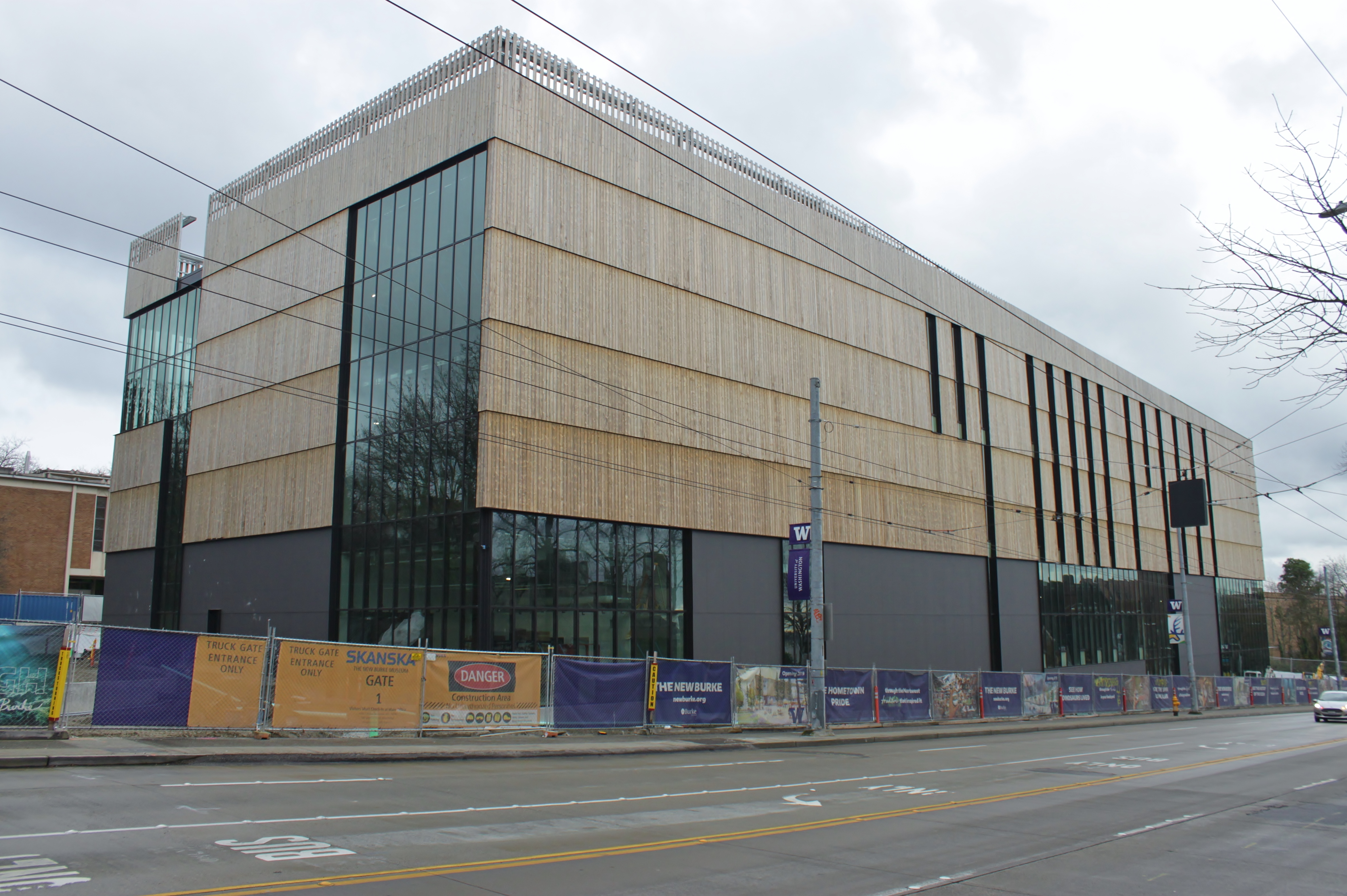
The Burke's new home opened on October 12, 2019, replacing a building that had grown too cramped for 16 million objects. Designed by UW alumnus Tom Kundig of Olson Kundig, the $106 million structure broke from traditional museum architecture by putting the work on display. Twelve visible labs allow visitors to watch scientists preparing fossils, cataloging specimens, and conducting research through floor-to-ceiling windows. Storage areas that would normally be hidden behind walls are visible through glass panels. Outside, a garden of 60 native Washington plant species surrounds the building and an adjacent courtyard. The museum's cafe, Off the Rez, serves Native American cuisine, connecting the Burke's deep engagement with Indigenous cultures of the Pacific Northwest to the daily experience of visiting. The old building was demolished in April 2019 after a careful transfer of millions of objects to the new facility next door.
From the Air
The Burke Museum is located at 47.661N, 122.310W on the northwest corner of the University of Washington campus in Seattle. From the air, look for the large campus bounded by NE 45th Street to the north and Montlake Boulevard to the east, with the distinctive Husky Stadium visible along the Ship Canal. The museum building sits near the intersection of 17th Avenue NE and NE 45th Street, identifiable by its modern angular design and adjacent garden courtyard. Nearest airports: Boeing Field/King County International (KBFI) 7nm south, Renton Municipal (KRNT) 9nm southeast, Seattle-Tacoma International (KSEA) 13nm south. Best viewed at 2,000-3,000 feet approaching from the west over Portage Bay.