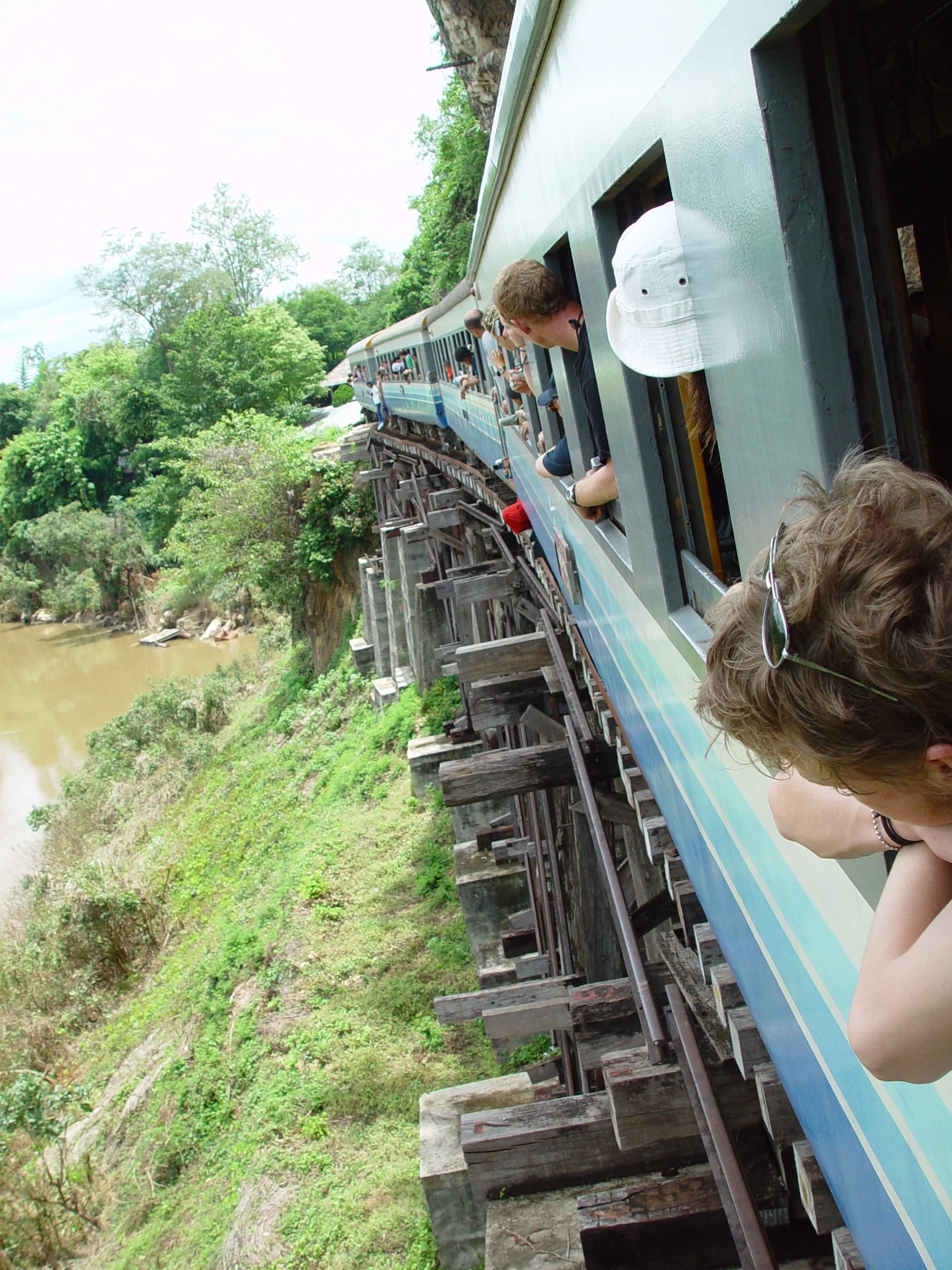
The Burma Railway: Tracks Laid in Suffering
They called it the Death Railway, and the name was earned in full. Between 1942 and 1943, the Imperial Japanese Army forced over 250,000 Southeast Asian civilians and 60,000 Allied prisoners of war to carve a 415-kilometer rail line through some of the most unforgiving jungle on Earth, connecting Ban Pong in Thailand to Thanbyuzayat in Burma. The British had surveyed this route decades earlier and dismissed it as too difficult. The Japanese built it in sixteen months. More than 90,000 civilians and 12,000 Allied soldiers died making it happen -- from disease, starvation, beatings, and exhaustion. The railway was a military necessity that became a mass grave.
An Impossible Route
The British had first surveyed a railway through these hills in 1885, tracing a path from Thailand across Three Pagodas Pass and down the valley of the Khwae Noi River into Burma. Engineers took one look at the terrain -- steep jungle ridges, rivers that flooded without warning, rock faces that would need to be cut by hand -- and shelved the plan. When Japan invaded Thailand on December 8, 1941, that abandoned survey became a blueprint for one of the war's most brutal engineering projects. Japan needed a supply line to its forces in Burma that avoided the Allied-controlled sea routes around the Malay Peninsula. The railway would run 258 miles through Thailand and 69 miles through Burma, requiring hundreds of bridges, countless cuttings, and the labor of tens of thousands.
The Human Cost
More than 180,000 Southeast Asian civilians were forcibly conscripted to build the railway -- Javanese, Malayan Tamils, Burmese, Malayan Chinese, and Thais trafficked by the Japanese military to work sites deep in the jungle. Limited colonial-era record-keeping means most of their names are lost. They died in numbers that can only be estimated: somewhere between 80,000 and 100,000 civilians perished during construction. Alongside them, some 60,000 Allied prisoners of war labored under the same brutal conditions. Malaria, cholera, dysentery, and tropical ulcers ravaged workers who were already weakened by starvation and physical abuse. Around 12,000 Allied soldiers died. One POW described finding himself "at the bottom of a social system that was harsh, punitive, fanatical, and often deadly." Artists like Ronald Searle and Jack Bridger Chalker secretly documented life in the camps, risking execution to create a visual record.
The Bridge and the River
The most famous structure on the line is Bridge 277, built over a stretch of the Mae Klong River near Kanchanaburi. British prisoners of war began construction on October 26, 1942, first building a temporary wooden bridge, then a permanent steel and concrete span. The river's name became tangled in translation -- British soldiers mispronounced "Khwae" as "Kwai" (meaning "buffalo" in Thai), and a 1952 novel and its 1957 film adaptation cemented the error in popular imagination. In 1960, the Thai government renamed the section of river passing under the bridge "Khwae Yai" to match the fame. The bridge survived Allied bombing campaigns in 1945, was repaired, and still stands today, carrying tourists on a short stretch of track that once carried supplies to war.
Hellfire Pass
Of all the cuttings along the railway, none carries more weight than Hellfire Pass in the Tenasserim Hills. It was the largest rock cutting on the entire line, carved through solid rock in a remote stretch of jungle where there were no proper tools -- no dynamite, no machinery. Workers chipped at the stone with hand drills, hammers, and picks, laboring through the night by the light of torches and bonfires. The flickering flames against the rock walls, and the skeletal figures of sick and starving men working in the firelight, gave the pass its name. Those who witnessed it said it looked like a vision of hell. Today Hellfire Pass is a memorial site, its walls still bearing the marks of hand tools, a silent record of what was demanded of human bodies in the service of a railway timetable.
What Remains
The railway was completed ahead of schedule. On October 25, 1943, the two sections of track -- one built from the Thai side, one from Burma -- met at kilometer 263, south of Three Pagodas Pass. The line operated for barely two years before Allied bombing rendered it unusable. After the war, the remains of Allied military dead were gathered from camps and lone graves along the route and reburied in official war cemeteries, including the Kanchanaburi War Cemetery. The mass graves of Southeast Asian civilian dead were exhumed and reburied at Wat Thaworn Wararam in Ban Tai. A short section of the original line still operates as a tourist railway in Thailand. Arumugam Kandasamy, trafficked from a Malayan estate at age fifteen, died in November 2024 at 97 -- believed to be the last living survivor of the civilian labor force.
From the Air
The Burma Railway ran from Ban Pong (13.82N, 99.88E) to Thanbyuzayat (16.00N, 97.72E) in Myanmar. The Bridge on the River Kwai is at approximately 14.04N, 99.50E near Kanchanaburi. Hellfire Pass is at approximately 14.37N, 98.86E. Nearest airports include Don Mueang (VTBD) 142 km east and Suvarnabhumi (VTBS) 134 km east. The Khwae Noi river valley is visible from altitude, winding through forested hills. The bridge at Kanchanaburi can be spotted near the confluence of rivers at the town.