The Night Montreal Burned Its Own Parliament
Alfred Perry, captain of a volunteer fire brigade, stood before a torchlit crowd on the Champ-de-Mars and placed his hat over the flame illuminating a petition to Queen Victoria. "The time for petitions is over," he declared. "If the men who are present here are serious, let them follow me to the Parliament Buildings." They followed. Within hours, Montreal's Parliament - seat of the Province of Canada's government - was a smoldering ruin, its legislative library and irreplaceable historical records reduced to ash. It remains the only time in the history of the British Empire and Commonwealth that citizens burned down their own Parliamentary Buildings in protest. The date was April 25, 1849, and the issue that drove ordinarily law-abiding subjects to arson was a bill that proposed to compensate people who had suffered financial losses during the rebellions of 1837-1838.
A Colony Tearing at Its Seams
The roots of the fire reached back more than a decade. In 1837 and 1838, citizens in both Upper and Lower Canada - present-day Ontario and Quebec - rebelled against the colonial government, demanding political reform and economic relief during a depression fueled by bad weather and the Panic of 1837. Lord Durham investigated and issued a sympathetic report, leading to reforms including the union of Upper and Lower Canada into a single province. But the wounds remained open. Many rebellion leaders had fled into exile; those who stayed had lost farms, businesses, and livelihoods to property damage and government reprisals. By the late 1840s, the question of whether these losses should be compensated had become the most explosive issue in Canadian politics.
Paying the Rebels
The Rebellion Losses Bill, introduced by reformist co-premier Louis-Hippolyte Lafontaine in January 1849, proposed to indemnify inhabitants of Lower Canada who had suffered property damage during the rebellions. An earlier commission had estimated receivable claims at nearly 242,000 pounds, though the actual payout was expected to stay under 100,000 pounds. The bill specifically excluded anyone who had pleaded guilty or been convicted of high treason. None of this mattered to its opponents. Tory politicians like Allan MacNab and Henry Sherwood denounced it as rewarding traitors and insulting the loyal subjects who had fought against the rebels. The English-language press in Montreal - The Gazette, the Courier, the Herald - was near-unanimous in its opposition. Only one English daily, the Pilot, supported the measure. Debates in the House turned violent before the bill even passed: fistfights erupted in the galleries, and the Speaker had to expel spectators. The Assembly passed the bill with majorities from both sections of the province. The Legislative Council approved it 20 to 14.
Forty-One Bills and a Riot
On April 25, 1849, the cabinet sent Francis Hincks to Governor Lord Elgin's residence at The Monklands to request his assent on a routine tariff bill - a European ship had arrived at the Port of Quebec and the new duties needed to be in force. Since Elgin was already coming to Parliament, he decided to assent to forty-one additional bills awaiting his signature. Among them was the Rebellion Losses Bill. When Elgin exited the building around 6:00 PM, a crowd of protesters blocked his path, pelting him and his aides with eggs and rocks. The governor scrambled into his carriage and fled at gallop speed back to Monklands, pursuers chasing him through the streets. Alarm bells rang across the city. The Gazette published an emergency Extra, calling on the "Anglo-Saxons" of Montreal to assemble at Place d'Armes. Between 1,200 and 1,500 people gathered to hear opposition speeches by torchlight.
Flames on the St. Lawrence
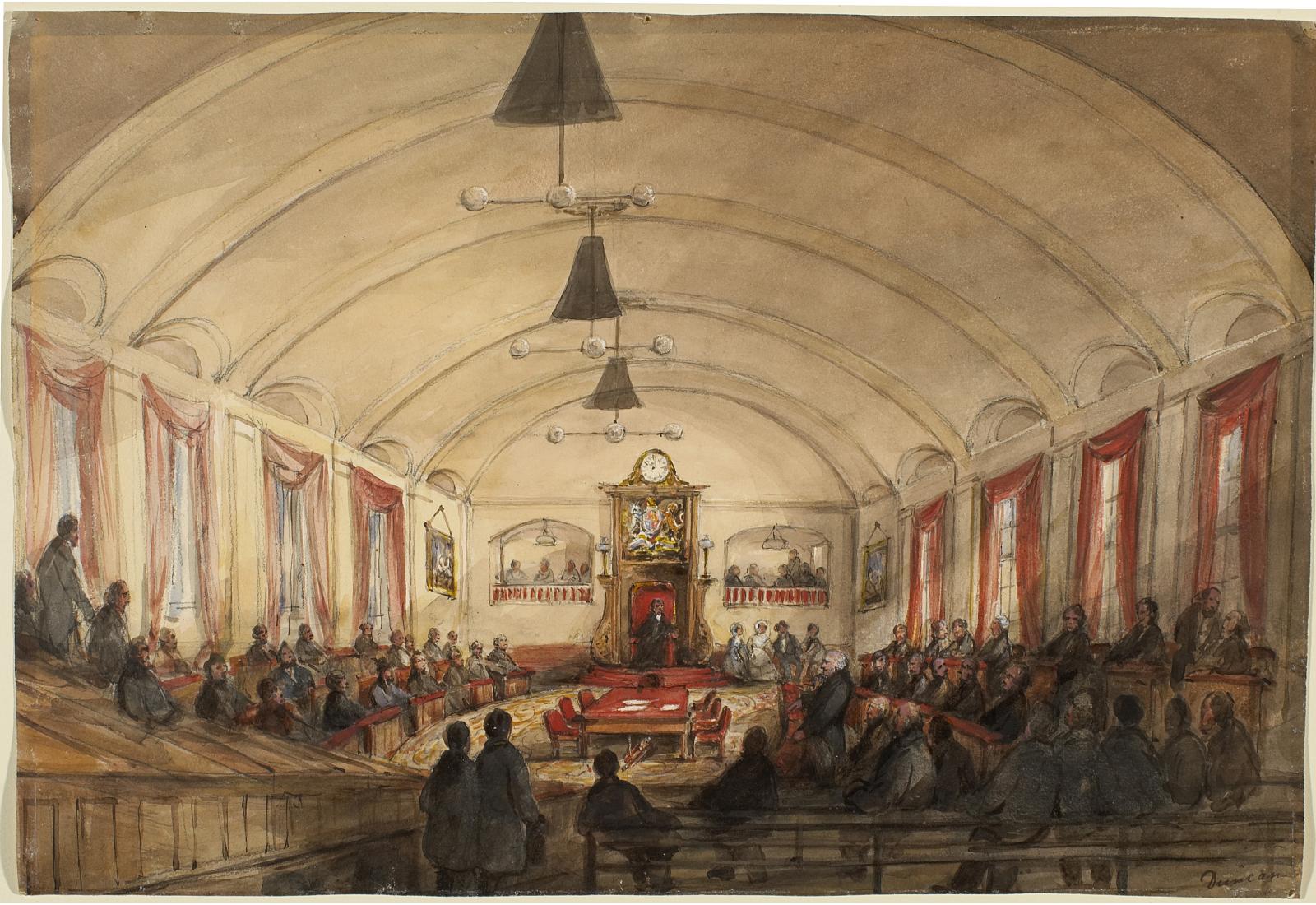
Perry's exhortation turned the protest into a march. The mob moved toward Parliament, pausing to smash the windows of the Montreal Pilot's offices along the way. When they reached the St. Anne's Market building, which housed both the Legislative Council and the Assembly, they found the House still in session - a committee was debating a judicial bill for Lower Canada at that late hour. The rioters shattered the windows. What happened next consumed not just a building but an era: the Parliament of the Province of Canada, its furniture, its documents, and its irreplaceable parliamentary library went up in flames. Historical records dating back decades were destroyed in a single night. The fire effectively ended Montreal's tenure as capital. The government would move to Toronto, then alternate with Quebec City in a rotating system known as perambulation, before Parliament eventually settled permanently in Ottawa - a city chosen partly because it was far enough from both English and French urban mobs to be safe.
Democracy Forged in Fire
The burning paradoxically strengthened the principles its perpetrators sought to destroy. Governor Elgin, despite the mob violence and personal attacks, refused to override the elected legislature or veto the bill. His restraint established that the Crown's representative would respect the will of Parliament - a foundational principle of Canadian democracy. Co-premiers Lafontaine and Baldwin, by maintaining order through constitutional process rather than authoritarian response, demonstrated that responsible government could survive its worst test. Many of the rebellion's leaders went on to shape the political and philosophical foundations of an independent Canada, achieved on July 1, 1867. The site of the burned Parliament at Place d'Youville in Old Montreal today gives little hint of what happened there. But the night the capital burned remains a turning point: the moment Canada chose democratic process over colonial obedience, even when democracy's results enraged half the population.
From the Air
The site of the former Parliament is at Place d'Youville in Old Montreal (45.50N, 73.56W), along the waterfront near the current Pointe-a-Calliere archaeology museum. From the air, Old Montreal is the dense historic quarter along the St. Lawrence's north bank, distinct from the modern downtown towers further north. The nearest major airport is Montreal-Trudeau International (CYUL), 20 km west. Montreal-Saint-Hubert (CYHU) lies across the river to the southeast. The St. Lawrence River and its islands - including Notre Dame Island and Saint Helen's Island - are prominent visual references when approaching from any direction.