Bussa Rebellion
The new administration in Bussa had been in place for three months when six hundred people decided they had seen enough of it. In early June 1915, armed with bows and arrows and led by a local prince named Sabukki, they seized the town, killed roughly half the members of the British-installed Native Administration, and sent the rest fleeing into the surrounding bush. For a brief moment, Bussa belonged to its own people again. The rebellion was small, lasting only days, but it exposed the fragility of indirect rule at the precise moment the British Empire could least afford to acknowledge it.
The Machinery of Indirect Rule
Bussa sat in Borgu Province, in the western reaches of Northern Nigeria. The town had been part of the Borgu Emirate, a political entity with its own hereditary leadership, before the British annexed it into the Northern Nigeria Protectorate. Between 1912 and 1914, Governor Frederick Lugard merged Northern and Southern Nigeria into a single protectorate and applied his doctrine of indirect rule: local leaders would govern their communities under British oversight, preserving traditional authority structures while extracting taxes and labor for the colonial state. The theory was elegant. The practice was less so. In Bussa, the hereditary Emir Kitoro Gani was judged too weak to collect taxes or fill labor quotas for railway construction. In 1912, the British resident at Yelwa, A.C. Boyd, broke up the Borgu Emirate into administrative districts, each governed by a Native Administration. Bussa's new administrator was Turaki, a former royal advisor who owed his position to British appointment rather than local legitimacy. Taxes went up.
Bows Against an Empire
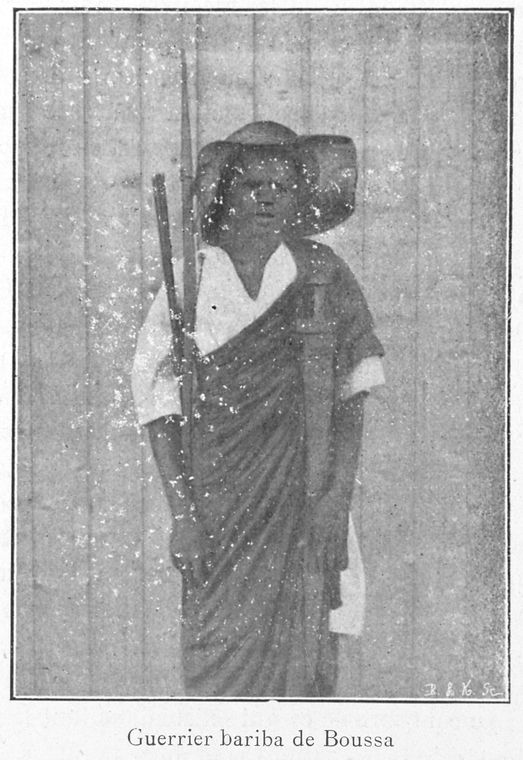
The insurrection began in early June 1915, the exact date unrecorded. Sabukki, described as a local prince, rallied approximately six hundred fighters who occupied the town. Their weapons were bows and arrows, traditional arms that were no match for rifles but sufficient against an administrative apparatus that had no military garrison. The rebels captured and killed about half the members of the Native Administration that had been installed just three months earlier. The surviving administrators abandoned their posts and fled. Though the rebellion was local and small in scale, it generated alarm far beyond Borgu. World War I was draining British military resources across Africa, and the Kamerun campaign against German forces in neighboring Cameroon had left garrisons understaffed. Colonial officials feared that any successful uprising, however minor, could inspire broader resistance across Nigeria and neighboring French Dahomey.
One Hundred and Fifty Shots
News of the rebellion reached the local District Official, Hamilton-Brown, on June 16. Despite the troop shortage, he assembled a small force from the West African Frontier Force and the Nigerian police. The government column moved into Bussa and engaged the rebels in what amounted to a brief skirmish. No soldiers were killed. Only 150 shots were fired, a measure of how one-sided the encounter was. Sabukki escaped across the border into French Dahomey, but the rebellion did not follow him there. The French colony remained quiet, and the uprising did not spread to neighboring communities.
The Weight of a Small Rebellion
The Bussa rebellion lasted days, involved a single town, and ended with a skirmish so minor that its total ammunition expenditure could be counted on a report. By conventional military standards, it barely registered. But its significance lay elsewhere. The rebellion demonstrated that indirect rule could not simply remove a legitimate leader and install a replacement without consequence. The people of Bussa had not rebelled against British sovereignty in the abstract; they had rebelled against the specific replacement of their emir with an appointed administrator and the raising of their taxes. It was a protest against the local mechanics of colonialism, not its global architecture. British historian Michael Crowder later made the Bussa rebellion the subject of a major scholarly work, recognizing it as a case study in how colonial systems generated resistance not through grand ideological opposition but through the accumulation of specific grievances. The rebellion belonged to a broader pattern of uprisings across British and French West Africa during World War I, including the Egba and Iseyin revolts in Nigeria and the Chilembwe uprising in Nyasaland, all fueled by the increased demands of a colonial state stretched thin by a European war.
From the Air
Located at 10.32N, 4.60E in Borgu, Niger State, Nigeria. The town of Bussa (now New Bussa, rebuilt after the original was flooded by Kainji Lake) sits near the western shore of Kainji Lake, which serves as the primary visual landmark. The lake and Kainji Dam to the south are visible from high altitude. Nearest airports include Minna Airport (DNMN) and Ilorin International Airport (DNIL). The Niger River valley defines the landscape. Best observed at 5,000-10,000 feet where the lake shoreline and surrounding savanna are clearly visible.