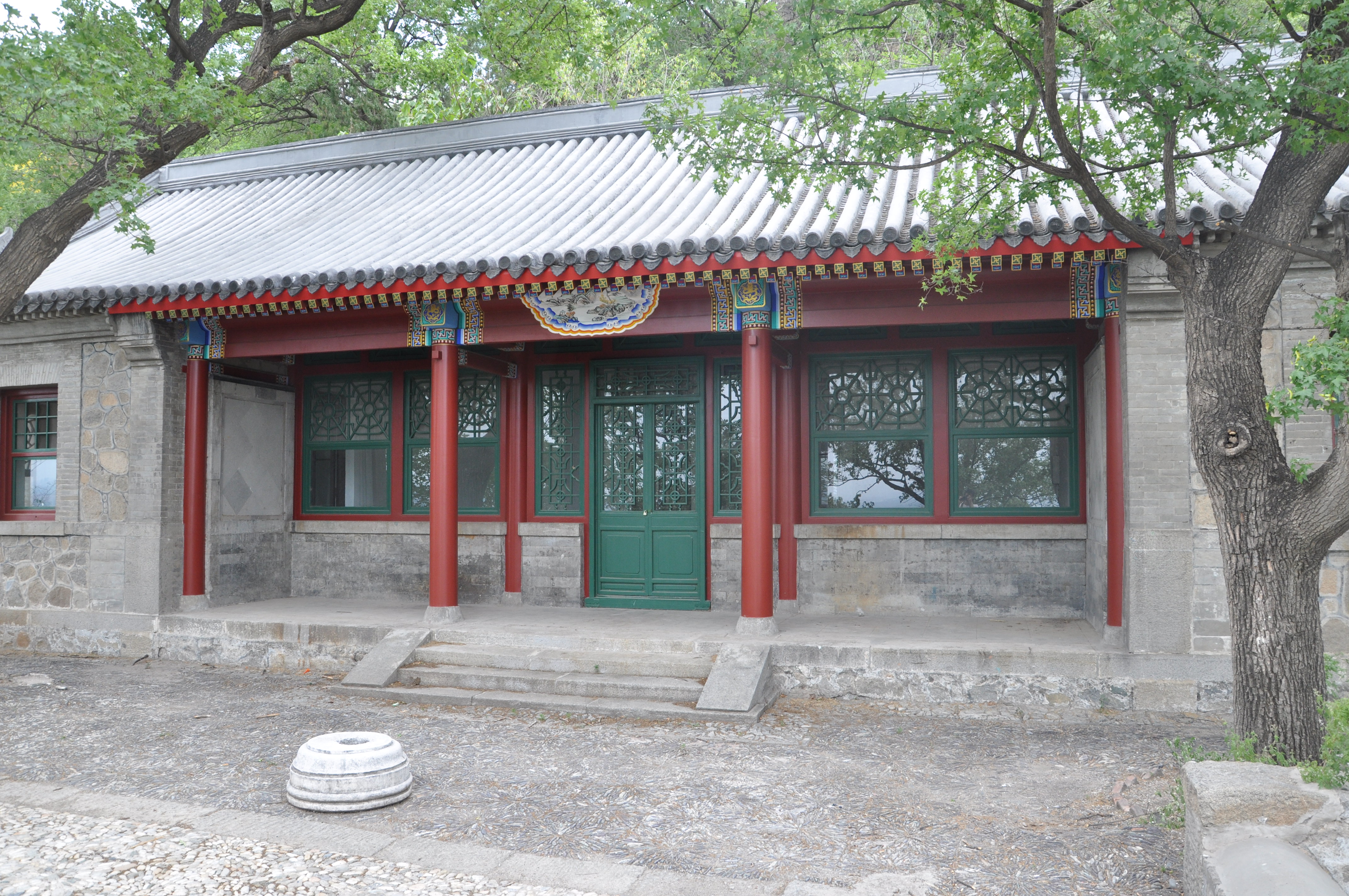
Bussiere Garden
Picture a French doctor in Chinese robes, pedaling a bicycle loaded with medicine through 30 kilometers of Japanese-occupied countryside toward the Western Hills. Jean-Augustin Bussiere did this more than once during the Second Sino-Japanese War, running supplies from Peking to guerrilla fighters in the mountains. His villa, Bussiere Garden, still stands in the hills of Haidian District -- a hybrid of Chinese courtyard architecture and European stonework that tells the story of a man who spent 41 years bridging two civilizations.
The Doctor Who Stayed
Bussiere arrived in Beijing in 1913 as a physician attached to the French legation and affiliated with the Peking Union Medical College. He came to import French medical equipment and expertise; he stayed for four decades. He married a Chinese woman named Wu Sidan, embraced Chinese culture with characteristic thoroughness -- learning the language, studying calligraphy and painting, eating Chinese food, wearing robes. His patients came from every social class. As president of a hospital during the war, he volunteered at the front, treating wounded Eighth Route Army soldiers and rural civilians. Later, he purchased cars to transport medical supplies and equipment from Japanese-occupied zones to the resistance areas along the Shanxi-Chahar-Hebei border.
A Garden Between Worlds
The estate Bussiere built in the hills north of Sujiaguo Town reflects its owner's double identity. It comprises three distinct structures: a Western-style barbican -- a three-story granite castle with a stone plaque from 1936 inscribed "To Practice Medicine to Save People" -- served as a treatment space for local villagers. The northern wing, perched on the mountainside, is a Chinese-style two-floor building with a traditional hip-and-gable roof, a lotus pond, wisteria, a fountain, and a stone bridge. The southern wing, built of black brick, was home to Bussiere's daughter. Horse chestnut trees, ginkgo, elm, and Sophora japonica shade the grounds. The compound was also, secretly, one of the Chinese Communist Party's underground intelligence stations. Before the Japanese invasion, Bussiere's British friends delivered two high-power telegraph transmitters through the garden to Yan'an.
Nobel Poets and Revolutionary Telegraphs
Bussiere Garden attracted a remarkable circle. The French poet Saint-John Perse, who would later win the Nobel Prize in Literature, visited China in Bussiere's company. His long expressionist poem Anabase was written against the landscape of the desert and nearby Mount Miaofeng. Andre d'Hormon, who spent more than a decade proofreading a French translation of the Chinese classic Dream of Red Mansions, was also a regular visitor. The garden served as a social hub for the French elite in China -- yet the guerrilla headquarters on Mount Miaofeng sat less than 100 meters away. The villa held these contradictions easily: literary salon and intelligence post, French castle and Chinese garden, a place where the Enlightenment met the revolution.
A Legacy Renewed
Bussiere returned to France in 1954 at the age of 82. His son Jean Louis, born the following year, became a cardiologist known in China as "Bussiere Junior." In 2001, the Haidian District government designated the garden a key cultural relics protection unit, and in 2011 it was added to Beijing's municipal list of protected historical sites. The renovation was completed in 2014, timed to the 50th anniversary of diplomatic relations between China and France. That same year, Xi Jinping, speaking in Paris, invoked Bussiere by name: "We will never forget that countless French friends have made an important contribution to our cause. Some of them, with the risk of their lives, opened up a route through which precious medicine was transported to the anti-Japanese base areas." The garden endures as a monument to one man's improbable life at the intersection of medicine, espionage, literature, and cross-cultural devotion.
From the Air
Located at 40.06N, 116.09E in the hills of Haidian District, northwest of central Beijing, near Mount Miaofeng and the Western Hills. The estate is nestled in hilly terrain north of Sujiaguo Town. Nearest major airport is Beijing Capital International Airport (ZBAA/PEK), approximately 45 km east. Best viewed at lower altitudes, 2,000-3,000 ft, where the villa compound is visible among wooded hillsides.