Butkara Stupa
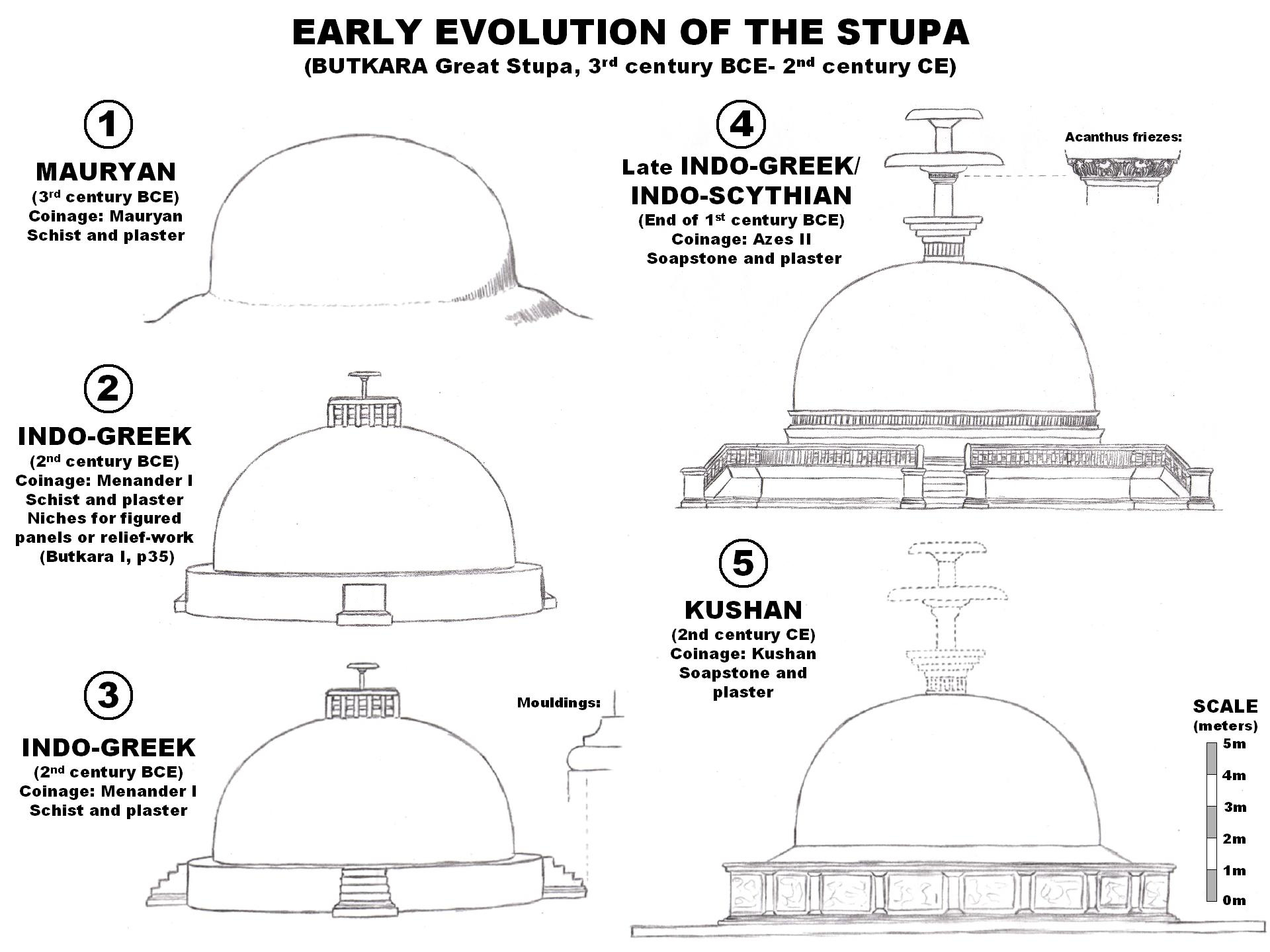
Buried beneath each layer of the Butkara Stupa is another, older version of itself. Five times over the centuries, builders in the Swat Valley enlarged this Buddhist monument by the simplest method imaginable: they encased the existing structure in a new, larger one, like nesting dolls made of stone. When Italian archaeologists began peeling those layers apart in 1956, they found coins that told a story spanning empires -- from the Mauryas to the Indo-Greeks to the Indo-Scythians -- and sculptures that redrew the timeline of one of art history's most consequential fusions.
Where Greek Columns Met Buddhist Prayer
The Butkara Stupa sits near Mingora in the Swat District of Khyber Pakhtunkhwa, Pakistan. In the centuries following Alexander the Great's campaigns, Greek-descended kings ruled northwestern India, and their cultural fingerprints are visible at Butkara in ways that would have startled both traditions. During the 2nd century BCE, the stupa was "monumentalized" -- the Italian excavators' term -- with Hellenistic architectural decorations. Corinthian capitals, the ornate column tops that crowned temples across the Mediterranean, appeared here bearing carved Buddhist devotees wearing the Greek chlamys cloak fastened with a fibula pin. This was not mere borrowing. It was the birth of Greco-Buddhist art, a tradition that would shape how the Buddha was depicted across Asia for the next two thousand years.
The Coin in the Column
Archaeology lives and dies by dating, and Butkara delivered its evidence with unusual precision. In the deepest stratum, excavators found a coin of Chandragupta Maurya, placing the stupa's origins in the Ashokan period -- the 3rd century BCE, when the great Mauryan emperor was spreading Buddhism across the subcontinent. The second stratum yielded a coin of Menander I, the Indo-Greek king who famously debated a Buddhist monk in the text known as the Milinda Panha. But the most striking find sat beneath an Indo-Corinthian capital: a reliquary and a coin of Azes II, the Indo-Scythian ruler, securely dating that sculpture to earlier than 20 BCE. Each coin was a timestamp sealed in stone, marking the moment one empire's patronage gave way to the next.
The Earliest Face of the Buddha
Among Butkara's most significant discoveries is an in-situ seated figure, either a Buddha or a Bodhisattva, that scholars consider one of the earliest known iconographic representations of the Buddha in northwestern India. Before this era, Buddhist art avoided depicting the Buddha in human form, representing him instead through symbols -- footprints, an empty throne, the Bodhi tree. The Butkara figure suggests that the shift toward figurative representation happened roughly simultaneously in the Gandhara region (around Swat and Peshawar) and in Mathura, far to the southeast in the Gangetic plain. Two artistic traditions, separated by hundreds of miles, arrived independently at the same revolutionary idea: give the Enlightened One a face.
An Italian Mission in the Swat Valley
The excavation was the work of the Istituto Italiano per l'Africa e l'Oriente, led by archaeologist Domenico Faccenna beginning in 1956. Faccenna's team spent years documenting the stupa's five enlargement phases, each one a record of the political and spiritual currents flowing through this valley. The nearby Hellenistic fortifications at Barikot are thought to be contemporary with the stupa's Greco-Buddhist phase, suggesting that Swat was not an outpost but a center of Indo-Greek civilization. Today, a large portion of Butkara's artifacts reside in the National Museum of Oriental Art in Rome and the City Museum of Ancient Oriental Art in Turin, thousands of miles from the valley where Greek stonemasons and Buddhist monks once collaborated on something neither tradition could have produced alone.
From the Air
Located at 34.76N, 72.36E near Mingora in the Swat Valley, Khyber Pakhtunkhwa, Pakistan. The valley is flanked by mountains on both sides and is visible as a wide green corridor from altitude. The Swat River runs through the valley floor. Nearest airport is Saidu Sharif Airport (OPSS), immediately adjacent. Peshawar (OPPS) is the nearest major airport, approximately 160 km to the south. Best viewed at 5,000-8,000 ft AGL. The archaeological site is near the city of Mingora, the largest settlement in the valley.