Bwindi Impenetrable National Park
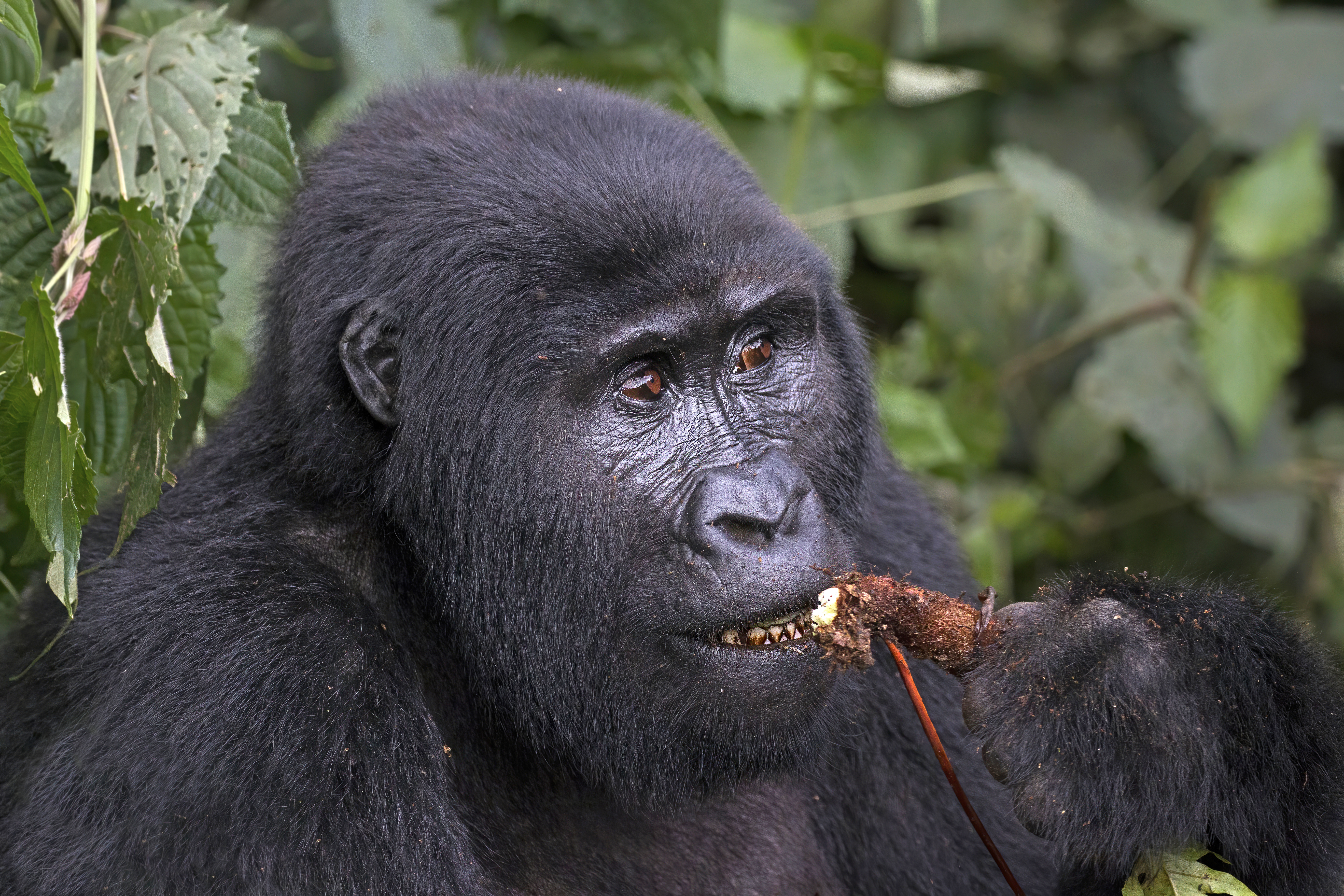
The name is not poetic. It is a warning. "Impenetrable" describes what happens when you step off the trail in Bwindi: a wall of vines, ferns, and undergrowth so dense that machetes barely make progress. This forest has been growing, uninterrupted, for at least 25,000 years -- one of the oldest surviving rainforests in Africa -- and its vegetation has had geological time to fill every gap between the trees. Somewhere inside that tangle, roughly half the world's mountain gorillas are going about their lives. There are approximately 1,063 mountain gorillas left on Earth, and Bwindi Impenetrable National Park shelters over twenty habituated families of them across four sectors of steep, muddy, cloud-draped forest in western Uganda.
The Forest That Survived the Ice Ages
During the driest periods of East African climate history, when most of the region's forests shrank or vanished, Bwindi endured. Its deep valleys and high ridges -- the altitude ranges from 1,160 to 2,607 meters -- created microclimates wet enough to sustain rainforest even as surrounding landscapes dried to grassland. This persistence turned Bwindi into a biological ark. Species that could not survive elsewhere found refuge here and stayed. The result is extraordinary: over 1,000 flowering plant species, more than 200 tree species, 120 mammal species, 350 birds, and 200 butterflies packed into 331 square kilometers of nearly vertical terrain. Twenty-three of the bird species are Albertine Rift endemics -- found nowhere else in the world. The African green broadbill, one of the continent's rarest birds, draws dedicated birders who consider it a life-list prize.
Tracking the Gorillas
Gorilla trekking at Bwindi is not a hike with a guaranteed payoff. Registration begins at 8:30 in the morning. Briefings start at nine. Then you walk -- sometimes for fifteen minutes, sometimes for eight hours, depending on where the gorillas slept the night before. The terrain is the park's namesake: steep hillsides where you grip bushes and grass to keep from sliding, stream crossings on slick logs, tunnels through vegetation that closes overhead. Porters are available and wise to hire, not only for the help but because their employment feeds money into communities that once viewed the forest as land to be cleared. When you reach the gorillas, you have one hour. The rule exists because mountain gorillas share roughly 98 percent of human DNA, making them vulnerable to our respiratory infections, our flu, our common colds. If you are sick, your permit is forfeited. The park allows only eight visitors per gorilla family per day -- a carrying capacity designed to protect the animals, not maximize revenue.
Four Sectors, Four Personalities
Bwindi's gorilla families are spread across four trailheads, each with a distinct character. Buhoma, in the north, is the most established sector -- the first to open to tourism, the most accessible by road, and the one with the widest range of lodges from luxury eco-camps to community-run guesthouses. Ruhija, to the east, sits on a high ridge favored by birders; its misty forests are home to several gorilla groups and some of the best Albertine Rift endemic sightings. Rushaga, in the south, specializes in the Gorilla Habituation Experience, where visitors spend up to four hours with a group still learning to tolerate human presence -- a rawer, less predictable encounter than standard trekking. Nkuringo, in the southwest, perches on a stunning ridgeline with views across to the Virunga volcanoes. The walk between Buhoma and Nkuringo, through the heart of the forest, takes five hours with a guide and is one of Uganda's great hiking experiences.
The Batwa and the Border
Bwindi's conservation story is not simple. When the Ugandan government upgraded the area from a forest reserve to a national park in 1991, the Batwa people -- one of East Africa's oldest indigenous groups -- were evicted from the forest where they had lived as hunter-gatherers for millennia. They received no compensation. The displacement pushed Batwa communities into poverty on the forest margins, and the resulting tensions shaped how Bwindi approaches community relations to this day. Cultural programs now employ Batwa guides to lead forest walks and share traditional knowledge, and tourism revenues are shared with surrounding villages. But the park also sits near the volatile border with the Democratic Republic of Congo, and its history includes a 1999 attack in which Interahamwe militants kidnapped and killed tourists and a ranger in the Buhoma sector. Such incidents are now extremely rare, and the park is well-patrolled by the Uganda Wildlife Authority, but Bwindi's human story is inseparable from the broader turbulence of the Great Lakes region.
The Impenetrable at Dawn
What stays with visitors is not the gorilla encounter alone but the forest itself. At dawn, before the trekking groups assemble, Bwindi is a cathedral of sound: the deep hooting of chimpanzees, the metallic calls of sunbirds, the steady drip of condensation falling from tree ferns that look like they belong in the Cretaceous. Giant red stinkwood trees and Newtonia buchananii tower above a canopy so thick that midday feels like dusk on the forest floor. Epiphytic orchids and mosses coat every surface. The air smells of wet earth and decomposition -- the constant recycling of organic material that has sustained this forest for 25,000 years. The name Bwindi, in the local Rukiga language, means "place of darkness," and even on a bright day, the canopy lets through only scattered columns of light. It is a place that reminds you how small and temporary human presence is, and how much has been going on in these mountains without us.
From the Air
Located at 1.05S, 29.62E in western Uganda near the DRC border. From cruising altitude, Bwindi is visible as a dense block of dark green forest -- distinctly different from the lighter cultivated land surrounding it on all sides. The park's irregular boundary follows ridgelines and valleys in steep terrain ranging from 1,160 to 2,607 m. The Virunga volcanoes are visible to the southwest. Nearest airstrips: Kihihi Airstrip (for Buhoma and Ruhija sectors) and Kisoro Airstrip (for Nkuringo and Rushaga sectors), both served by daily flights from Entebbe International Airport (HUEN). Kigali International Airport (HRYR) in Rwanda is an overland alternative from the south.