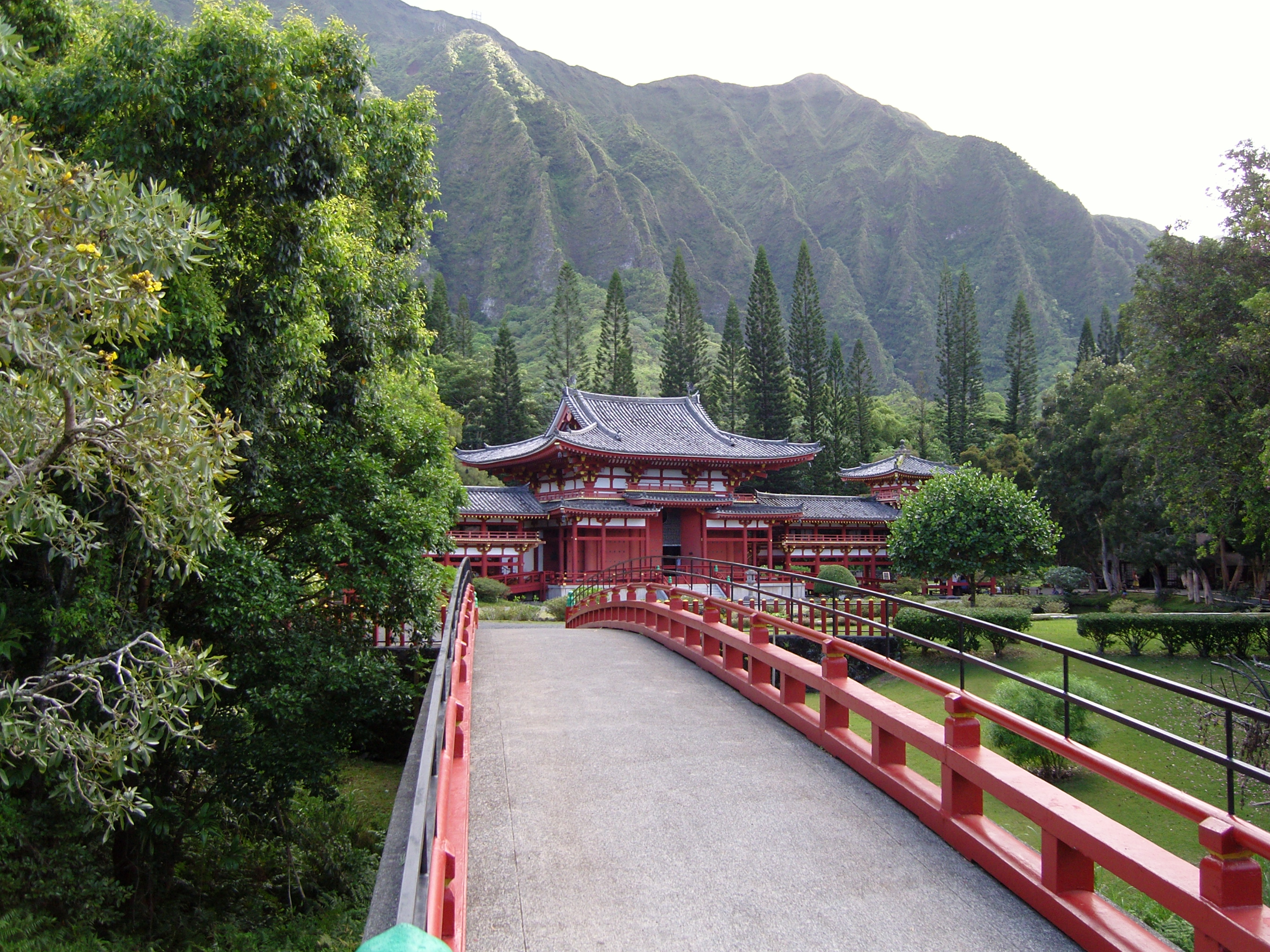
Byodo-In Temple
A three-ton brass bell hangs at the entrance, and visitors ring it before stepping inside. The sound carries across the Valley of the Temples on Oahu's windward coast, bouncing off the fluted ridges of the Ko'olau Range and fading into mist. Behind the bell stands the Byodo-In Temple, a crimson structure reflected in a koi-filled pond, flanked by peacocks and wild chickens. It looks ancient. It is not. Dedicated in June 1968, this concrete replica of a 900-year-old World Heritage Site near Kyoto was built to mark the centennial of Japanese immigration to Hawaii -- a monument not to religion exactly, but to the persistence of culture across an ocean.
An Original in Uji
The original Byodo-in stands near the ancient city of Kyoto, founded as a monastery by the nobleman Fujiwara no Yorimichi in 1052 during the Heian period. Its centerpiece is the Phoenix Hall, named for the twin fenghuang birds perched on the roof with outstretched wings. Inside, a wooden statue of Amitabha carved by the master artisan Jocho in 1053 sits surrounded by fifty-two bodhisattvas dancing and playing instruments on floating clouds -- an artistic rendering of Sukhavati, the pure land of Buddhist scripture. The hall, the statue, and the bodhisattvas are all designated Japanese national treasures. From 2001 to 2007, the original underwent extensive restoration to preserve nearly a millennium of craftsmanship.
A Century of Crossings
Japanese immigrants began arriving in the Kingdom of Hawaii in the late 1860s, drawn by labor contracts on sugarcane and pineapple plantations. They joined Chinese, Filipino, Korean, Portuguese, and Native Hawaiian workers in the fields, and over the decades built temples, schools, and community organizations that wove Japanese culture into the fabric of the islands. By 1968, a century had passed since those first arrivals, and the state decided to honor the anniversary in stone -- or rather, in concrete. The Byodo-In Temple was commissioned as a smaller-scale replica of the Kyoto original, though built with modern materials rather than the traditional joinery of its wooden ancestor. Governor John A. Burns, long admired in the Japanese community for championing Japanese-American civil rights during the territorial era, presided over the dedication.
The Valley of Many Faiths
The temple sits within the Valley of the Temples Memorial Park, founded by developer Paul Trousdale in 1963. What makes this cemetery unusual is its ecumenism. Large Catholic statues depicting the Passion of Christ and the Virgin Mary stand within sight of the Buddhist temple. Shinto, Protestant, Catholic, and Buddhist residents of Hawaii are buried here side by side. The mausoleums hold some of the islands' most prominent figures, including the entrepreneur Walter F. Dillingham. For a time, former Philippine President Ferdinand Marcos was interred in a private mausoleum overlooking the Byodo-In -- a geopolitical footnote tucked into a memorial garden. The juxtaposition of traditions feels distinctly Hawaiian, a place where faiths coexist without competing.
Lotus, Koi, and Cameras
Inside the temple, an eighteen-foot gilded statue of the Lotus Buddha gazes serenely from beneath 11,000 square feet of roof. The temple welcomes worshippers of all faiths, hosting not only meditation and prayer but also weddings and events. Outside, the grounds have become one of Oahu's most photographed locations, recognizable from episodes of Hawaii Five-O, Magnum P.I., and Lost, where the temple stood in for a South Korean setting. The 2001 film Pearl Harbor used it as a replica of the original Japanese temple. Mist-capped mountains loom directly behind, and on overcast mornings the clouds descend low enough to brush the roof tiles, making the valley feel like a pocket of Kyoto transplanted across the Pacific.
From the Air
Located at 21.43N, 157.83W in the Valley of the Temples on Oahu's windward coast. The temple's red structure is visible against the green valley floor, backed by the dramatic fluted cliffs of the Ko'olau Range. Best viewed at 2,000-3,000 feet AGL approaching from the east over Kaneohe Bay. Nearest airports: PHNL (Honolulu International, 10 nm SW), PHNG (Kaneohe Bay MCAS, 3 nm NE).