Bytown
The name was a joke. At a small dinner party sometime around 1827, a group of British officers needed something to call the scattering of tents and shanties that had sprouted where the Rideau Canal met the Ottawa River. Lieutenant Colonel John By was directing the canal's construction, so someone suggested "Bytown" -- a jocular reference that got a few laughs and then, to everyone's surprise, stuck. It appeared on official correspondence by 1828. For the next twenty-seven years, this rough-edged settlement would bear its accidental name through riots, epidemics, timber booms, and bitter fights over land -- before reinventing itself as the City of Ottawa and, a decade later, as the capital of a new nation.
The Canal That Built a Town
Bytown owed its existence to imperial anxiety. After the War of 1812 exposed how vulnerable the St. Lawrence River was to American attack, Britain needed a secure military supply route between Montreal and the Great Lakes. The answer was the Rideau Canal, a 202-kilometre waterway linking the Ottawa River to Lake Ontario at Kingston. Colonel John By arrived in 1826 with orders from Governor General Dalhousie to oversee construction. The founding was marked by a ceremonial sod turning, and Dalhousie authorized By to divide the surrounding land into lots. By laid out streets that mostly survive today -- Wellington, Rideau, Sussex, Sparks -- and the settlement split into two halves around the canal. Upper Town, to the west, occupied the high ground where Parliament Hill now stands. Lower Town, to the east, grew into the commercial district still anchored by the ByWard Market.
Corktown and the Deep Cut
Among the thousands who dug the canal were hundreds of Irish labourers who had arrived penniless from County Cork. Colonel By allowed them to erect turf and log shanties along both sides of the "Deep Cut" section of the canal, a concession to their desperate poverty. This improvised settlement became known as Corktown. By 1829, roughly 150 houses clung to the muddy banks, and women and children had joined the men. The settlement may have sprawled without sanction through the Lower Town swamp and along the banks of the Rideau River. These were the men who performed the hardest labour on the canal, blasting through rock and wading through swamps rife with malaria. Their shantytown was not a town at all, but it was the human foundation on which Bytown was built.
Timber, Riots, and Growing Pains
Once the canal was finished in 1832, the Ottawa River timber trade took over as Bytown's economic engine. Squared timber was floated down the Ottawa River to Quebec for export to Britain, and entrepreneurs flooded in to profit from the boom. But prosperity brought violence. The Shiners' War, which raged from 1835 to 1845, pitted Irish Catholic labourers against French Canadian rivermen in a bloody struggle for control of the timber trade. Barely had that conflict cooled when the Stony Monday Riot erupted in 1849, a political clash between Tories and Reformers that turned the streets into a battleground. Through it all, Bytown kept building. Thomas McKay constructed the commissariat building in 1826, now preserved as the Bytown Museum. He also built Rideau Hall, which would become the official residence of Canada's governor general. Notre-Dame Cathedral Basilica rose in the developing town, and the University of Ottawa traces its origins to an 1846 college.
Before Bytown: Richmond Landing
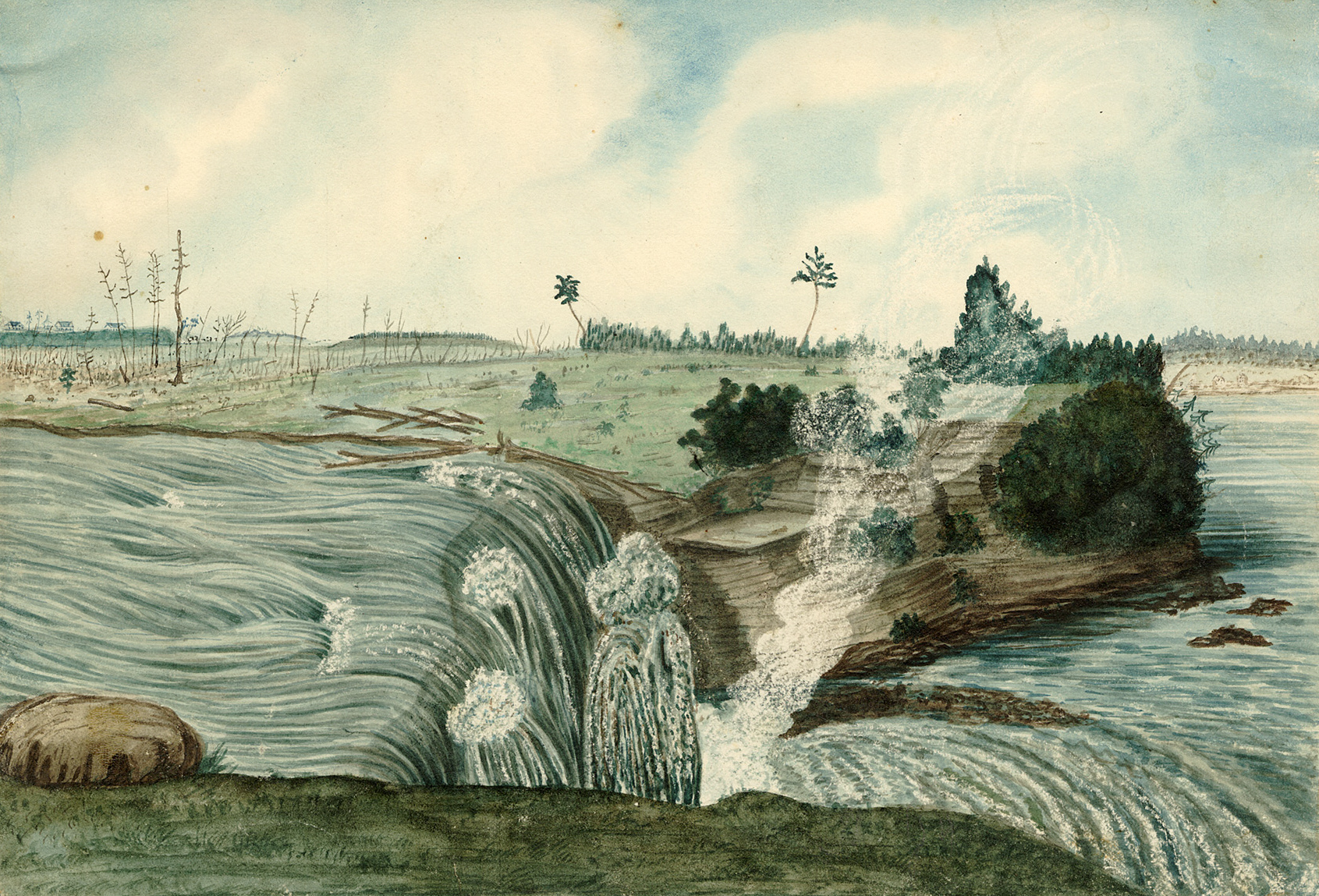
Bytown was not the first settlement on this stretch of river. In 1809, a man named Jehiel Collins built a log cabin and store on the south shore of the Ottawa River near the thundering Chaudiere Falls. Collins is credited as the first settler of what would become Bytown. His little outpost passed to an assistant named Caleb T. Bellows, and by 1819 the landing had its first tavern. That same year, soldiers building a road to Richmond, Ontario stayed at the settlement, and it became Richmond Landing. The road they cut through the forest -- stumps and all, likely following an old portage trail around the falls -- became Richmond Road, Ottawa's first thoroughfare. A tavern from this era, shown on Bytown's earliest maps, was excavated in modern times before the construction of the Canadian War Museum, whose east side now covers the site.
From Joke to Capital
Bytown's path to incorporation was tortuous. The Ordnance Department controlled lands in the town's core that had originally belonged to Nicholas Sparks, and many residents believed these holdings blocked economic progress. Multiple attempts at incorporation beginning in 1845 were stymied. An 1847 act was actually sanctioned by the Legislative Assembly and the governor, only to be disallowed by the Queen -- possibly because the Crown feared losing control of the military lands. When Ordnance finally returned the disputed property through the Vesting Act, the obstacle was removed, and Bytown was incorporated on January 1, 1850. John Scott, elected in 1847, served as the town's first mayor. Just five years later, on January 1, 1855, Bytown became the City of Ottawa. The joke of a name was retired, but it lives on in the Bytown Museum, the ByWard Market, and the memory of a canal-building camp that became a nation's capital.
From the Air
Bytown's historic core is located at 45.42N, 75.69W, where the Rideau Canal meets the Ottawa River. From the air, the canal's distinctive eight-lock staircase descending from Parliament Hill to the river is clearly visible. Upper Town corresponds to the area around Parliament Hill (the prominent Gothic Revival buildings on the bluff), while Lower Town extends eastward to the ByWard Market district. The Chaudiere Falls, site of Richmond Landing, are visible just upstream. Recommended viewing altitude: 2,000-4,000 feet AGL. Nearest airports: Ottawa/Macdonald-Cartier International (CYOW) 8nm south, Ottawa/Rockcliffe (CYRO) 3nm northeast, Gatineau Executive (CYND) 5nm north.