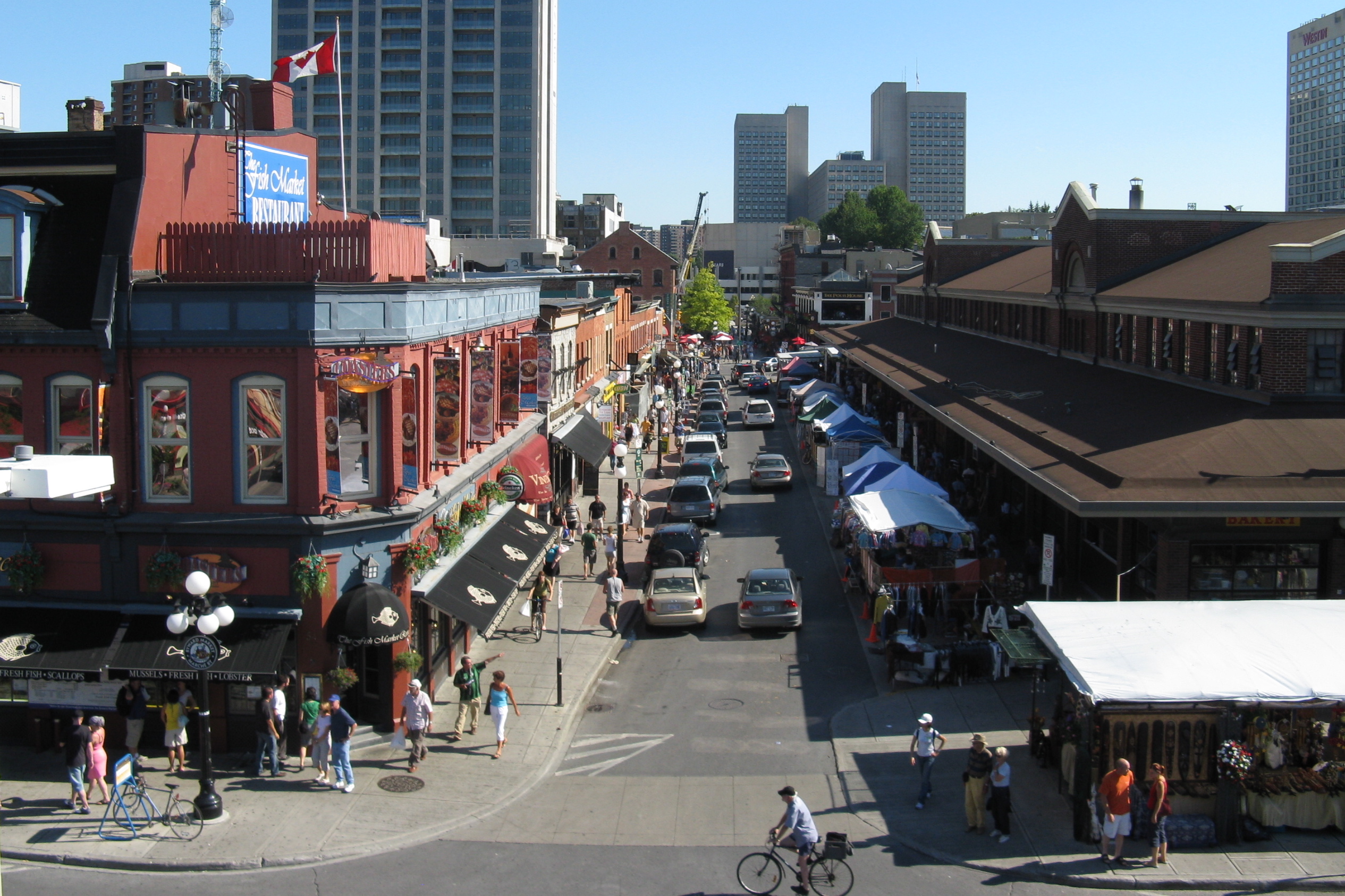
ByWard Market
The BeaverTail -- a slab of fried dough stretched into the shape of a beaver's tail, dusted with cinnamon sugar -- is sold from a stall that has been serving them in roughly the same spot for decades. Around it, farmers stack pyramids of Ontario peaches in summer and bushels of squash in autumn. This is the ByWard Market, and it has been Ottawa's public marketplace since before Ottawa was Ottawa. When Lieutenant Colonel John By surveyed and divided this land into lots in the late 1820s, the eastern half of his settlement became the "By Ward," and the open-air market that sprang up along George, York, ByWard, and William streets has never stopped trading. Nearly two centuries on, it remains the densest concentration of eating places, bars, and nightclubs in the National Capital Region.
A Surveyor's Ward, a City's Soul
The name is a piece of municipal archaeology. John By, the Royal Engineer who directed construction of the Rideau Canal beginning in 1826, also surveyed and planned the settlement that grew around it. The eastern portion of Bytown was designated the "By Ward" -- an administrative division named for its surveyor -- and the market that took root there inherited the name. The district sits in the historic Lower Town, bordered by Sussex Drive to the west, Cumberland Street to the east, Cathcart Street to the north, and Rideau Street to the south. Sussex Drive, one of Ottawa's most important ceremonial routes, connects the market to Parliament Hill and the prime minister's residence. The market building operates year-round, while open-air stalls offering fresh produce and flowers appear in warmer months, regulated by the ByWard Market District Authority, which also oversees the smaller Parkdale Market on the city's west end.
Where French Met Irish
The ByWard Market grew at the intersection of Ottawa's two founding communities. French Canadians and Irish immigrants made this neighbourhood their focal point, and the large Catholic population between them supported the construction of Notre-Dame Cathedral Basilica, one of the oldest and largest Roman Catholic churches in Ottawa. The cathedral's profile proved so distinctive that architect Moshe Safdie incorporated its silhouette into the design of the National Gallery of Canada, built directly across Sussex Drive. That kind of dialogue between old and new defines the district. Five open-air courtyards developed over the years stretch from Saint Patrick Street to George Street, their cobblestones lined with flowers, park benches, fountains, and sculptures. Several surrounding houses are designated heritage buildings, standing within sight of the modern United States Embassy on Sussex Drive, whose bronze sculpture by Joel Shapiro was dedicated by Hillary Clinton.
After Dark
When the office towers on Wellington Street empty out, the ByWard Market fills up. A four-block zone around the market holds the highest density of restaurants, bars, and nightclubs in the National Capital Region, and the streets beyond add boutiques and more restaurants in abundance. University students and young professionals throng the district at night, drawn by a bar scene that has made the market Ottawa's premier nightlife destination. Buskers line the sidewalks -- magicians, guitarists, singers -- performing for crowds that spill between patios. The transformation is dramatic: a neighbourhood that sells fresh corn and cut flowers by day becomes a corridor of music, neon, and conversation by evening. The district also sits steps from the Rideau Centre shopping mall, making it a natural gathering point where the capital's political, cultural, and social lives overlap.
Constant Reinvention
The ByWard Market has survived by adapting. What began as a produce market for a canal-building settlement evolved through the timber boom era, absorbed waves of immigration, and reinvented itself again as Ottawa grew into a modern capital. A multitude of specialty food stores and restaurants have sprouted in recent decades, reflecting the increasingly cosmopolitan nature of downtown Ottawa. The neighbourhood today is markedly mixed: young professionals, families, tourists, diplomatic staff from nearby embassies, and longtime francophone residents all share the same sidewalks. The area is predominantly English-speaking, but the French presence that helped build the district remains significant. In 2000, broadcaster CHUM Limited opened a studio complex at 87 George Street, and when a fire destroyed CTV's Nepean studios in 2010, the station relocated to the market -- proof that even media companies are drawn to the district's energy.
Two Centuries of Trade
According to the 2011 Census, only about 3,000 people actually live in the ByWard Market area. But the population that passes through daily dwarfs that figure. The market operates under a City of Ottawa municipal services corporation run by a nine-member board of directors, a structure that reflects both its civic importance and the complexity of managing a district that functions simultaneously as a residential neighbourhood, a heritage precinct, a tourist destination, and a commercial engine. From the air, the market's footprint is modest -- a handful of blocks tucked between the canal and the river. But on the ground, it feels vast, a place where you can buy a wheel of Quebec cheese, eat pho, browse a gallery, catch a street performer, and end the night at a jazz club -- all without crossing a major road. That density of experience is what John By's modest ward became, and it shows no sign of slowing down.
From the Air
The ByWard Market is located at 45.43N, 75.69W, in Ottawa's Lower Town district immediately east of the Rideau Canal and Parliament Hill. From the air, the market area is identifiable as the dense block of low-rise buildings between Sussex Drive (the prominent tree-lined road running north) and Rideau Street. The distinctive glass and granite form of the National Gallery of Canada sits on the northwest edge. The Rideau Centre mall's large rooftop is visible to the south. Recommended viewing altitude: 2,000-3,000 feet AGL. Nearest airports: Ottawa/Macdonald-Cartier International (CYOW) 8nm south, Ottawa/Rockcliffe (CYRO) 3nm northeast, Gatineau Executive (CYND) 5nm north.