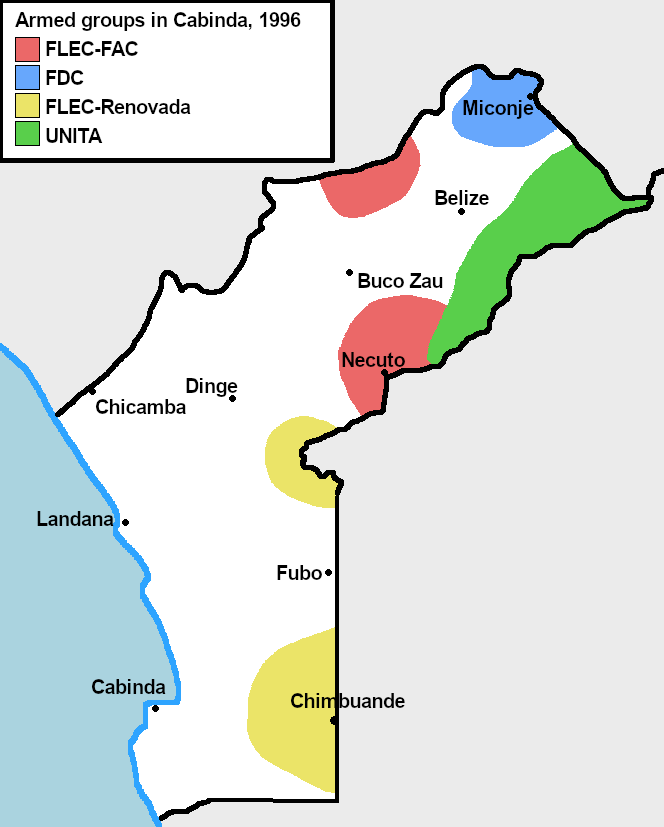
Cabinda War
In January 2010, gunmen ambushed the Togo national football team's bus as it traveled through Cabinda province for the African Cup of Nations tournament that Angola was hosting. The driver, assistant manager, and media officer were killed, and several players were wounded. The Front for the Liberation of the Enclave of Cabinda, or FLEC, claimed responsibility -- then said the attack was a mistake, that the intended target had been the Angolan military. The incident briefly put Cabinda on the world's front pages, but the war that produced it had been grinding on for thirty-five years already. It continues still, making it one of the longest-running separatist conflicts in Africa.
From Protectorate to Province
The roots of the conflict reach back to 1483, when the Portuguese navigator Diogo Cao first explored the Cabindan coast. By the 1885 Treaty of Simulambuco, Cabinda became a Portuguese protectorate -- legally and administratively distinct from the colony of Angola to the south. But in 1956, Portugal transferred Cabinda's administration to Angola without consulting local leaders. When Angola's three liberation movements -- the MPLA, FNLA, and UNITA -- negotiated independence terms with Portugal in the 1975 Alvor Agreement, no one representing Cabinda was invited to the table. FLEC, which had formed in 1963 from a merger of several separatist groups, proclaimed independence on August 1, 1975. On November 11, the day of Angolan independence, Cuban and MPLA forces entered Cabinda and claimed it as a province. FLEC's armed struggle began that same day.
Cold War Proxy, Forgotten Front
The conflict quickly became entangled in the Cold War's African theater. Cuba, East Germany, and the Soviet Union backed the MPLA government that controlled Cabinda. On the other side, France and Belgium allegedly provided FLEC with training and financial support, while Zaire -- modern-day DRC -- remained the movement's primary foreign backer. FLEC itself splintered during the Angolan Civil War into at least five factions: FLEC-Renovada, FLEC-N'Zita, FLEC-Lubota, the Communist Committee of Cabinda, and the Uniao Nacional de Libertacao de Cabinda. The fragmentation weakened the insurgency. UNITA rebels collaborated with FLEC-FAC at times, yet also cooperated with the MPLA in operations against FLEC when it suited them. After the Angolan Civil War formally ended in 2002, the military freed up by that peace was redeployed to Cabinda, and the province saw a significant increase in Angolan troop presence.
Ceasefires That Did Not Quiet the Guns
In July 2006, Antonio Bento Bembe -- representing the Cabinda Forum for Dialogue and a faction of FLEC -- signed a Memorandum of Understanding for Peace with the Angolan government in the village of Macabi. The agreement confirmed Cabinda as part of Angola, granted special economic status and local governance powers, and condemned further insurgency. Bembe was appointed a minister without portfolio in the Angolan government. But the Paris-based FLEC-FAC rejected the deal entirely, arguing that Bembe lacked authority to negotiate and that only total independence was acceptable. Violence continued: FLEC fighters killed three Angolan soldiers in Cabinda city in March 2008; in November 2010, militants ambushed a convoy carrying Chinese workers, killing two Angolan soldiers. In March 2011, Angolan secret services assassinated three FLEC commanders in the Republic of the Congo within the span of twenty-four days. The killing continued through the 2010s and into the 2020s, with eighteen government soldiers killed in the Necuto area in August 2022.
The Human Cost
Beyond the casualty figures, the conflict has produced a systematic pattern of human rights abuses documented by Human Rights Watch, Freedom House, and the Bertelsmann Stiftung. Between September 2007 and March 2009 alone, Angolan authorities arbitrarily detained, tortured, and humiliated at least thirty-eight people before putting them on trial for alleged security crimes. The detained included Angolan military members charged with desertion and a former Voice of America journalist known for criticizing the government. Detainees were denied contact with lawyers or family members for extended periods. Journalists, civil rights activists, and clergy in Cabinda have faced harassment after being accused of sympathizing with FLEC. Human rights organizations have also documented violations committed by FLEC. Caught between both sides are the people of Cabinda themselves -- including over 3,500 who live in refugee camps in the DRC and Republic of the Congo, displaced from a home whose future remains contested.
From the Air
Located at 5.55S, 12.40E in the Cabinda exclave of Angola. The territory is separated from mainland Angola by a strip of DRC territory. Dense tropical forest covers much of the interior where guerrilla operations have occurred, particularly in the Buco-Zau district to the north. Offshore oil platforms are visible in the Atlantic to the west. Nearest airport: Cabinda Airport (FNCA). Recommended viewing altitude: 8,000-12,000 feet AGL for an overview of the exclave's geography and its borders with the Republic of the Congo and DRC.