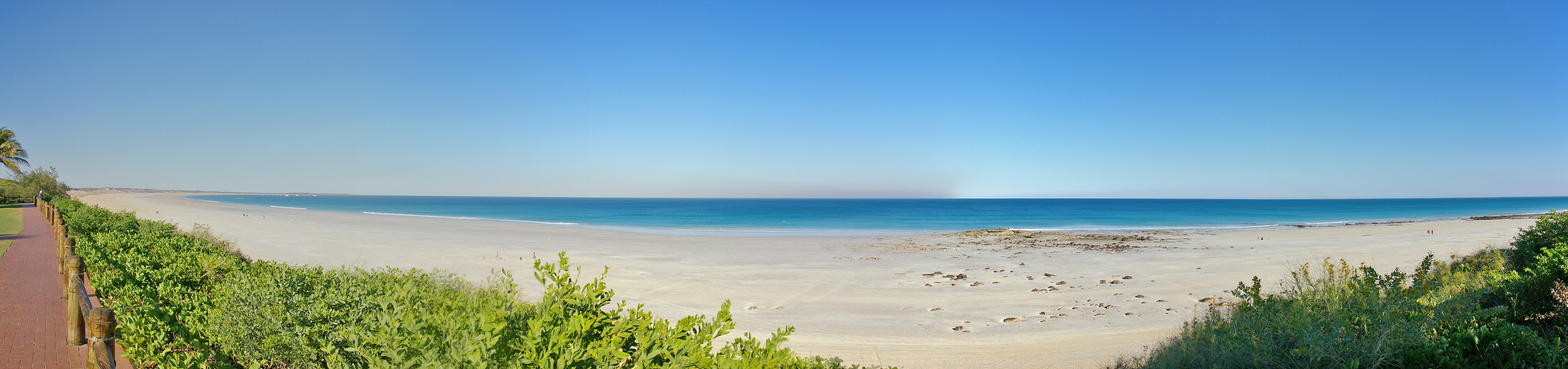
Cable Beach
The name sounds like it belongs to a resort developer's brochure, but it records an engineering achievement. In 1889, a submarine telegraph cable was laid from this beach across the Indian Ocean to Java, linking Australia to the communications networks of mainland Asia, Europe, Britain, and North America. That single wire, hauled ashore through the surf, pulled an isolated continent closer to the rest of the world. The beach that bore the cable's landing point kept the name, and over a century later it draws visitors who come not for telecommunications history but for 22 kilometres of white sand facing the Indian Ocean -- a coastline so expansive that even in peak tourist season, you can walk for an hour without seeing another person.
The Wire That Changed a Continent
Before the cable landed at Broome, Australia's communications with the outside world depended on ships that took weeks to cross the ocean. The telegraph line to Java, completed in 1889, created a near-instantaneous link between this remote coast and London, New York, and beyond. Java was already connected to mainland Asia and Europe through an existing cable network, so the Broome connection filled the last gap. The cable came ashore on the hard white sand of the beach that would take its name, a fitting junction between the vast Indian Ocean and the even vaster Australian interior. The telegraph station that served the cable is long gone, replaced by resort hotels and camel tour operators, but the beach endures as a monument to the moment Australia stopped being quite so far from everywhere else.
White Sand, Nine-Metre Tides
Cable Beach faces due west into the Indian Ocean, collecting the full force of tropical sunsets that turn the water gold and copper. The beach stretches approximately 22 kilometres from Gantheaume Point in the south to the Willie Creek lagoon outlet in the north. Its sand is fine, white, and firm enough for vehicles, which are permitted on the northern section. The waves are usually gentle between May and October -- Broome's dry season and peak tourist period -- making the water safe for swimming and wading. The tidal range is enormous, up to ten metres, which means the beach's character shifts dramatically through the day. At high tide, the water laps close to the dunes. At low tide, the exposed sand stretches wide enough to feel like a separate landscape, with pools and channels glistening in the sun. The landward side is backed by red pindan cliffs, creating a vivid color palette of rust, white, and turquoise that defines the Kimberley coastline.
Camels at Sunset
Dromedary camels were imported to Australia in large numbers during the mid-19th century to serve as pack animals in the arid interior, where horses and mules could not survive. Afghan and Pakistani handlers, known as cameleers, drove them across the outback hauling freight and supplies. Motor trucks made them redundant in the 1920s, and many camels were turned loose. They bred prolifically in the wild, and Australia now has one of the largest feral camel populations on Earth. At Cable Beach, their descendants have found a third career. Several operators run camel trains along the sand, and the sunset ride -- silhouetted dromedaries plodding along the shoreline against a blazing orange sky -- has become Broome's most iconic image. It is a scene that manages to be both tourist spectacle and accidental homage to the animals that helped build the outback.
Where the Lagoon Floods
At the northern end of Cable Beach, Willie Creek meets the sea through a lagoon outlet that offers one of the area's most unusual experiences. Visitors arrive two to three hours before a spring high tide, walk 45 minutes to the end of a sandy spit, and then ride inflatable rafts back up the lagoon as the rising tide floods it with warm, clear water. It is an exhilarating, slightly unpredictable ride powered entirely by the ocean's own rhythms. South of Cable Beach, Gantheaume Point juts into the sea amid red rock formations that contrast sharply with the white sand. At the very lowest tides, three-toed dinosaur footprints emerge from the rock platform -- traces left by therapods 130 million years ago. Between the ancient footprints and the modern camel rides, Cable Beach compresses geological time into a single walk along the shore.
From the Air
Located at 17.93S, 122.21E on the west coast of the Broome peninsula, facing the Indian Ocean. Broome International Airport (YBRM) is about 5 km to the east. From the air, Cable Beach is a striking 22-km arc of white sand bordered by the turquoise Indian Ocean to the west and red pindan cliffs to the east. Gantheaume Point marks the southern end with distinctive red rock formations. The Willie Creek lagoon outlet is visible at the northern end. At low tide, the beach widens dramatically, and the contrast between white sand, red earth, and blue water is vivid at any altitude.