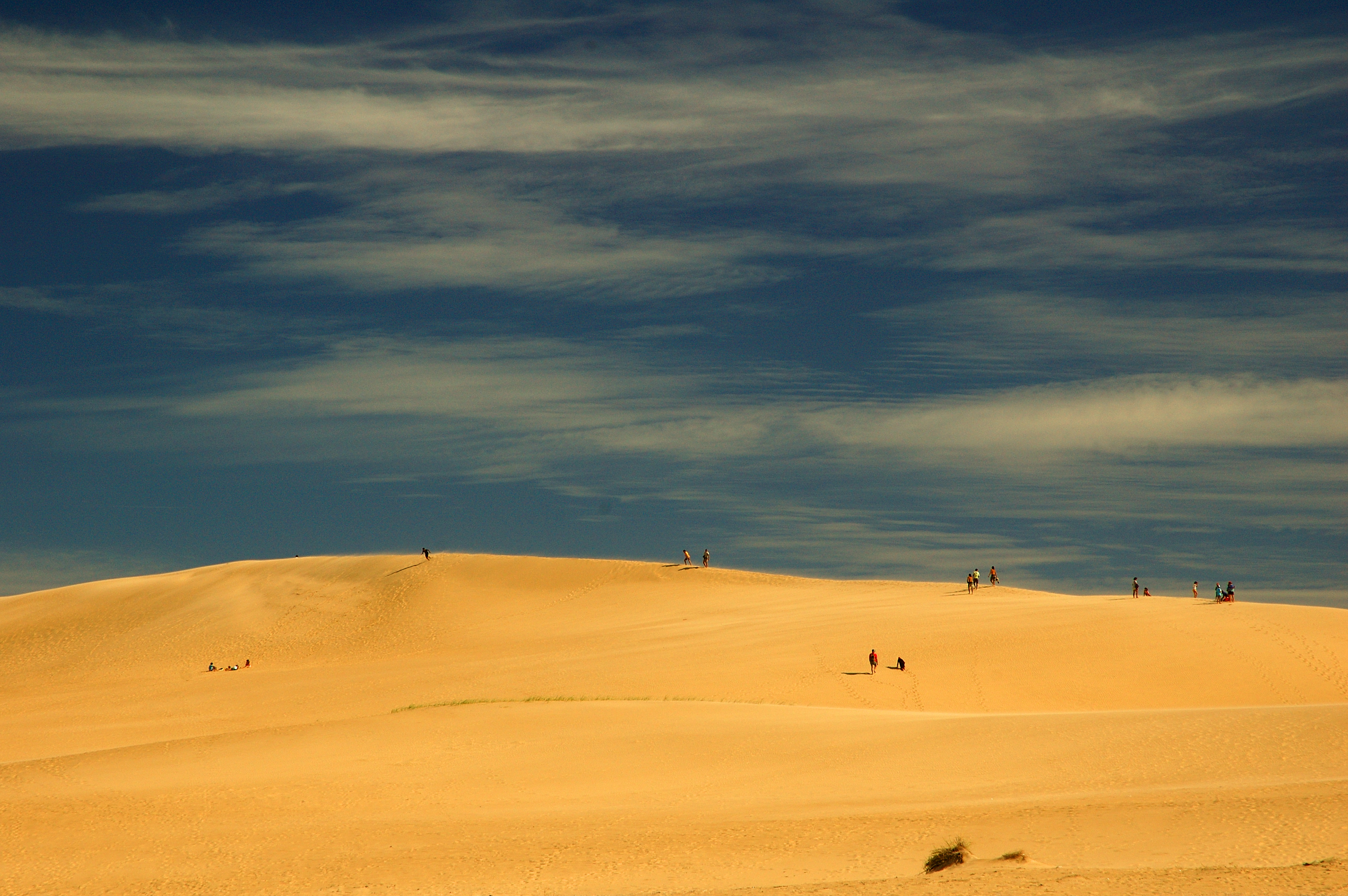
Cabo Polonio
The four-wheel-drive trucks bounce across seven kilometers of sand dunes, their passengers gripping seat backs as the vehicles lurch through terrain that has defeated every attempt to build a road. This is how you arrive at Cabo Polonio, one of the last truly off-grid communities in South America, a scattering of cabins perched on dunes where there is no central electricity, no running water, no sewerage system, and no cell service worth mentioning. What began as an improvised hippie colony has evolved into something stranger: a national park since 2009, where new construction is banned but existing residents continue their experiments in living outside the grid. At night, with no street lights to compete, the Milky Way blazes overhead while candles flicker in cabin windows and the distant roar of a sea lion colony carries across the dunes.
Getting There
Cabo Polonio does not welcome casual visitors. Private vehicles cannot enter the national park at all, leaving only three options: the bouncing truck ride from Portal del Cabo on the highway, a seven-kilometer walk through deep sand that takes two to three hours, or the scenic approach from Barra de Valizas to the north, hiking through dunes or along the beach. The trucks operate on schedules that thin dramatically in winter, sometimes running only five or six times daily, and the park prohibits both tents and pets. This friction is intentional. Every barrier between Cabo Polonio and the outside world helps preserve what makes it extraordinary, filtering out those unwilling to accept its terms.
Life Without Infrastructure
Electricity in Cabo Polonio comes from solar panels, car batteries, or not at all. Water arrives in tanks trucked across the dunes. Hostels sometimes lose reservations when the internet goes down, and things occasionally go missing because there are no locks worth trusting. These inconveniences are also the point. Visitors come here specifically to disconnect from a wired world, to experience what life feels like when the constant hum of technology falls silent. The handful of restaurants and small shops operate by candlelight after dark, and entertainment consists of conversation, stargazing, and the simple pleasure of being somewhere genuinely remote while still accessible by bus from Montevideo.
The Sea Lion Colony
Cabo Polonio shares its headland with one of the largest sea lion colonies on the Atlantic coast. The animals haul out on rocks just offshore, their barking audible throughout the village, their pungent presence impossible to ignore. Less romantically, the beach sometimes features the carcasses of colony members who did not survive the season, an unpleasant reality that visitors must accept as part of the ecosystem. But watching hundreds of sea lions congregate on the rocks, lounging in the sun, squabbling over prime positions, provides a wildlife spectacle unmatched anywhere else on Uruguay's coast. This is their place; humans are merely tolerated guests.
The Slow Journey North
For travelers with time and sturdy shoes, Cabo Polonio sits at the midpoint of one of South America's great coastal walks. Three days of hiking north leads to Punta del Diablo, passing through tiny fishing villages that make Cabo Polonio look developed. The route follows endless beaches, crosses streams where there are no bridges, and demands self-sufficiency since services are sparse and unpredictable. Those who complete the journey understand Uruguay's Atlantic coast in a way that car travelers never can: the scale of the emptiness, the power of the wind, the simple hospitality of villagers who see few foreign faces. Money becomes essential where there are no ATMs, so bring plenty of cash.
From the Air
Located at 34.40 degrees S, 53.79 degrees W, on a prominent headland extending into the Atlantic Ocean along Uruguay's eastern coast. The village is identifiable by its isolated position at the end of a sand dune peninsula with no visible roads or significant infrastructure. The sea lion colony on offshore rocks is visible as clustered dark shapes. Nearest airports: Capitan de Corbeta Carlos A. Curbelo International (SULS) near Punta del Este, 100 km southwest; Carrasco International (SUMU) in Montevideo, 250 km west. The vast sand dune system surrounding the village contrasts sharply with the green countryside inland.