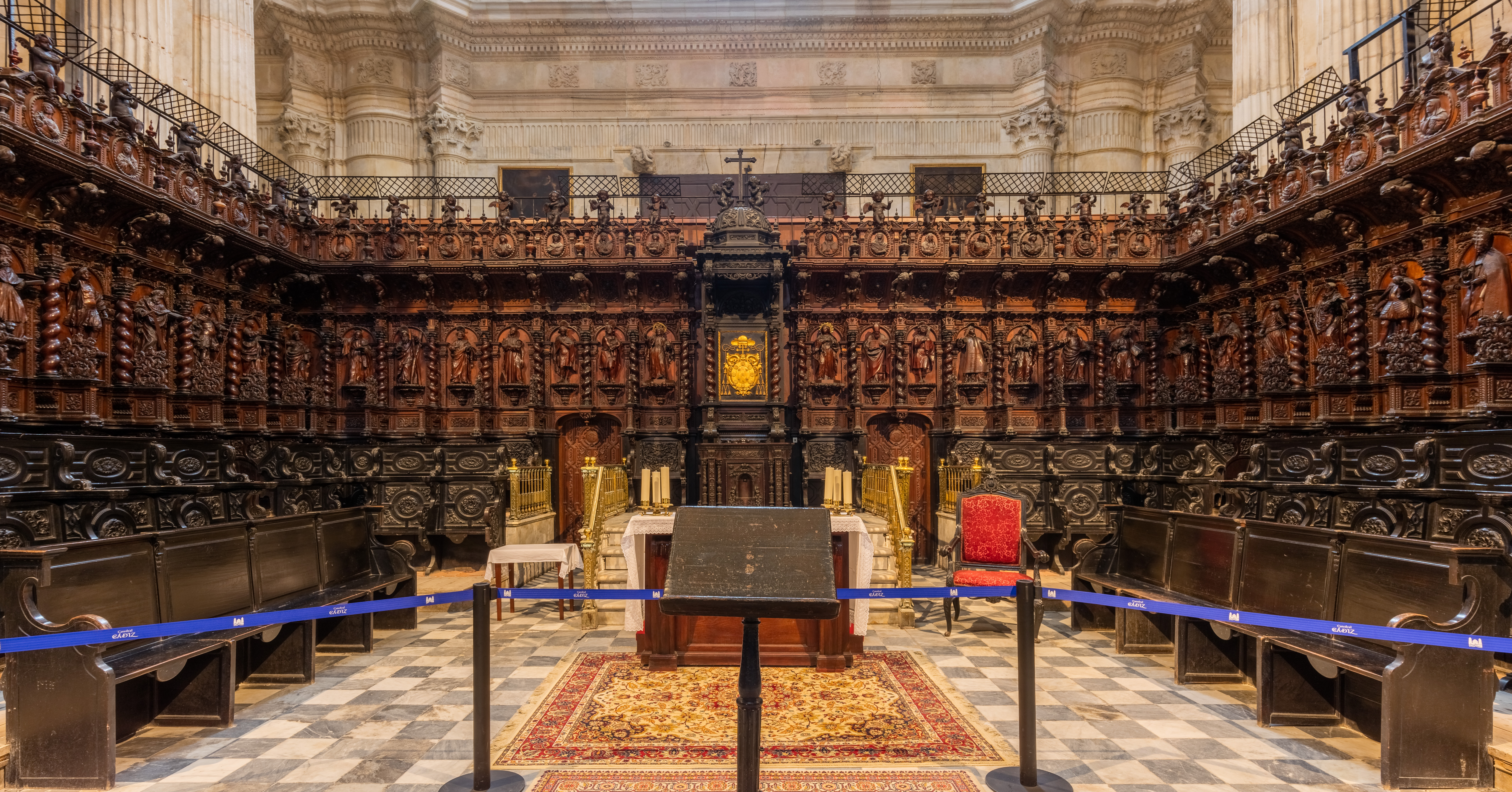
Cadiz Cathedral
One hundred and sixteen years. That is how long it took to build the Cathedral of the Holy Cross over the Waters in Cadiz, from the first stone in 1722 to the last in 1838. In that span, the American Revolution was fought and won, Napoleon rose and fell, and Spain's empire in the Americas collapsed. The cathedral absorbed all of it. Designed as baroque, it acquired rococo elements as fashions shifted, and was finally completed in the neoclassical style. Walk through it from nave to apse and you walk through the aesthetic history of an entire century.
Cathedral of the Americas
The 18th century was a golden age for Cadiz. The city held a monopoly on trade with Spain's American colonies, and wealth poured through its port in quantities that made the old cathedral of Santa Cruz seem embarrassingly small. A new cathedral was needed, one commensurate with the city's status as the gateway to the New World. The project was known informally as the Cathedral of the Americas because it was financed almost entirely by the profits of transatlantic commerce. Architect Vicente Acero, who had spent years working on Granada Cathedral, drew up the original plans. But Acero left the project before its completion, and was succeeded by several other architects, each of whom brought their own ideas about what the building should become.
A Century of Changing Hands
The succession of architects is written into the cathedral's fabric. Acero's original baroque vision is visible in the ground plan and the bold massing of the structure. Later hands added rococo flourishes -- lighter, more decorative touches that reflect the mid-18th-century taste for elegance over grandeur. By the time the building was finally completed in 1838, neoclassicism had swept European architecture, and the finishing touches were applied in the cool, restrained vocabulary of columns and pediments that characterized the post-Napoleonic era. The result is not incoherent but layered, a building where each generation left its signature without entirely erasing what came before. The chapels contain paintings and relics salvaged from the old cathedral and from monasteries throughout Spain, adding yet more historical depth to the interior.
Falla and Peman Rest Below
Beneath the cathedral, the crypt holds the remains of two of Cadiz's most celebrated sons. Manuel de Falla, the composer whose works -- including Nights in the Gardens of Spain and The Three-Cornered Hat -- drew on Andalusian folk traditions to create a distinctly Spanish modernist idiom, was born in Cadiz in 1876. Jose Maria Peman, the poet and playwright who became one of the most prominent literary figures of 20th-century Spain, was also a native of the city. Both are buried here, beneath the cathedral that their city's transatlantic wealth built. The crypt itself is an atmospheric space, low-vaulted and cool, where the sound of the city above is muffled to silence.
A View from the Tower
The Levante Tower, one of the cathedral's twin bell towers, is open to visitors. From its summit, the panorama encompasses the old city of Cadiz, the harbor, the Bay of Cadiz, and the open Atlantic beyond. Cadiz occupies a narrow peninsula connected to the mainland by a thin strip of land, and from the tower the city's unusual geography becomes clear: it is almost an island, wrapped in water on three sides. The cathedral sits near the western tip of this peninsula, its golden dome visible from across the bay. The building was declared a Bien de Interes Cultural in 1931, recognizing it as one of Spain's most significant cultural properties. In the Plaza de la Catedral below, the cathedral shares space with the baroque Santiago church, built in 1635 -- a reminder that even before the great cathedral rose, this square was already the spiritual heart of the city.
From the Air
Coordinates: 36.529N, 6.295W. Cadiz Cathedral is located near the western tip of the narrow Cadiz peninsula, its golden dome visible from considerable distance across the Bay of Cadiz. The city's distinctive peninsula geography -- nearly surrounded by water -- is unmistakable from the air. Nearest airports: LERT (Rota Naval Base, 20 km north), LEXJ (Jerez, 35 km northeast). The Bay of Cadiz, the Atlantic coast, and the bridge connecting the peninsula to the mainland are all visible.