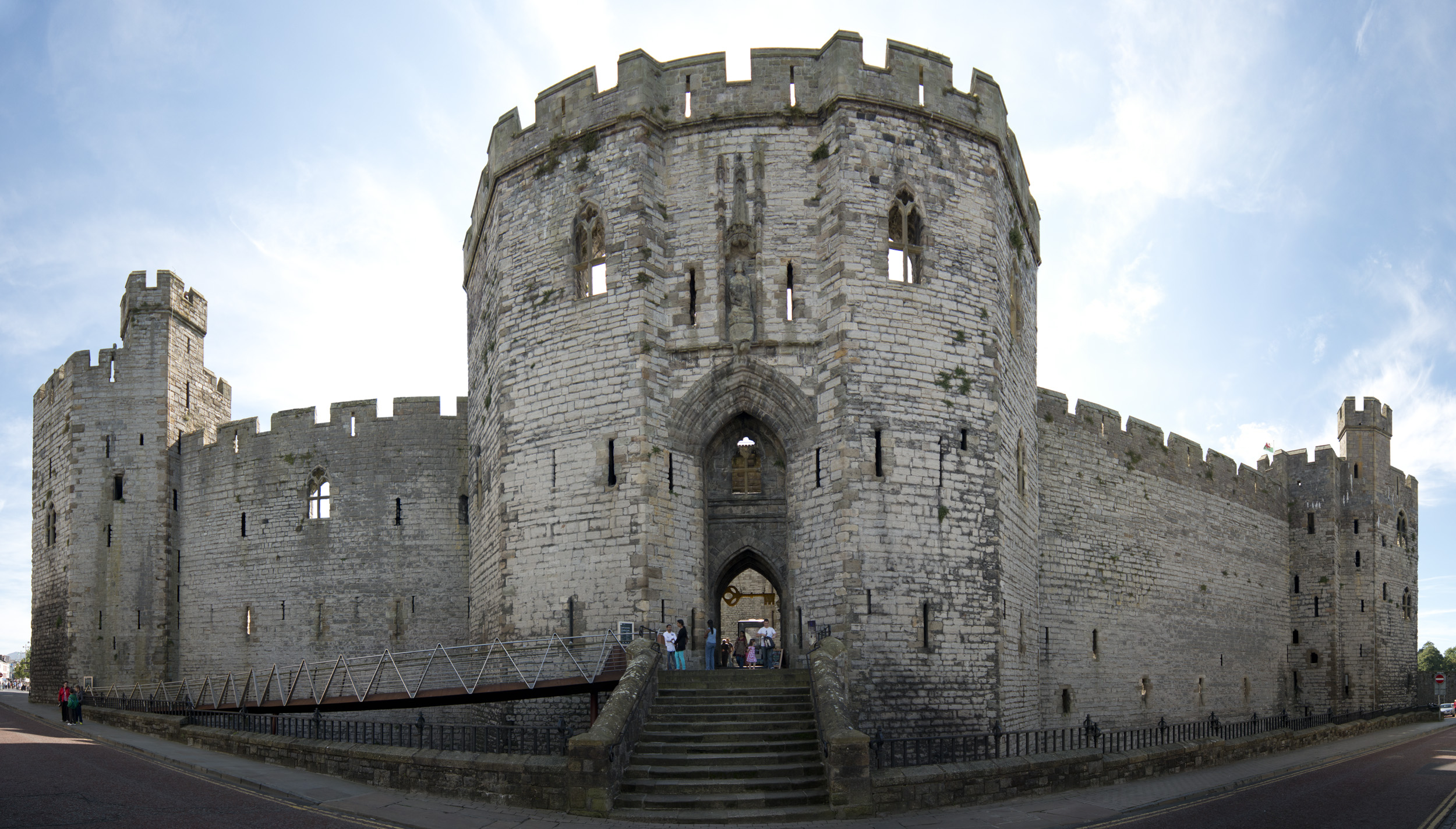
Caernarfon Castle
Edward I did not just want to conquer Wales. He wanted to make the conquest feel inevitable -- as if it had been foretold by Roman emperors and Arthurian legend alike. At Caernarfon, he found his stage. The remains of the Roman fort Segontium lay nearby, and a Welsh legend held that Magnus Maximus had dreamed of a fort -- "the fairest that man ever saw" -- at the mouth of a river in a mountainous country, opposite an island. Edward claimed this prophecy for himself and built a castle designed to look like it had always been there, its banded coloured stone and polygonal towers echoing the Walls of Constantinople rather than any English model.
The Iron Ring's Centrepiece
Between 1284 and 1330, the English crown spent between 20,000 and 25,000 pounds on Caernarfon's castle and town walls -- an astronomical sum that strained royal finances to their limits. The architect was Master James of Saint George, the foremost military engineer in Europe, brought from Savoy specifically for Edward's Welsh castles. James designed Caernarfon as the administrative capital of conquered North Wales, and the architecture was meant to intimidate as much as defend. The castle's layout follows the terrain: a narrow, figure-eight enclosure divided into upper and lower wards. The Eagle Tower at the western corner was the grandest, with three turrets once crowned by carved imperial eagles and a water gate at basement level for visitors arriving by the River Seiont. Despite the expense, much of the interior was never completed. Foundations still mark where buildings would have stood had the money not run out.
Constantinople on the Menai Strait
Caernarfon looks different from Edward's other Welsh castles, and the differences were deliberate. Where Harlech, Conwy, and Beaumaris use round towers, Caernarfon's towers are polygonal. Where the others are built in uniform stone, Caernarfon's walls are banded with alternating colours. Historian Arnold Taylor argued that these features were meant to invoke the Walls of Constantinople -- a conscious use of Byzantine Roman imagery to assert imperial authority. The Welsh legend of Macsen Wledig, in which Magnus Maximus dreams of a perfect fort in just such a location, may have been deliberately co-opted. When workers reportedly discovered Magnus's remains near the castle, the discovery was almost certainly staged. Historian Abigail Wheatley has suggested the design also drew on Roman sites in Britain to create allusions to Arthurian legitimacy. Either way, the message was clear: English rule in Wales was not mere military occupation but the fulfilment of ancient destiny.
Siege, Investiture, and Glyndwr
For two centuries after the conquest, Caernarfon functioned as the capital of North Wales, constantly garrisoned and administered by English officials. Welsh people were largely excluded from the most important administrative positions -- a discrimination that fuelled the Glyndwr Rising at the start of the 15th century. Owain Glyndwr's forces besieged Caernarfon in 1401, and the Battle of Tuthill was fought nearby. In 1403 and 1404, Welsh troops supported by French forces besieged the castle again. It held, but the attacks exposed the fragility of English control. Centuries later, the castle found a new ceremonial purpose. In 1911, at the insistence of Chancellor of the Exchequer David Lloyd George -- a Welshman raised in nearby Caernarfonshire -- Caernarfon hosted the investiture of Edward, Prince of Wales. The precedent was repeated in 1969 for Prince Charles, who would reign as Charles III from 2022.
World Heritage
In 1986, Caernarfon was inscribed as a UNESCO World Heritage Site alongside Conwy, Harlech, and Beaumaris under the designation "Castles and Town Walls of King Edward in Gwynedd." UNESCO called them the finest examples of late 13th- and early 14th-century military architecture in Europe. A three-year, five-million-pound restoration project concluding in April 2023 has opened previously closed areas and enabled wheelchair access to the battlements. Over 155,000 people visit annually. The castle houses the Royal Welch Fusiliers Museum, and the town walls -- among the best-preserved medieval town defences in Europe -- still encircle the settlement Edward founded to consolidate his conquest. The polygonal towers and banded walls still project exactly the authority Edward intended, though the authority they now represent is not his but the enduring power of medieval craftsmanship over propaganda.
From the Air
Located at 53.14N, 4.28W on the banks of the River Seiont where it meets the Menai Strait, with Anglesey visible across the water. The polygonal towers and town walls are clearly distinguishable from the air. Nearest airports: Caernarfon airfield nearby, RAF Valley (EGOV) on Anglesey. Best viewed at 1,500-2,500ft AGL. Snowdonia's peaks rise to the southeast. The castle and intact town walls together form an unmistakable complex.